

3.2.1 Proportion of graduates in health professions
The total number of graduates is 3,802, with 700 coming from health-related programs (including bachelor’s, master’s, specialized master’s, and doctoral programs). These programs encompass various departments such as Physical Education, Counseling Psychology, Health Education, Human Development, Special Education, Life Sciences, Nutrition, Rehabilitation Counseling, Social Work, Biomedical Science, and the EMBA in Health Promotion. —reference: 2023 Academic year statistics on graduation numbers from National Taiwan Normal University.
Academic year | 2022 | 2023 |
Total of graduates | 3605 | 3802 |
Number of graduates in health professions | 614 | 700 |
Proportion of graduates in health professions | 17.03% | 18.41% |
3.3.1 Current collaborations with health institutions
NTNU draws on its expertise in health promotion, education, research, and social engagement to advance healthy aging, school health promotion, and active outdoor play through local, national, and global collaborations. These partnerships connect university resources with community health services, health education, and international health initiatives.
1. Generations in Harmony: Healthy Aging and Intergenerational Learning Project
Collaboration level: Local collaboration
Through this University Social Responsibility (USR) project, NTNU brings together local governments, cultural health stations, universities, nonprofit organizations, and industry partners to promote physical fitness, technology-assisted assessments, digital inclusion, and intergenerational learning. These activities support older adults’ health and well-being through physical activity, everyday skills, and social interaction.
- Providing ongoing physical activity opportunities in partnership with the Department of Social Welfare
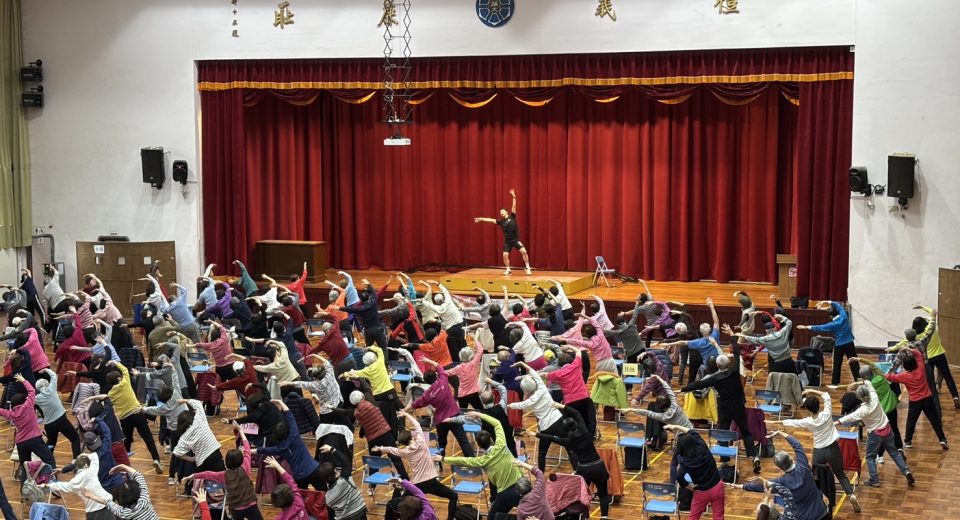
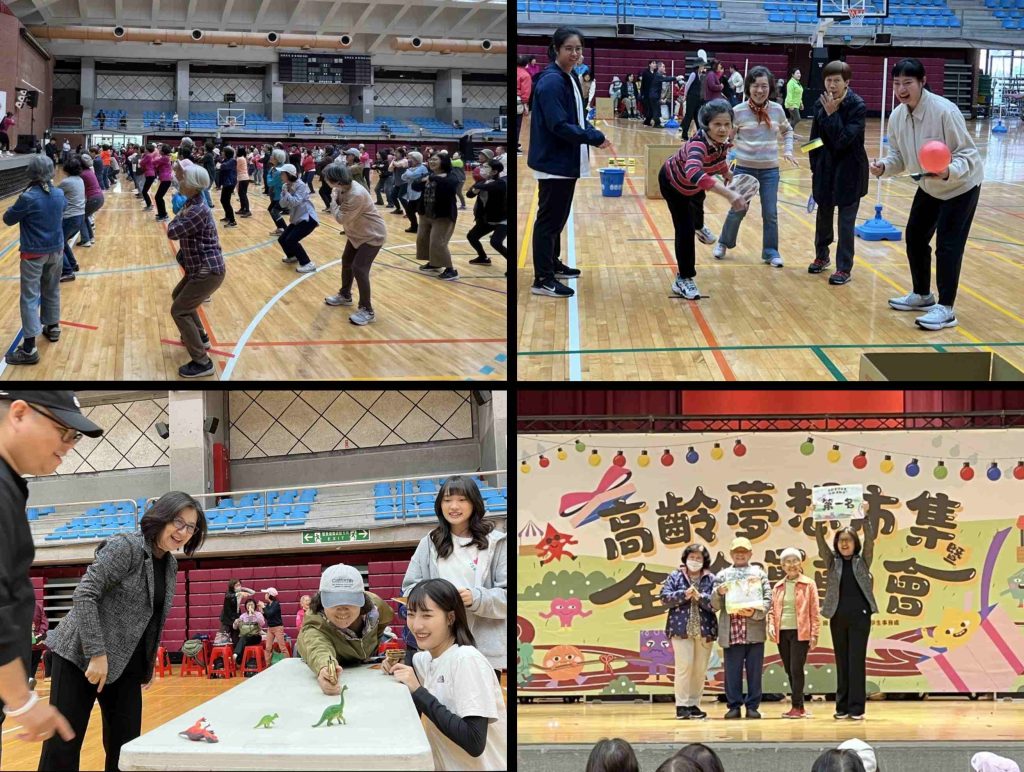
NTNU collaborates with the Department of Social Welfare, Taipei City Government, to operate its Active Living Hub for Older Adults and deliver related courses. In 2025, the hub offered four course cycles comprising 18 courses and activities related to older adults’ physical and mental health and active living. Physical activity formed part of this ongoing community provision, giving older adults regular opportunities to exercise.
A total of 240 physical activity sessions recorded 7,030 attendances by older adults, with teachers and students also participating. These recurring sessions encouraged older adults to incorporate exercise into their daily lives, with a focus on maintaining physical abilities and the fitness needed for independent living.
The hub also organized 80 intergenerational shared-meal activities and 14 lectures and workshops, bringing physical activity and social interaction together in a community setting. Alongside exercise, shared meals, learning, and intergenerational interaction provided opportunities for social participation and supported physical and psychosocial well-being.
- Bringing physical fitness courses and technology-assisted assessments into local communities
NTNU works with the Yilan–Hualien Digital Opportunity Center, Wujie Township Office, and Suao Township Office to deliver physical fitness courses and technology-assisted assessments for older adults in local communities. The activities combine opportunities to exercise with assessments that help participants understand their health-related physical fitness, connecting health education with their physical condition and everyday activity needs.
These collaborations delivered 99 sessions, recording 2,970 attendances by community-dwelling older adults. By bringing university teaching and assessment resources into community settings and drawing on local partners’ community connections, NTNU provides opportunities for older adults to access health knowledge, participate in exercise, and better understand their physical fitness in support of healthy aging and independence.
- Promoting digital inclusion and intergenerational learning at cultural health stations
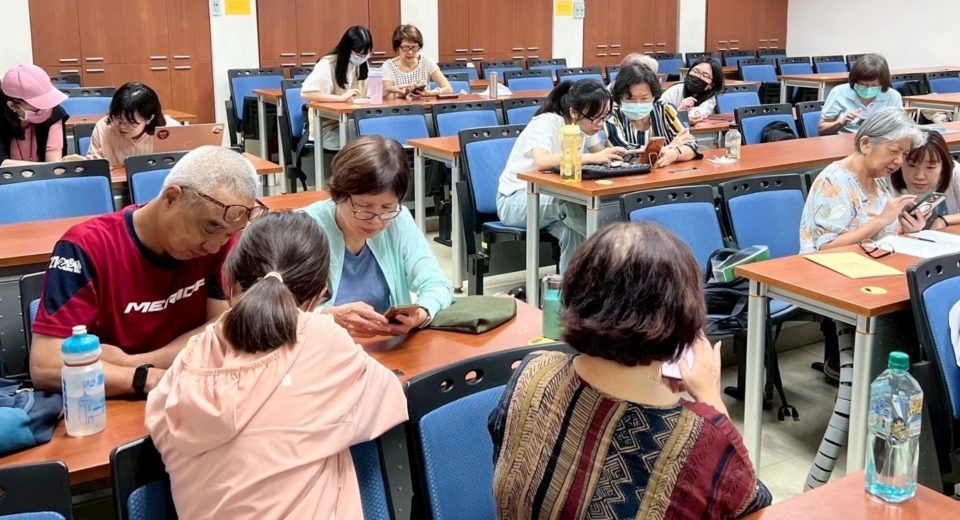
NTNU delivers its Digital Inclusion Education Initiative for Healthy Aging at the Zhongzheng Cultural Health Station in Xindian District and the Pakelang Cultural Health Station in Zhonghe District, New Taipei City. With student participation, the initiative supports older adults in developing everyday digital skills while creating opportunities for intergenerational exchange. Across the two stations, 96 activities recorded 2,880 attendances by older adults and 272 student attendances, bringing learning opportunities into familiar community settings.
NTNU also collaborates with the Department of Information Technology, Taipei City Government, on the Neighborhood Digital Assistance Service. Students help provide digital consultations for community-dwelling older adults, alongside information security, fraud prevention, and media literacy education. The service addresses difficulties with digital tools and incorporates guidance on assessing information and recognizing fraud risks, supporting older adults’ participation in digital life. In 2025, the service recorded 152 student attendances and 1,104 attendances by older adults.
- Expanding social participation through arts and cultural activities
NTNU collaborates with Body Phase Studio and Guling Street Avant-garde Theatre to participate in four drama creation and staged-reading exchange activities. It also co-organizes the “Yufen’s Written Reflections” Staged Reading Concert with Lee Ko-Yung Memorial Library Linkou New Taipei City, providing opportunities for expression and interaction through drama, staged readings, and music.
The project also participates in Mountain Community Foodways, organized by the Department of Cultural Affairs, Taipei City Government, to promote creative intergenerational programs and extend intergenerational learning into local cultural activities.
- Developing talent for services for older adults through cross-sector collaboration
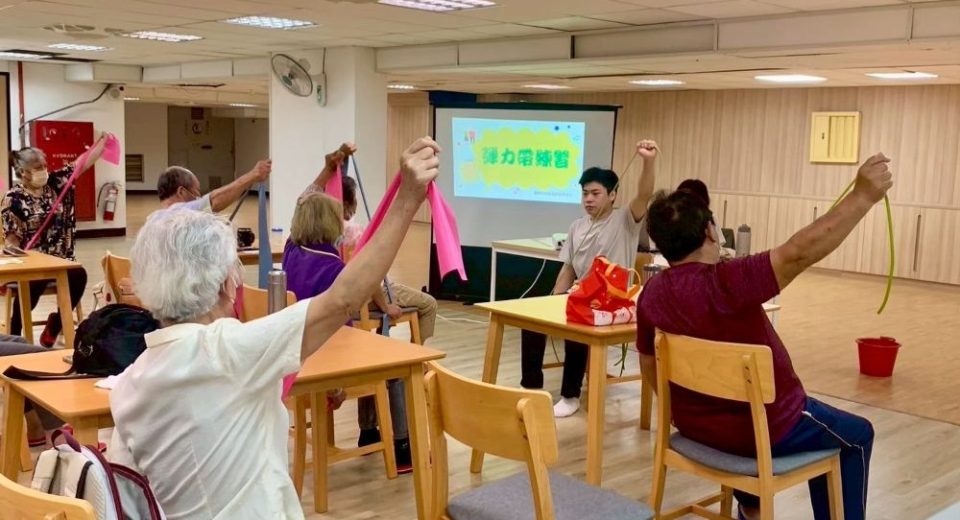
NTNU collaborates with other universities to develop talent in services for older adults and the design of active-aging programs. Courses on aging-related knowledge support participants in developing their capacity to serve older adults and design learning programs. A total of 18 courses attracted 917 participants.
The project also works with Chunghwa Telecom Foundation, Taiwan Service-Learning Association, King Car Cultural & Educational Foundation, and Yang Sheng Foundation to organize talent development lectures and professional seminars, facilitating exchanges of knowledge and practical experience across disciplines. In addition, NTNU co-organizes the “Social Practice—Habo Star-Making” lecture with Lion Travel Service Co., Ltd., expanding dialogue between services for older adults and industry practice.
List of Collaboration Partner
Universities | |||
National Ilan University | Taipei Medical University | National Yang Ming Chiao Tung University | National Taipei University of Business |
Asia Eastern University of Science and Technology | Fo Guang University | Chung Yuan Christian University | Chang Gung University of Science and Technology |
Chaoyang University of Technology | Pusan National University, South Korea |
|
|
Government | |||
Department of Social Welfare, Taipei City Government | Department of Information Technology, Taipei City Government | Department of Cultural Affairs, Taipei City Government | Zhongzheng Cultural Health Station, Xindian District, New Taipei City |
Pakelang Cultural Health Station, Zhonghe District, New Taipei City | Lee Ko-Yung Memorial Library Linkou New Taipei City | Yilan–Hualien Digital Opportunity Center | Wujie Township Office |
Suao Township Office |
|
|
|
Nonprofit Organizations | |||
Body Phase Studio | Guling Street Avant-garde Theatre | Chunghwa Telecom Foundation | Taiwan Service-Learning Association |
King Car Cultural & Educational Foundation | Yang Sheng Foundation |
|
|
Industry | |||
Lion Travel Service Co., Ltd. |
|
|
|
2. Taiwan Health-Promoting Schools (HPS) Program
Collaboration levels: Local collaboration; National collaboration
Commissioned by the K-12 Education Administration, Ministry of Education, NTNU implements initiatives under the Taiwan Health-Promoting Schools program. Working with local school networks, NTNU provides teacher professional development, program guidance, and health education resources to support the integration of health promotion into teaching, school environments, and everyday life.
The program follows six domains: school health policies, the physical school environment, the social school environment, community relationships, personal health skills, and health services. It helps schools develop school-based health promotion measures in response to their health needs. The health services domain emphasizes health observation, surveys, and screening to understand the health status of teachers and students and inform appropriate measures. The community relationships domain emphasizes connections among schools, parents, government agencies, local health service institutions, and community organizations to create supportive school and living environments.
In 2025, the program website published teacher professional development materials for the 2024–2025 academic year. Topics included student participation, advocacy and empowerment, sexuality education, tobacco and betel nut use prevention, National Health Insurance and appropriate medication use, healthy body weight, vision care, and oral health. These resources support teachers in planning health education and student participation activities and help local schools translate health knowledge into teaching and school practices.
Through the Taiwan Health-Promoting Schools website, NTNU also brings together teaching materials, presentation slides, videos, health education resources, indicators, measurement tools, and program results. This national platform supports local schools’ access to health promotion resources and the exchange of practical experience, contributing to students’ health literacy and healthy living practices.
3. Participation in the 2025 Position Statement on Active Outdoor Play
Collaboration level: Global collaboration
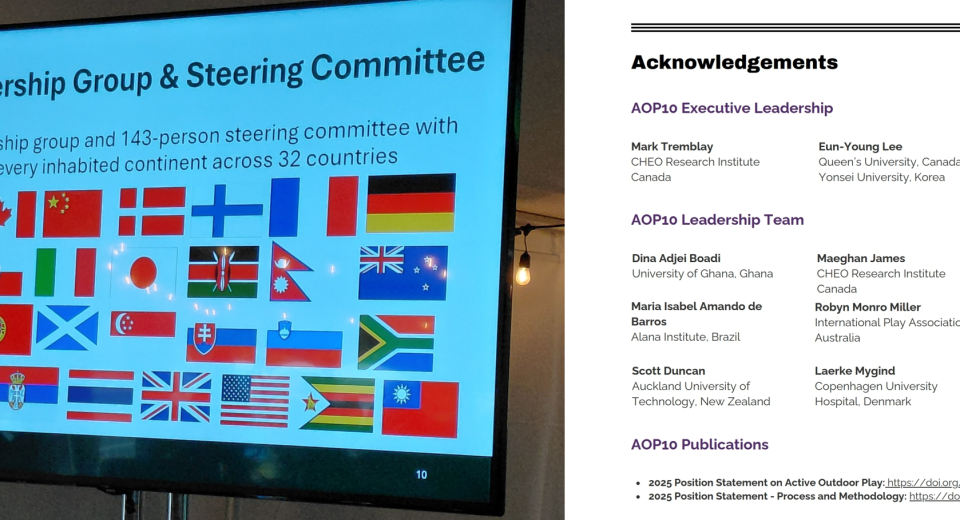
In 2025, Associate Professor Po-Yu Wang of NTNU’s Department of Civic Education and Leadership served on the leadership team of the international project for the 2025 Position Statement on Active Outdoor Play. Jointly initiated by Outdoor Play Canada, Queen’s University, the University of Ottawa, and the Children’s Hospital of Eastern Ontario Research Institute, the project connects expertise in outdoor education and health research to promote health and well-being across all ages.
Drawing on extensive literature reviews and analysis, the updated statement responds to challenges including climate change, internet addiction, and social and health inequalities. It advocates active outdoor play as a health promotion strategy for people of all ages and encourages its integration into daily life, learning, and work.
Associate Professor Wang traveled to Ottawa, Canada, from September 25 to 28, 2025, to join international representatives in launching the updated statement. Through participation in the international team and this shared health initiative, NTNU connects its outdoor education expertise with international health promotion research and practice, facilitating knowledge exchange on active outdoor play and healthy living across all ages.
3.3.2 Health outreach programmes
NTNU combines expertise in health promotion, exercise, psychological counseling and education to provide health and well-being support for older adults, family caregivers and disadvantaged households eligible for social welfare assistance. Through University Social Responsibility (USR) projects, community partnerships and student service activities, NTNU continued to offer community exercise, technology-assisted health assessments, psychological support and health education in rural communities in 2025, making university expertise accessible to community residents.
1. Generations in Harmony: Healthy Aging and Intergenerational Learning Project
Target groups: Older and middle-aged adults in local communities, and their supporters
Through this USR project, NTNU works with communities in Taipei, New Taipei and Yilan to support healthy living and social participation among older adults. The project combines regular physical activity, technology-assisted health assessments, digital inclusion and intergenerational learning. Guided by community needs, it brings together faculty, students, health professionals and local partners to provide ongoing health promotion services.
- Providing regular community exercise to support healthy aging
In 2025, NTNU delivered two large-scale community health promotion programs at its Gongguan Campus, running from March to May and from September to December. These programs provided 28 fitness sessions for older adults, recording 6,496 attendances, with instructors, teaching assistants and nurses participating in delivery. The recurring sessions gave older adults regular opportunities to engage in physical activity, supporting the mobility and fitness needed for everyday life. Four health promotion lectures also helped participants expand their health knowledge.
In partnership with the Department of Social Welfare, Taipei City Government, NTNU offered the Healthy and Active Living Course Series at the Active Living Hub for Older Adults. The series comprised 240 sessions and recorded 7,030 attendances during the year. A further 120 USR Exercise Classes for Older Adults recorded 3,640 attendances, providing continued access to exercise and health education in the community.
In Yilan, the project continued its community services in Wujie and Suao, delivering 99 fitness sessions across 20 communities and recording 2,970 attendances by older adults. These activities brought opportunities for physical activity into residents’ everyday community settings.
- Using technology-assisted health assessments to strengthen health awareness
NTNU worked with the Active Living Hub for Older Adults, the Yilan–Hualien Digital Opportunity Center, and partner day care and long-term care providers to organize five technology-assisted health assessment events for 380 older adults. These assessments helped participants better understand their physical condition and lifestyle. By encouraging self-directed health management and regular fitness activities, the project connected health assessments with everyday health promotion.
- Integrating community service into professional education
NTNU incorporated community health services into courses preparing students to work with older adults. In spring 2025, 20 students taking Elderly Health Service Practicum provided services at seven community sites. In the autumn, 24 students taking Practice of Elderly Health Service participated in community placements and developed four service programs, which they delivered through interactions with older adults at the Dream Market for Older Adults.
In June, NTNU partnered with National Ilan University to organize collaborative training and intergenerational learning activities in Wujie Township. The activities combined digital inclusion, fraud prevention in daily life and health-related fitness, enabling students to apply their knowledge in community settings while encouraging learning across regions and generations.
- Addressing digital inclusion and social support needs
The project delivered 96 sessions of the Digital Inclusion Education Initiative for Healthy Aging at the Active Living Hub for Older Adults, community sites in Taipei and Indigenous cultural health stations in New Taipei, recording 2,880 attendances by older adults. NTNU also worked with the Department of Information Technology, Taipei City Government, to provide digital consultations, helping older adults resolve difficulties using technology. Fraud prevention and the identification of false news were incorporated to support safer participation in digital life.
A survey of care circumstances explored needs relating to health monitoring, daily living support, emotional companionship and caregiver stress, providing information for program adjustments. NTNU also held 17 lectures on proactive coping for middle-aged and older adults, offering opportunities to learn about aging and caregiving.
In November 2025, the project organized an All-Ages Sports Day. Older adults, middle-aged adults and young people formed intergenerational teams and participated in fitness activities and traditional games, bringing together physical activity, social interaction and intergenerational inclusion.
2. Warm Hearts in the Community: An Ecological Systems Model of Counseling Services for Older Adults
Target groups: Older adults in local communities, family caregivers and other community residents
NTNU integrates expertise in educational psychology, guidance and counseling, health education, human development and social work to bring professional psychological support into communities. Working with Hsin-Tien Psychological Counseling Clinic, community service sites and Beitou Parent-Child Center, the project provides individual counseling, family counseling sessions, personal growth groups, community workshops and mental and physical well-being activities. These services address different levels of support needed by older adults and family caregivers.
- Providing professional counseling and family support
The Community Counseling Program for Older Adults continued in 2025, with professional counseling psychologists providing individual counseling and family counseling sessions. The program recorded 134 service contacts with older adults and family caregivers during the year. It offered support for emotional and psychological difficulties, while family sessions addressed needs relating to companionship and family relationships, giving older adults and caregivers access to professional psychological resources.
- Supporting emotional expression and personal growth in community settings
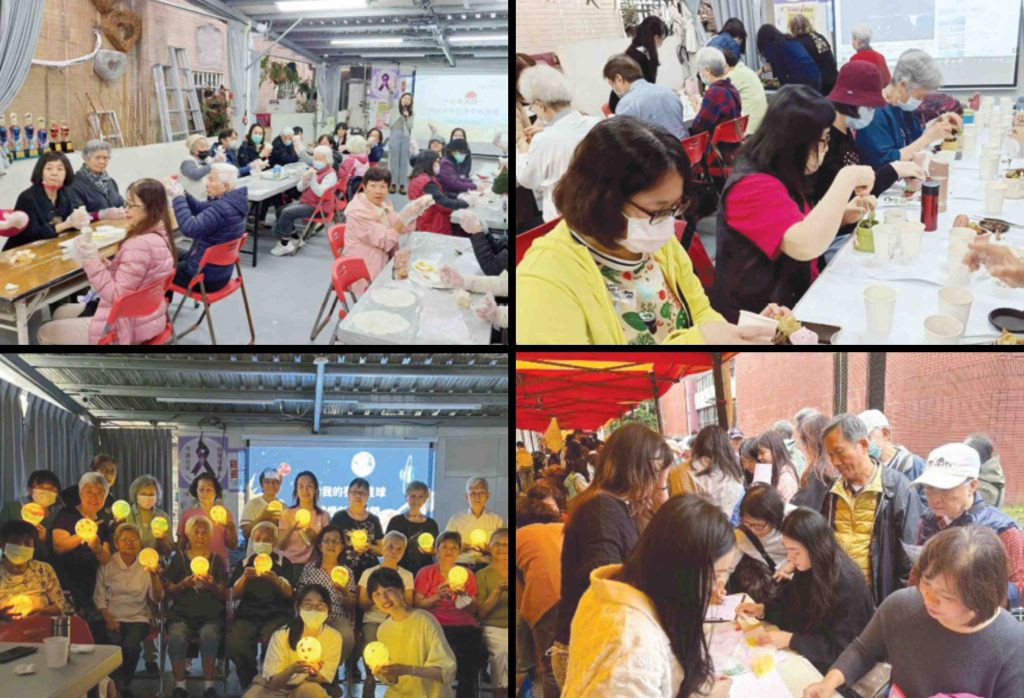
NTNU held eight Mental Well-Being Workshops at the Jinhua Village Community Service Site, recording 240 attendances by older adults. The workshops combined mindfulness, exploration of personal strengths, sharing of life experiences and creative activities. Through sachet-making, gardening, collage and other forms of creation, participants were encouraged to express their feelings, recognize their personal resources and connect with others.
In partnership with Hsin-Tien Psychological Counseling Clinic, NTNU also delivered six Community Well-Being Workshops for Older Adults, recording 53 attendances. Topics included sensory experiences, emotional relaxation, self-exploration and life storytelling. Led by mental health professionals and psychology interns, the workshops used leaf printing, pastels, mosaic collage, scented candles and plant terrariums to provide supportive opportunities for expression and sharing.
NTNU worked with Beitou Parent-Child Center to offer six Personal Growth Groups for Older Adults, recording 48 attendances. The sessions addressed mindfulness, emotional awareness, interpersonal relationships, communication, relationship conflicts and intergenerational interaction. Structured activities and shared experiences supported participants’ self-understanding and interpersonal connections.
- Promoting mental and physical well-being through interactive experiences
At the Dream Market for Older Adults, the project offered interactive booths featuring heart rate variability (HRV) stress tests, emotional well-being activities using herbal sachets, and therapeutic consultations using colored-salt jars. These booths recorded 172 visits and gave older adults and their families accessible opportunities to learn about mental and physical well-being and everyday ways to relieve stress.
In 2025, the project organized 26 activities, recording 710 in-person attendances and an average annual activity satisfaction rate of 97.83%. It also held seven case discussion seminars for psychology interns, supporting the training of practitioners working with older adults and the quality of services through professional discussion and shared practice.
3. Sanzhi Community Service Camp for Older Adults and Support for Disadvantaged Families
Target groups: Older adults in local communities and disadvantaged households eligible for social welfare support (Local communities; Disadvantaged people)
On May 2–3, 2025, NTNU’s Department of Health Promotion and Health Education partnered with The New Life Social Welfare Development Promotion Association of the Republic of China to organize a two-day, one-night community service camp for older adults. A 14-member group of faculty and doctoral students, led by Assistant Professor Chia-Chen Chang, visited the Putou Senior Care Site and the Xinzhuang Xinwo Senior Care Site in Sanzhi District, New Taipei City. The camp enabled participants to apply learning from health promotion and elder care courses to community service.
- Promoting healthy living through music, movement and interaction
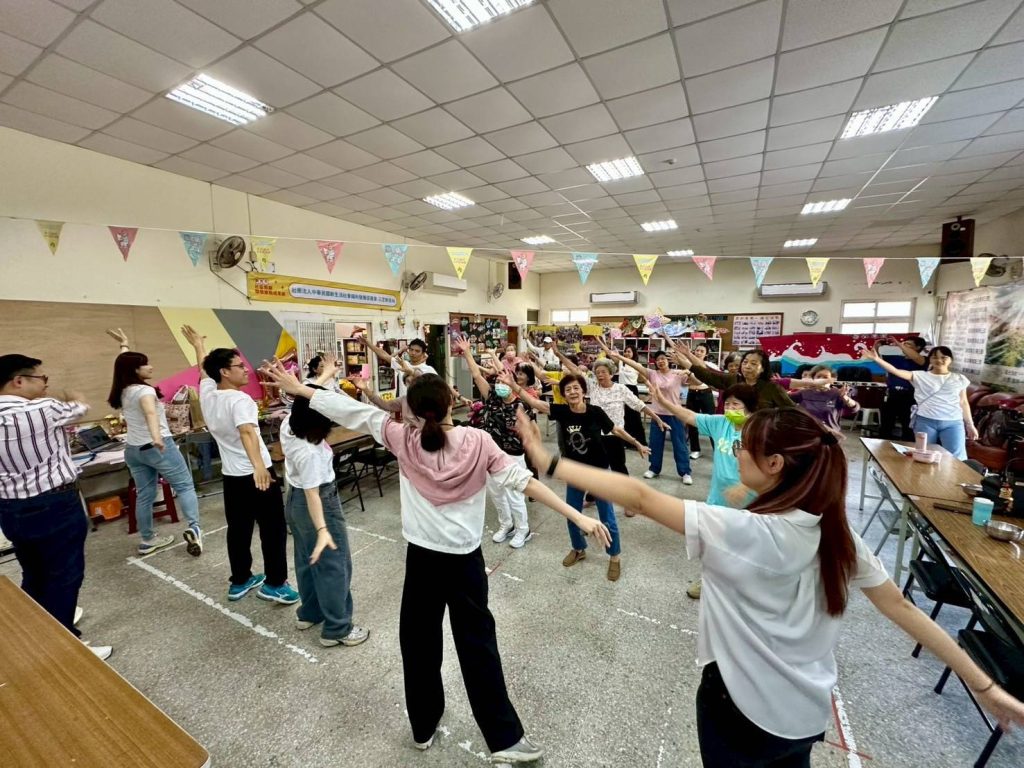
Faculty and students designed music-based movement and health promotion activities for older adults. Playing the song “Blossoming Hearts,” they guided participants through movements that encouraged physical activity and group interaction. Activities were facilitated in Taiwanese Hokkien and incorporated intergenerational exchanges, connecting health promotion with language and everyday experiences familiar to the participants.
The team also organized carnation-making activities for Mother’s Day and used instant photographs to capture participants’ smiles. Seasonal celebrations, creative activities and companionship provided opportunities for emotional connection. An herbal tea experience and discussions about healthy living integrated health education into everyday situations, addressing both physical activity and psychosocial well-being.
- Providing everyday support through the distribution of essential supplies
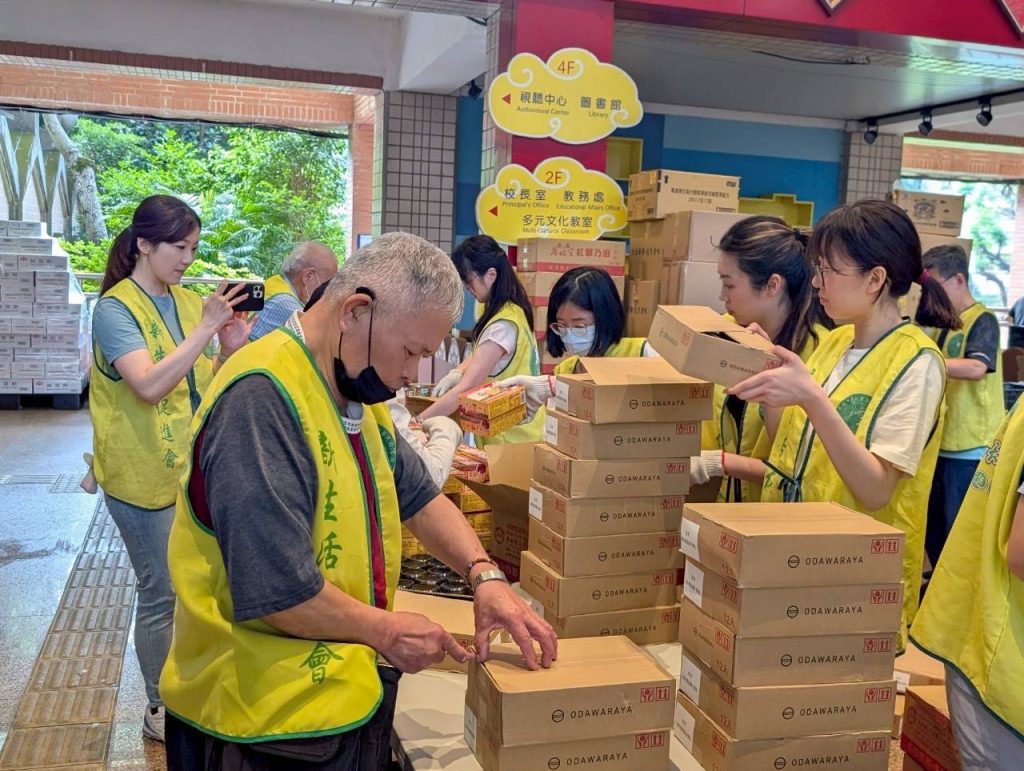
Alongside the health activities at the community sites, faculty and students helped move and prepare supplies on May 2 and joined a distribution event at Sanzhi Elementary School the following day. The event provided 25 types of supplies for 881 households listed by the Sanzhi District Office as eligible for social welfare support. It brought together the association, NTNU faculty and students, corporate volunteers and Scout groups.
NTNU participants helped move and sort supplies, guide attendees and support communication at the event. Proxy collection arrangements were also provided to help people with limited mobility obtain supplies. By combining community health activities with everyday support for disadvantaged households, NTNU connected students’ professional learning with local needs and put community health promotion and support for disadvantaged groups into practice.
3.3.3 Shared sports facilities
Guided by a commitment to community inclusion, NTNU provides local residents and the general public with free access to its outdoor sports facilities and campus open spaces through its Campus Open Declaration. These include outdoor athletic fields and courts, campus green spaces and other open areas, enabling community residents to share campus resources and enjoy more opportunities for everyday exercise and recreation.
While ensuring campus safety and normal teaching operations, NTNU allows members of the public to enter and use these facilities and spaces free of charge whenever they are not scheduled for classes or reserved for other activities. No prior application or reservation is required.
By sharing its outdoor sports facilities and open spaces free of charge, NTNU encourages community residents, faculty and students, and sports groups to make shared use of these campus resources. This approach aims to establish long-term partnerships between NTNU and local communities, promoting health for all and a sustainable living environment.
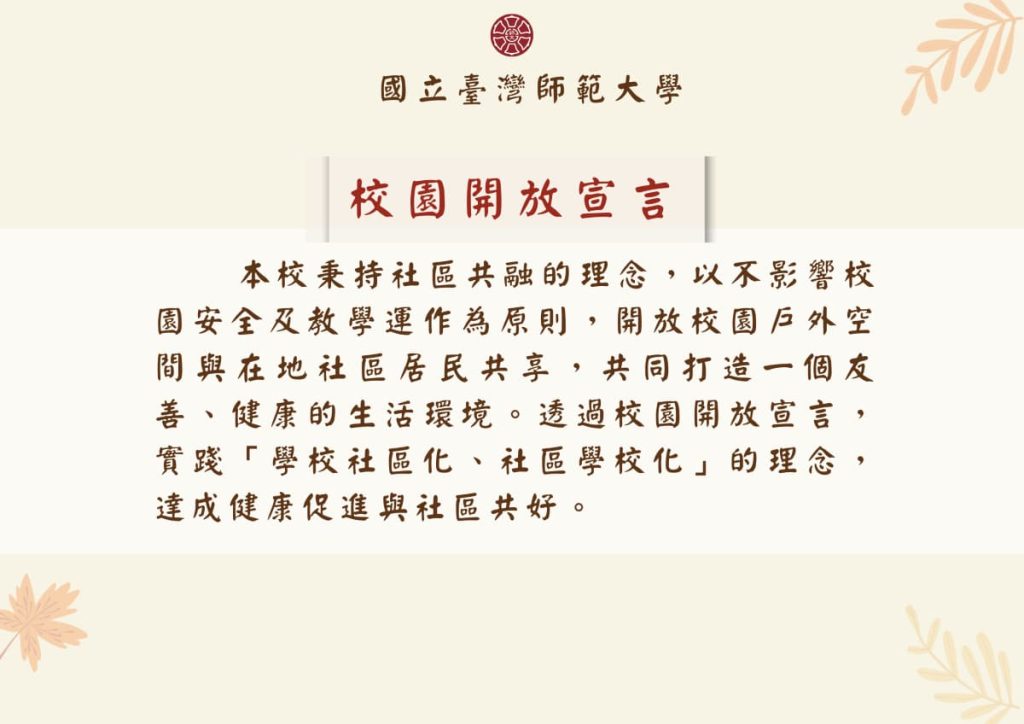
國立臺灣師範大學校園開放宣言
本校秉持社區共融的理念,以不影響校園安全及教學運作為原則,開放校園戶外空間與在地社區居民共享,共同打造一個友善、健康的生活環境。透過校園開放宣言,實踐「學校社區化、社區學校化」的理念,達成健康促進與社區共好。
3.3.4 Sexual and reproductive health care services for students
Through its Health Center, NTNU provides students with sexual health information, educational activities and access to preventive supplies. These services help students understand sexual health and HIV/AIDS prevention and support their sexual and reproductive health needs.
- Free Access to Health Information and Diverse Sex Education Activities
The Health Center maintains a “Sex Education (including HIV/AIDS Prevention)” webpage that brings together resources from the Taiwan Centers for Disease Control and relevant nongovernmental organizations. The page provides educational infographics on pre-exposure prophylaxis (PrEP), HIV/AIDS prevention information and awareness videos, which students can access free of charge.
In 2025, NTNU organized 12 sex education and related awareness activities, recording 2,124 attendances. All activities were free of charge for students. Examples included the “HIV/AIDS Prevention Begins with Understanding” infographic, the “HIV/AIDS Is Not the End of Life” online health talk, a campus pop-up event, and an interactive Q&A activity on HIV/AIDS prevention at the New Student Orientation Learning Resources Fair. These online materials, talks and campus interactions gave students more opportunities to access sexual health information.
NTNU also held thematic talks such as “What Are Perpetrators of Sexual Violence Thinking?” and “Making Women’s Sexual Needs Visible,” alongside discussions on romantic relationships and a reading group. These activities provided opportunities for students to learn about sexuality, bodily needs and interpersonal relationships.
Sex Education and Related Awareness Activities in 2025
Activity | Type | Date | Attendances |
HIV/AIDS Prevention Begins with Understanding | Infographic | 2025-04-25 | 780 |
HIV/AIDS Is Not the End of Life | Online health talk | 2025-05-01 | 844 |
Campus HIV/AIDS Prevention Pop-up Event | Pop-up event | 2025-05-16 | 110 |
New Student Orientation Learning Resources Fair: HIV/AIDS Prevention | Interactive Q&A activity | 2025-08-28 | 152 |
Reading Group: Bloom Into You | Reading group | 2025-09-24 | 21 |
Romantic Challenges: A Discussion | Health talk | 2025-10-08 | 25 |
Gender and Work: A Discussion | Health talk | 2025-10-16 | 32 |
Philosophical Reflections on Misogyny and Patriarchy | Health talk | 2025-11-06 | 26 |
HIV/AIDS: An Ongoing Reality | Health talk | 2025-11-19 | 41 |
What Are Perpetrators of Sexual Violence Thinking? | Health talk | 2025-11-29 | 58 |
Making Women’s Sexual Needs Visible | Health talk | 2025-12-03 | 12 |
HIV/AIDS Explained | Health talk | 2025-12-04 | 23 |
Total | 2,124 |
On-Campus Access to Preventive Supplies
NTNU has installed condom vending machines on campus, offering condoms at NT$10 per box and providing students with on-campus access to preventive supplies. Through free sexual health information, educational activities and on-campus supply, NTNU connects health knowledge with practical access to resources, supporting students in practicing safer sex and meeting their contraceptive needs.
3.3.5 Mental health support for students
NTNU provides students with diverse mental health support through free psychological counseling, mental health education and group activities, support mechanisms associated with mental health leave, the advising system, and reduced-fee counseling programs. The Student Counseling Center, departments and graduate institutes, advisers, and course instructors work together to proactively support students’ needs and help them access appropriate psychological support and referral resources.
1. Individual Counseling Services
NTNU’s Student Counseling Center provides free, confidential individual psychological counseling for all students. Psychologists and intern psychologists offer support for issues including self-exploration, career planning, interpersonal relationships, emotional adjustment, family relationships, and stress management. These services help students develop emotional management and interpersonal communication skills and improve their adjustment to daily life and academic study.
Students may request individual counseling through the Counseling Service System in the NTNU Information Portal or visit the Center in person for assistance with making an appointment. After a request is submitted, the psychologist assigned to the student’s department or graduate institute contacts the student by phone or email. The Center then matches the student with a suitable psychologist and makes further arrangements based on their needs. The Center also provides case management and mental health support for at-risk students and students in crisis, helping those in need connect with off-campus resources.
In 2025, the Student Counseling Center provided psychological counseling to 1,352 students, with 6,463 service contacts, and case management involving mental health support for 2,070 at-risk students and students in crisis, with 9,389 service contacts. Issues addressed and services provided included mental illness (64 students, 133 service contacts), campus gender-related incidents (51 students, 157 service contacts), sexual harassment or sexual assault (23 students, 53 service contacts), suicide and self-harm concerns (53 students, 150 service contacts), referrals to off-campus resources (40 students, 44 service contacts), and domestic violence (9 students, 33 service contacts). The remaining issues concerned adjustment to daily life and related matters.
In addition to individual counseling and case management, the Center provides mental health education and group support through mental health lectures and a series of personal growth group workshops. In 2025, it held 19 mental health lectures with 505 attendances and 22 personal growth group workshops with 273 attendances.
2. Implementation of “Mental Health Leave” Policy
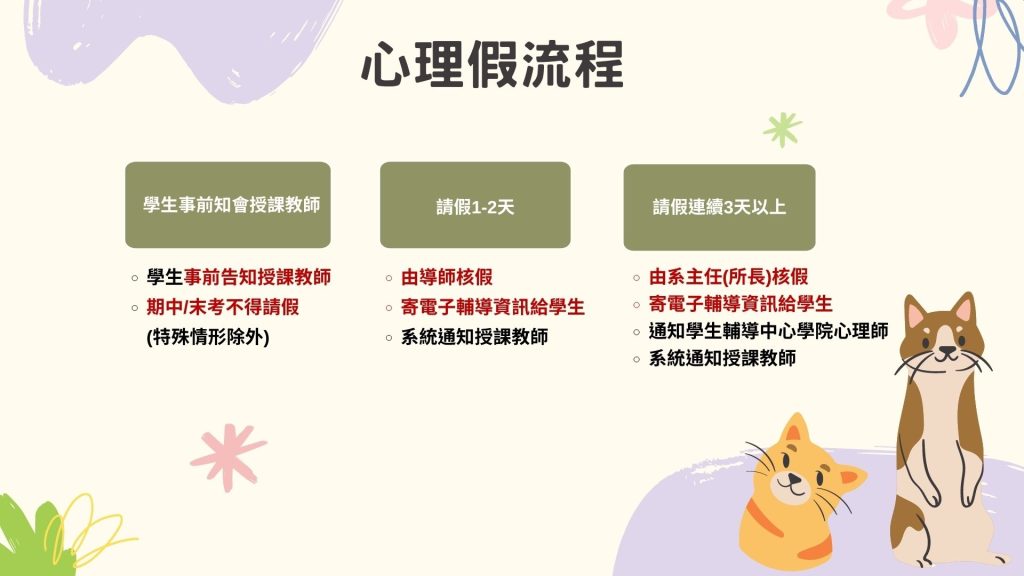
Since April 2023, NTNU has implemented a Mental Health Leave Policy that integrates departments, instructors, mentors, and the Student Counseling Center to establish a comprehensive mental health care mechanism.
- For absences within two days, mentors reach out to express concern and support.
- For absences of three or more days, department chairs or directors provide follow-up and arrange counseling or medical support when necessary.
- For continuous absences of more than three days, the system automatically notifies case-management psychologists at the Counseling Center to assess the student’s condition and offer appropriate services or referrals.
- The system automatically sends caring messages to students, providing information on emotional support and counseling resources.
- Once the leave process is completed, course instructors are informed to provide timely care and support.
This policy institutionalizes psychological care as part of NTNU’s administrative framework, ensuring that students’ mental health needs are detected early, addressed promptly, and monitored continuously.
3. Student Care and Psychological Support through the Advising System
Through its student advising system, NTNU provides individual students with initial care, emotional support, and referrals when needed. Particular attention is given to overseas Chinese and international students’ adjustment to daily life and academic study.
Under the Regulations for National Taiwan Normal University Advising System, Student Advisers are required to maintain contact with departments and students’ parents, understand students’ family and personal circumstances, provide timely assistance or referrals, and use on-campus and off-campus resources to strengthen primary prevention for at-risk students. Student Advisers must also maintain monthly records of group and individual advising to support ongoing care and guidance.
Through regular contact, individual care, and referrals as needed, advisers help students express their concerns and access relevant support. In the 2024–2025 academic year, 19,371 advising contacts were recorded, including 1,416 contacts involving emotional support and referrals.
Student Advisers in each department also organize learning and personal development activities during designated student affairs and advising periods, in line with departmental priorities and initiatives relating to a bilingual campus and physical and mental health. These include activities on multiculturalism and Indigenous Education for All, healthy and friendly campus initiatives, career and internship development, adviser–student gatherings, university and departmental alumni talks, and end-of-semester support activities. These activities support students’ adjustment, learning, and personal growth, with 4,313 activities held in the 2024–2025 academic year.
4. Reduced-Fee Counseling for Students at Hsin-Tien Psychological Counseling Clinic
NTNU’s Hsin-Tien Psychological Counseling Clinic offers reduced-fee counseling for students through the University and College Student Counseling Program. Licensed psychologists provide professional psychological support to undergraduate and graduate students, helping those with further support needs access counseling resources.
The program charges students less than the standard fees for the general public. Each 50-minute session costs NT$1,600, and each student may use the program for up to six sessions per year, helping reduce the cost of accessing professional counseling. Students can scan the QR code on the program poster to complete the appointment form and request a counseling appointment.
In 2025, the program served 33 enrolled students through 139 service contacts, one student on a leave of absence from study through six service contacts, and two teaching interns through 12 service contacts.
3.3.6 Smoke-free policy
To protect the health of all faculty, staff, students, and campus users and provide a healthy learning and working environment, NTNU has established the National Taiwan Normal University Regulations for Tobacco Hazards Prevention to promote a fully smoke-free campus. The Regulations were approved at the 338th Administrative Council meeting on November 28, 2012, and amended and approved at the 373rd Administrative Council meeting on October 13, 2021. Smoking, including the use of electronic cigarettes and heat-not-burn products, is prohibited in all indoor and outdoor areas on campus. Littering cigarette butts is also prohibited.
- Scope
NTNU’s tobacco hazards prevention regulations apply to all faculty, staff, and students, as well as vendors, visitors, and other individuals from outside NTNU entering campus. All campus users are required to comply.
- No-Smoking Signs and Education
The Office of General Affairs is responsible for installing prominent no-smoking signs at the entrances to all campuses and advising on-campus shops not to sell tobacco products. All administrative and academic units shall work together with communities, civic organizations, and student clubs to promote tobacco hazards prevention. Faculty and staff training, health education, student club activities, classroom instruction, and adviser hours shall be used to enhance awareness of tobacco hazards prevention among members of the campus community.
- Addressing and Reporting Violations
NTNU faculty, staff, and students have a responsibility to advise individuals smoking on campus to stop. Individuals who refuse to comply may be reported, and the identities of those reporting violations shall remain confidential. Repeat offenders shall be reported to local health authorities in accordance with the Tobacco Hazards Prevention Act.
Vendors, visitors, and other individuals from outside NTNU who violate the campus smoking regulations shall first be advised to stop smoking. If they fail to comply, the matter shall be reported to campus security, or local health inspectors shall be notified to address the violation on campus.
- Smoking Cessation Counseling and Support
Faculty, staff, and students who wish to quit smoking may seek assistance from the Health Center. The Center provides counseling, smoking cessation support, or referrals for treatment to help those in need access relevant resources. In accordance with the regulations, NTNU may also reward individuals who have contributed to tobacco hazards prevention and commend those who have successfully quit smoking.
The full text of the National Taiwan Normal University Regulations for Tobacco Hazards Prevention is provided below.
3.3.7 Mental health support for staff
NTNU supports faculty and staff mental health through free, confidential professional counseling under its Employee Assistance Program, alongside mental health lectures, groups, and workshops. By combining individual counseling with opportunities to learn about stress management, emotional exploration, and self-care, NTNU helps faculty and staff access appropriate support and actively promotes good mental health.
1. Free Psychological Counseling
Through its Employee Assistance Program, NTNU provides free psychological counseling delivered by Hsin-Tien Psychological Counseling Clinic, helping faculty and staff access professional mental health support. The service is available to full-time faculty and staff, assistants, and interns. Eligible individuals may receive up to six free counseling sessions per year, each lasting 50 minutes. Users must present their employee ID card when accessing the service.
Faculty and staff may request counseling by phone, through an online form, or by completing an appointment form at the Clinic’s reception desk. The Clinic is located at No. 16, Lane 5, Qingtian Street, Da’an District, Taipei City. Appointments can be made by calling 02-7749-5720. Service hours include some weekday evenings and Saturdays, allowing faculty and staff to inquire about and arrange suitable counseling times around their work and personal schedules.
All counseling records and personal data are kept confidential and stored in accordance with relevant regulations and professional ethics. These protections provide an environment that respects privacy and supports faculty and staff in seeking professional psychological assistance with peace of mind.
In 2025, Hsin-Tien Psychological Counseling Clinic provided counseling services to 157 NTNU faculty and staff members, with 691 service contacts.
2. Mental Health Support: Groups and Workshops
NTNU’s Office of Student Affairs organizes mental health lectures and a series of personal growth groups and workshops for faculty, staff, and students. These activities provide opportunities to learn about stress management, emotional exploration, interpersonal relationships, self-care, and self-acceptance, actively promoting good mental health.
A total of 19 mental health lectures were held, recording 505 attendances. In the 2024–2025 academic year, 22 personal growth groups and workshops recorded 273 attendances: 10 activities with 96 attendances in the first semester and 12 activities with 177 attendances in the second semester. These attendance figures represent the combined participation of faculty, staff, and students.
Participation in Groups and Workshops, 2024 Academic Year
Semester | Number of Groups and Workshops | Attendances |
First semester | 10 | 96 |
Second semester | 12 | 177 |
Total | 22 | 273 |
Groups and Workshops, First Semester of the 2024 Academic Year
No. | Activity | Facilitator | Date | Attendances |
1 | 解密生涯迷蹤,活出真實的自己——生涯意義建構團體 | 王煒萱 | Oct. 7–Dec. 2 | 31 |
2 | 星際迷航:尋找我的關係星球-人際界線探索團體 | 林臻 | Oct. 2–Nov. 12 | 29 |
3 | 情緒勒索養成記-擺脫以愛為名的套索工作坊 | 溫珈瑩 | Oct. 5 | 9 |
4 | 《夢映.煦光》芳香夢境探索工作坊(一) | 潘奐璇 | Nov. 3 | 5 |
5 | 讓我們同「桌」吧:玩出關係的N種心法-桌遊人際增能工作坊 | 曾于珊 | Nov. 16 | 8 |
6 | Fit in or not fit in:僑生跨文化適應工作坊 | 陳芝犖 | Nov. 17 | 0 |
7 | 穿越繁忙生活,擁抱自己的不完美-正念減壓工作坊 | 許侑倢 | Nov. 9 | 6 |
8 | 《夢映.煦光》芳香夢境探索工作坊(二) | 潘奐璇 | Nov. 23 | 4 |
9 | 《香氣引路.悠遊童話》芳香關係探索工作坊 | 潘奐璇 | Nov. 30 | 3 |
10 | Crafting Well-being Workshop: Self-Care through Art | 陳芝犖 | Dec. 7 | 1 |
Total | 10 activities | 96 |
Groups and Workshops, Second Semester of the 2024 Academic Year
No. | Activity | Facilitator | Date | Attendances |
1 | 《紓壓輕旅,舒暢行——壓力管理、紓壓與放鬆訓練團體》 | 王煒萱 | Mar. 10–May 5 | 34 |
2 | 「在異國扎根:尋找自我之路」境外生適應工作坊 | 陳芝犖 | Mar. 22 | 3 |
3 | 「香氣拾光:從異鄉走入內在」境外生故事調香工作坊Ⅰ | 潘奐璇、陳芝犖 | Mar. 22 | 10 |
4 | 「香氣拾光:從異鄉走入內在」境外生故事調香工作坊Ⅱ | 潘奐璇、陳芝犖 | Mar. 23 | 8 |
5 | 告別亂糟糟,從「心」斷捨離-人生整理工作坊 | 陳穎姿 | Apr. 13 | 9 |
6 | 和自己談場「練」愛吧!-親密關係探索團體 | 許侑倢 | Apr. 15–May 20 | 33 |
7 | 情緒「桌」迷藏——桌遊情緒增能團體 | 曾于珊 | Apr. 16–May 21 | 41 |
8 | 《微光對話,共築心景》微景觀蠟燭伴侶增溫工作坊 | 潘奐璇 | Apr. 19 | 9 |
9 | 「異鄉共燭.微景語心」境外生人際微景觀蠟燭工作坊 | 陳芝犖、潘奐璇 | Apr. 20 | 9 |
10 | 「遇.我.內在秘境」自我接納工作坊 | 林臻 | Apr. 26 | 7 |
11 | 《香徑.夢途》夢境探索調香工作坊 | 潘奐璇 | May 3 | 5 |
12 | 家的遠近:探索關係中舒適界限工作坊 | 陳盈帆 | May 10 | 9 |
Total | 12 activities | 177 |