

13.2.1 Low-carbon power generation monitoring system
NTNU’s three campuses are equipped with low-carbon energy facilities. The real-time status of low-carbon energy usage can be checked, tracked, and measured on the solar power monitoring and maintenance website. The planning and design of solar panels are discussed and evaluated at the Sustainable Development Committee meetings and approved by the relevant authorities. The total power generation in 2024 was 474,972 kWh, equivalent to 1709.90 GJ.
- Solar panels at the Heping campus: The Education Building will generate 231,968 kWh of electricity in 2024, and the Boai Building will generate 116,920 kWh in 2024.
- Solar panels at the Linkou campus: The power generation produced 126,084 kWh in 2024.
- There are four heat pumps in the second dormitory of the Gongguan campus. The heat pump system maintains a constant temperature throughout the year, monitors energy consumption 24 hours a day, and implements energy-saving measures. During holidays, the load is reduced and the temperature is adjusted according to the season. Taking August as an example, compared with the same period in 2024, 12% of electricity was saved, and 7,804 kWh of electricity was saved during the same period.
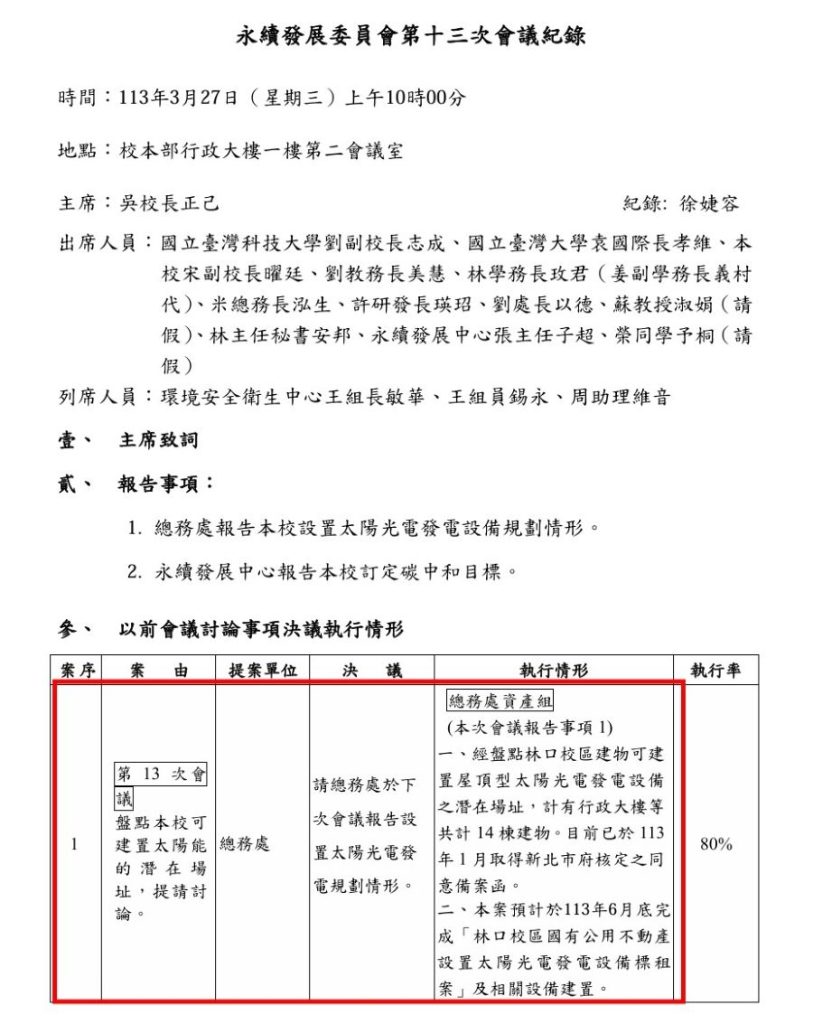
The planning and installation of solar panels will be discussed and evaluated at a public meeting of the Sustainable Development Committee.

A solar power generation monitoring and maintenance website provides real-time access to measurement data.
13.2.2 Low-carbon energy use
NTNU has a solar power monitoring and maintenance website that allows users to query, track, and measure the real-time status of low-carbon energy. The planning and design of solar panels are discussed and evaluated at the Sustainable Development Committee meetings and approved by the relevant authorities. The total power generation in 2024 was 474,972 kWh, equivalent to 1709.90 GJ:
- Heping Campus Solar Panels: The Education Building generated 231,968 kWh in 2024, and the Bo’ai Building generated 116,920 kWh in 2024.
- Linkou Campus Solar Panels: The power generation in 2024 was 126,084 kWh.
13.3.1 International and Taiwan Climate Change Education Programs and Activities
NTNU, in collaboration with the Ministry of Education’s Climate Change Teaching Information Platform and NGOs, is promoting a sustainable development-oriented climate change education program, encompassing school-based curriculum design from elementary to high school. The curriculum integrates the concepts of UN Climate Change Education (CCE) and Sustainable Development Education (ESD), covering topics such as mitigation, adaptation, climate science, and net-zero emissions. It emphasizes interdisciplinary and multi-faceted learning to cultivate students’ comprehensive climate literacy and practical skills.
1. Promoting Climate Change Education Across All School Levels
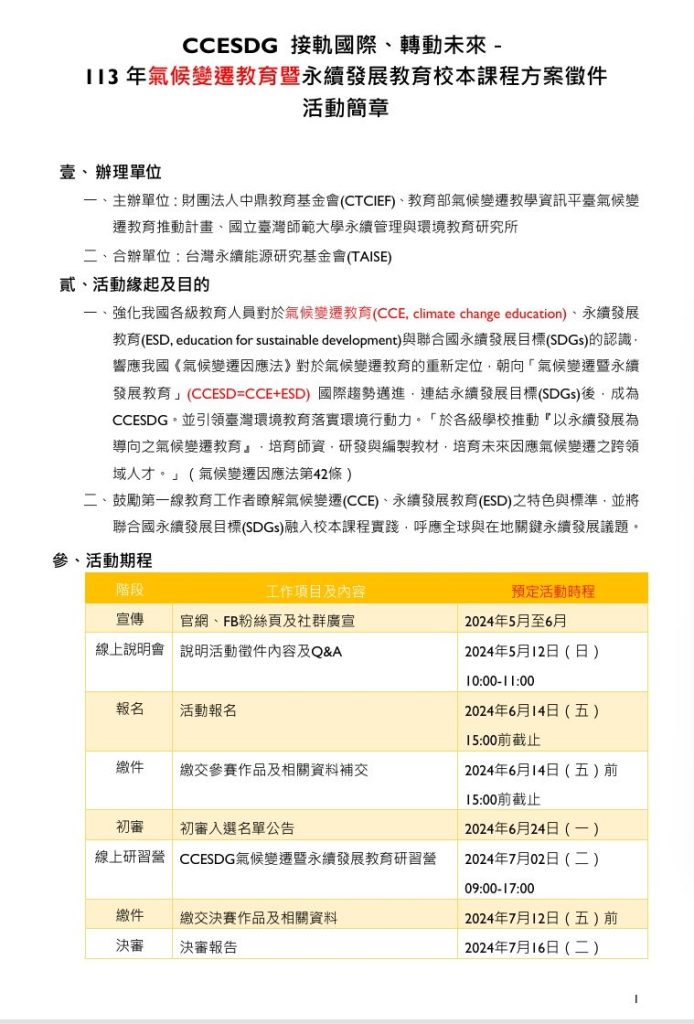
Our Institute of Sustainable Management and Environmental Education collaborates with the Ministry of Education’s Climate Change Teaching Information Platform and related non-governmental organizations to jointly promote the “Climate Change Education Promotion Plan for Schools at All Levels.” We organize the Climate Change and Sustainable Development Education School-Based Curriculum Program Call for Proposals to enhance the understanding of climate change education (CCE), education for sustainable development (ESD), and the United Nations Sustainable Development Goals (SDGs) among educators nationwide. This initiative responds to the repositioning of climate change education under Taiwan’s Climate Change Response Act and advances toward the international trend of integrating climate change and sustainable development education (CCESD = CCE + ESD). By linking with the SDGs, it evolves into CCESDG. The plan aims to lead Taiwan’s environmental education toward effective environmental action. It encourages frontline educators to understand the characteristics and standards of CCE and ESD, integrating the UN SDGs into school-based curricula to address key global and local sustainability issues.
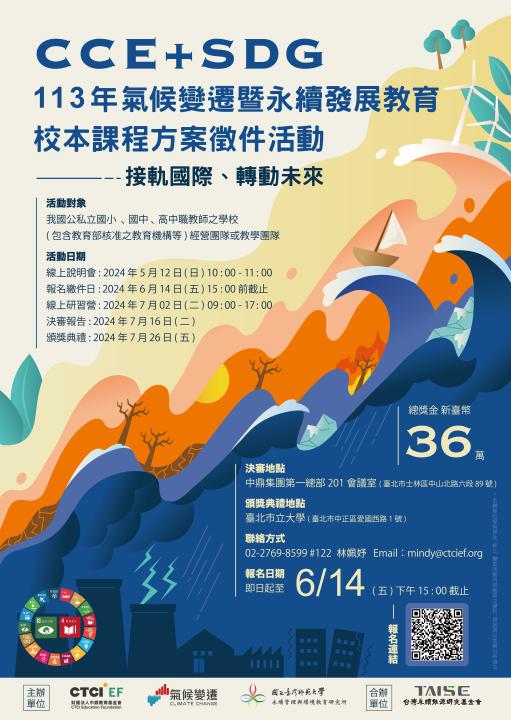
Poster for the 113th Anniversary Climate Change Education and Sustainable Development Education School-Based Curriculum Program (2024)
2. Offering Climate Change Courses
The Institute of Sustainable Management and Environmental Education at our university incorporates UN Sustainable Development Goals (SDGs) climate action into its curriculum to address climate change, exploring emission reduction standards, future carbon pricing, green energy, and renewable technology development. With climate change education at its core, the university actively promotes related courses and projects. For example, in response to the UN SSDs, it promotes diverse teaching activities and projects. The Monitoring and Disaster Prevention credit program offers courses in climatology, climate change, and its impact assessment to deepen students’ climate action education and practical skills.
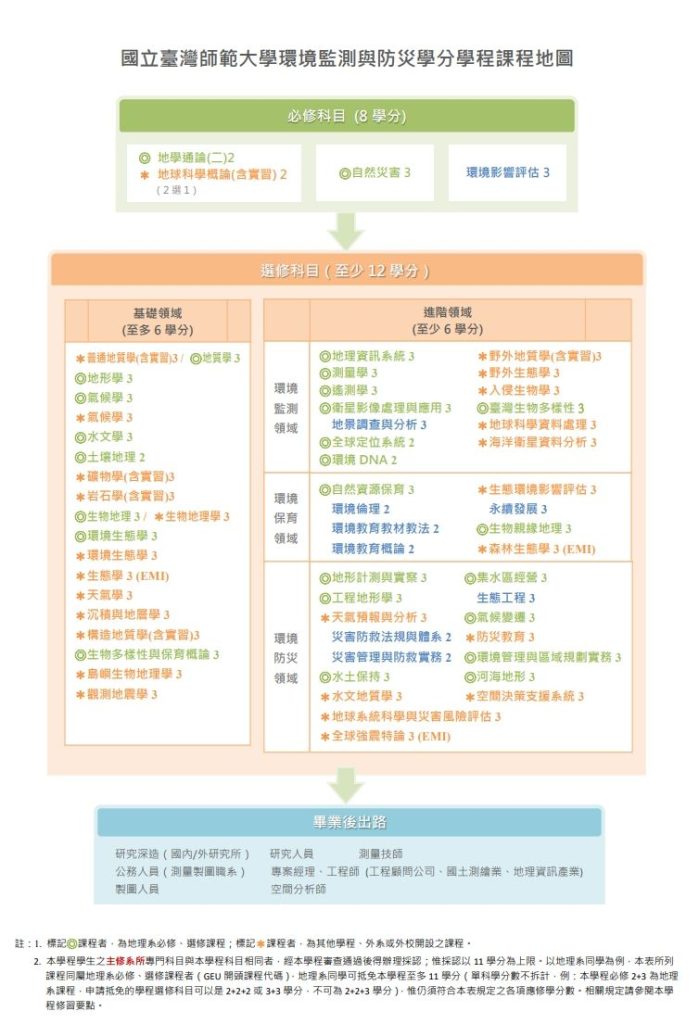
In the foundational area of monitoring and disaster prevention credit programs, courses related to climate change education are incorporated as a key component of the curriculum.
3. Promoting the Net-Zero Talent Training Program
To achieve the national goal of net-zero emissions by 2050, our university actively assists the Ministry of Environment in promoting the “Net-Zero Green Collar Talent Cultivation and Promotion Program,” offering the “Green Collar Youth Training Course.” The course covers international and global net-zero emission trends and challenges, greenhouse gas inventory, etc. Furthermore, a nationwide training network has been established, forming the “Ministry of Environment Net-Zero Green Collar Talent Northern Region Cultivation Center,” collaborating with other universities to jointly develop diverse education, training, and promotion programs. Climate change-related educational courses, including topics such as international trends in net-zero emissions, the current status of climate governance, climate risks and impacts, greenhouse gas management and inventory, and ISO 14067:2018 carbon footprint inventory, are designed to promote public education on international and local climate change risks, impacts, mitigation, adaptation, disaster reduction, and disaster prevention.
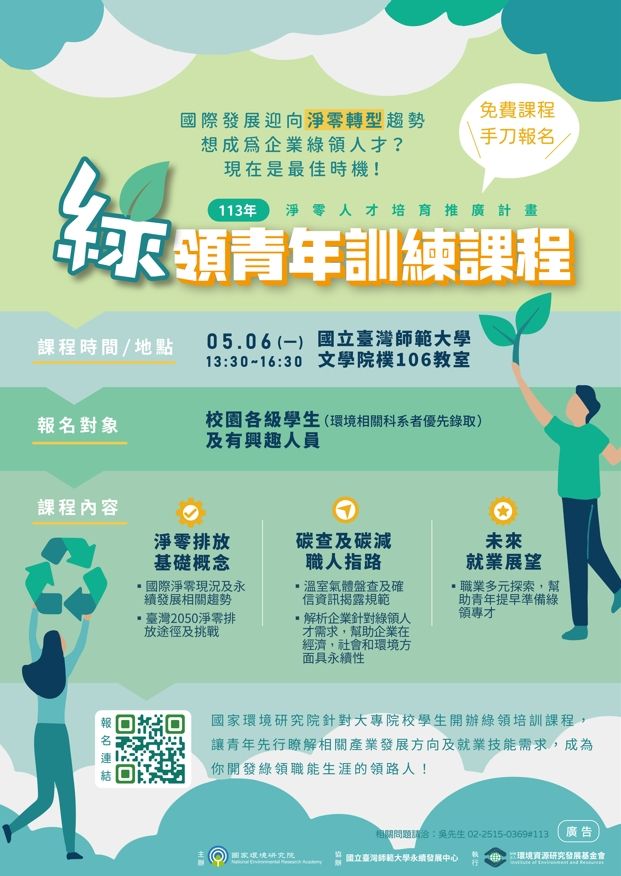
Studying under the Ministry of Environment’s Green Collar Youth Training Program
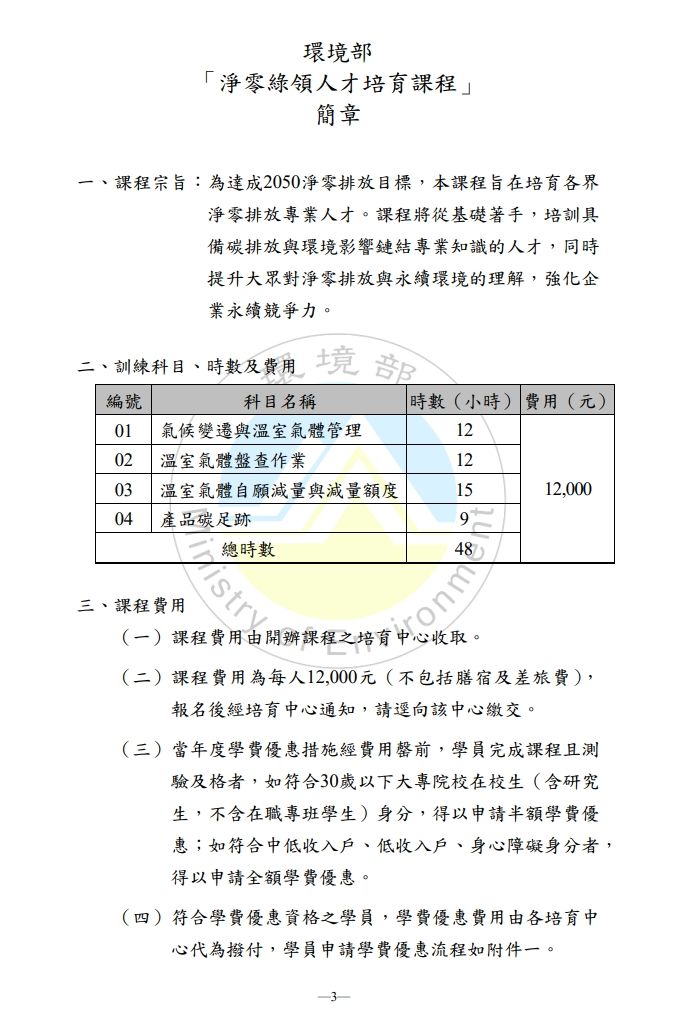
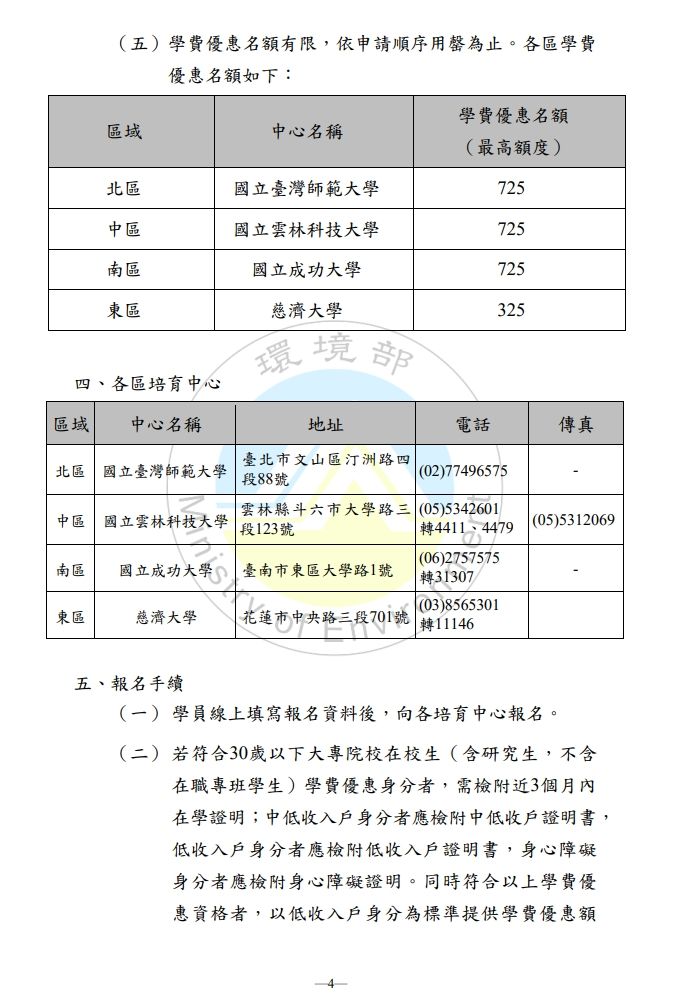
The Ministry of Environment’s “Net Zero Green Collar Talent Cultivation and Promotion Program” outlines courses covering international and Taiwan-specific climate change trends and developments.
4. Advocating for Climate Change Activities Worldwide
To implement our university’s climate action plan and promote climate action with local governments and communities, our university, in collaboration with the Vision Project Foundation and the Taiwan Youth Sustainable Development Association, co-organized a “Climate Crisis Photography Exhibition” with on-campus sustainability clubs and Cathay Financial Holdings. With the theme “Every year is the hottest year yet,” the exhibition includes content related to the “COP United Nations Climate Summit.”
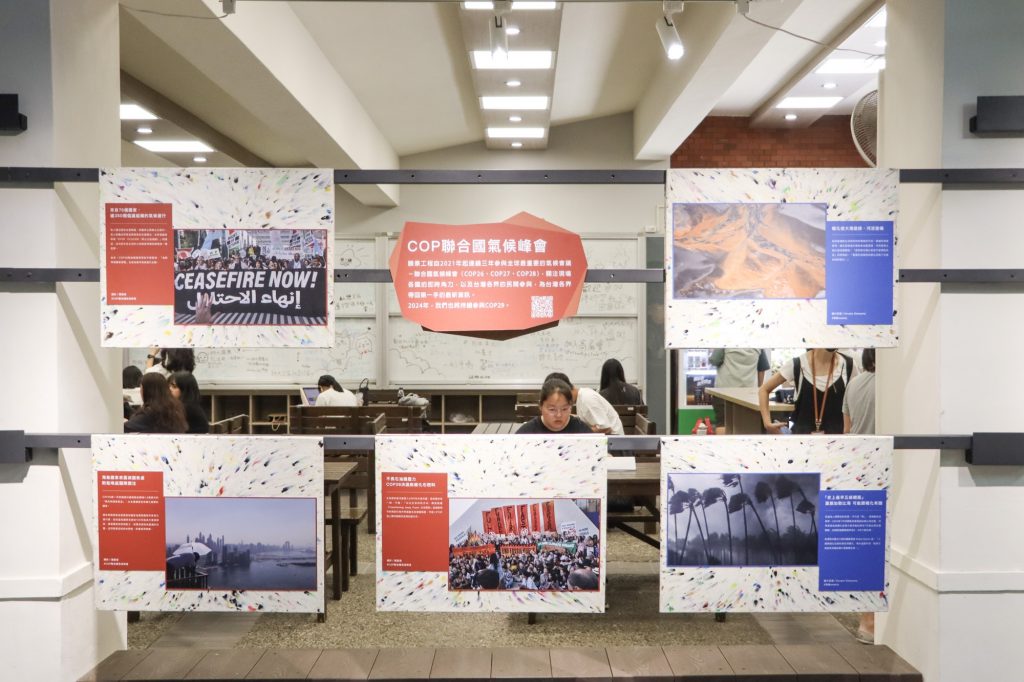
The Climate Action Exhibition features five themed zones: “Climate Weekly”, “COP United Nations Climate Summit”, “Thawing Greenland”, “Urban Climate Refugees”, and “The Climate Crisis in Your Eyes”.
13.3.2 Shared Climate Action Plan
NTNU actively develops a climate action plan, promoting sustainable development through three main directions. First, it promotes a joint climate action and disaster response plan, holding a seminar on “Analysis of Climate Change and Corporate Sustainability Trends After COP29” following the UN COP29 Climate Change Conference. Second, it collaborates with the Ministry of Education and NGOs to promote climate change action education in schools at all levels, designing interdisciplinary school-based courses to deepen students’ understanding and practice of climate change and sustainability. Finally, it shares climate crisis action with the community, holding a “Climate Crisis Photography Exhibition” to showcase global climate issues, inspiring faculty, students, and the community to participate in carbon reduction and sustainability practices, demonstrating the university’s social responsibility.
1.Promoting Collaborative Planning for Climate Action and Disaster Management
NTNU’s Graduate Institute of Sustainability Management and Environmental Education continuously promotes collaborative climate action and disaster planning, actively participating in sustainability dialogues between governments and businesses. Following the UN COP29 Climate Change Conference, on December 3, 2024, it co-hosted a seminar with the Ministry of Transportation and Communications entitled “Analysis of Climate Change and Corporate Sustainability Trends After COP29,” focusing on global climate policies and corporate adaptation strategies to promote cross-sectoral collaboration to strengthen national climate resilience.
2. Collaborating with Public and Private Sectors to Promote Climate Change Action Education in Schools at All Levels
Our Institute of Sustainable Management and Environmental Education, in collaboration with the Ministry of Education’s Climate Change Teaching Information Platform and related non-governmental organizations, is jointly promoting the “Climate Change Education Promotion Program in Schools at All Levels.” This initiative calls for submissions of school-based curriculum proposals on climate change and sustainable development education (CCE) to enhance educators at all levels in Taiwan’s understanding of CCE, ESD, and the United Nations Sustainable Development Goals (SDGs). It responds to the repositioning of climate change education in Taiwan’s Climate Change Response Act, moving towards the international trend of “Climate Change and Sustainable Development Education” (CCESD = CCE + ESD), and connecting with the SDGs to form CCESDG. It also guides Taiwan’s environmental education in implementing environmental action. “Promoting ‘Sustainability-Oriented Climate Change Education’ in schools at all levels, cultivating teachers, developing and compiling teaching materials, and nurturing interdisciplinary talents to address future climate change” (Article 42 of the Climate Change Response Act). It encourages frontline educators to understand the characteristics and standards of CCE and ESD, and to integrate the UN SDGs into school-based curriculum practices, addressing key global and local sustainability issues.
Poster for the 113th Anniversary Climate Change Education and Sustainable Development Education School-Based Curriculum Program (2024)
3. Sharing Climate Crisis Action with the Community To promote climate action
To promote climate action, NTNU collaborated with the Vision Project Foundation and the Taiwan Youth Sustainable Development Association, with Cathay Financial Holdings as a co-organizer, to host the “Climate Crisis Photography Exhibition.” The exhibition, themed “Every Year Is the Hottest Year,” showcases 30 photographs reflecting global climate change, covering five thematic sections: “Climate Weekly,” “COP UN Climate Summit,” “Thawing Greenland,” “Urban Climate Refugees,” and “The Climate Crisis Through Your Eyes.” A public photography contest was also held, inviting communities and students to document local climate phenomena, creating a special section on “The Climate Crisis Through Your Eyes.” Furthermore, innovative global carbon reduction cases were showcased to inspire local communities to take carbon reduction action. Through diverse themes and images, the exhibition promoted climate education to faculty, students, and neighboring communities, fulfilling the university’s social responsibility and community sharing in facing the climate challenge together.communities, fulfilling the university’s social responsibility and sharing with the community to jointly address the climate challenge.
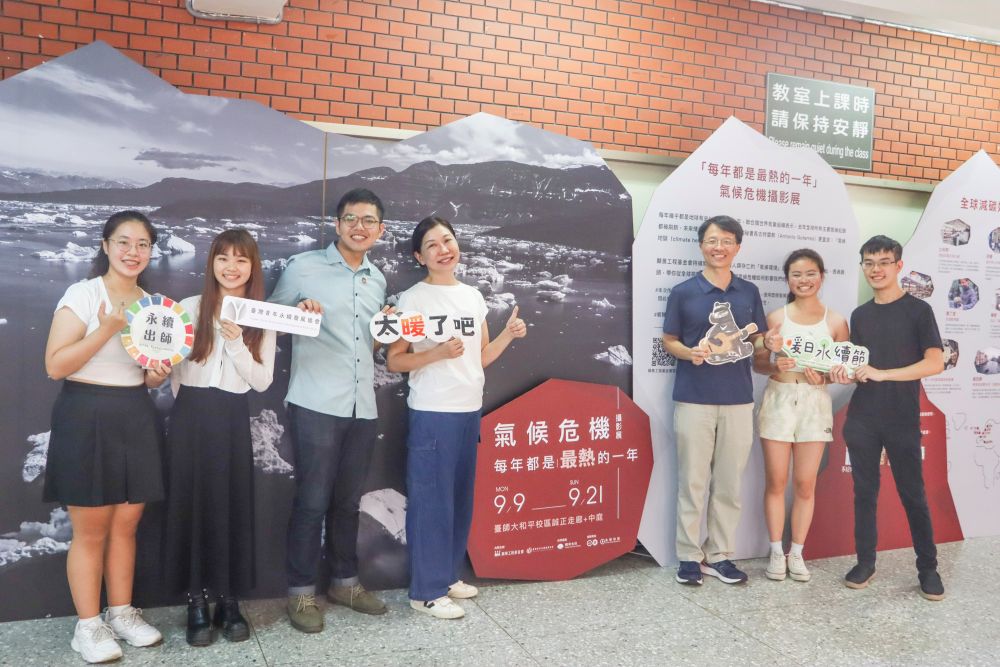
NTNU, together with the Vision Project Foundation and the Taiwan Youth Sustainable Development Association, co-organized the “Climate Crisis Photography Exhibition”.
13.3.3 Co-operative planning for climate change disasters
NTNU continues to collaborate with governments and businesses to promote climate action and disaster planning, integrating teaching, research, and virtual reality training systems for disaster prevention to jointly strengthen climate resilience and social responsibility.
1. Promoting Climate Action and Disaster Planning
Following the UN COP29 Climate Change Conference, the Graduate Institute of Sustainable Management and Environmental Education at National Taiwan Normal University has continued to promote climate action and disaster planning, actively participating in sustainability collaborations with governments and businesses. On December 3, 2024, a seminar titled “Analysis of Climate Change and Corporate Sustainability Trends After COP29” was co-hosted with the Ministry of Transportation and Communications, focusing on global climate policies and corporate adaptation strategies to promote inter-departmental cooperation and strengthen national climate resilience.
The seminar was attended by the Minister of Environment, the Director-General of the Climate Change Agency, and numerous corporate sustainability chiefs and industry leaders, who jointly explored climate finance, carbon reduction technologies, and sustainable adaptation actions. Participants engaged in in-depth exchanges on topics such as the “2050 Net-Zero Emissions Pathway,” “Energy Storage and Hydrogen Energy Applications,” “Climate Finance Mechanisms,” and “Corporate Climate Risk Governance,” forging a consensus on public-private sector cooperation in decision-making.
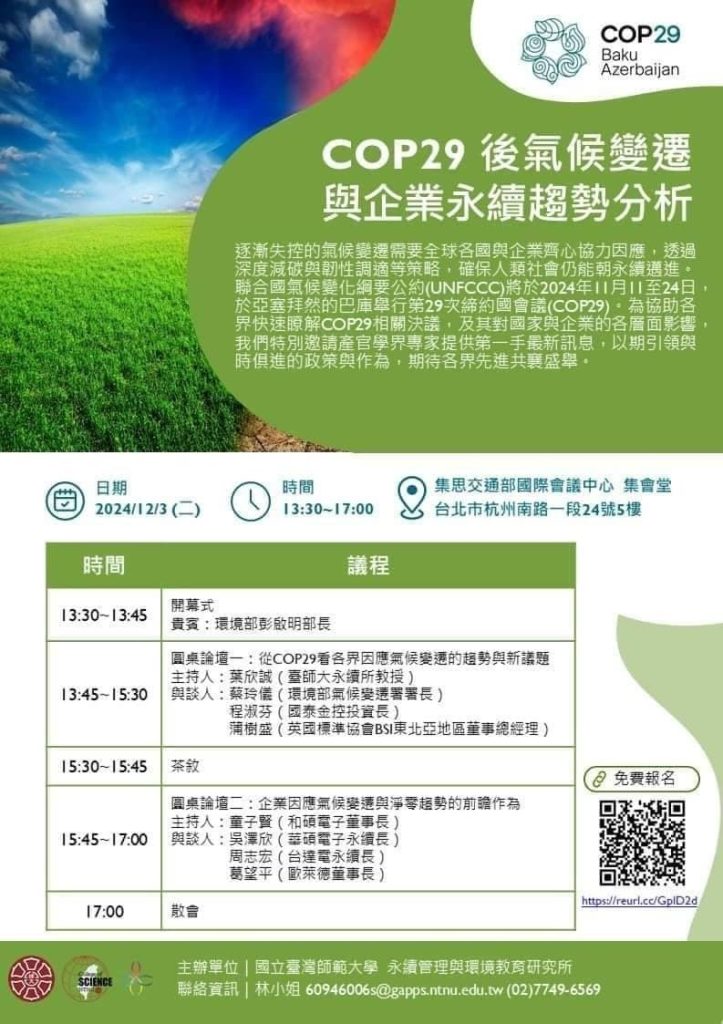
Agenda for the “COP29 Post-Climate Change and Business Sustainability Trends Analysis Seminar.”
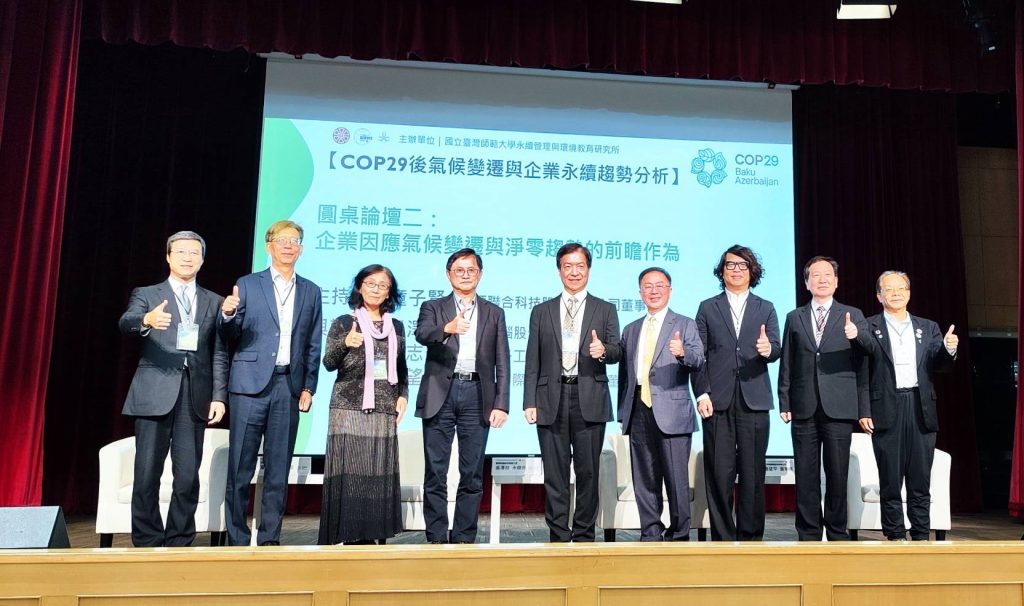
The “COP29 Post-Climate Change and Corporate Sustainability Trends Analysis Seminar” aims to address climate change by collaborating with governments and businesses to plan climate change disaster response actions.
2. Participation in International and Inter-University Research to Mitigate Global Climate Change
Professor Chung-Chi Chen of the Department of Life Sciences at NTNU participated in an international and inter-university research team conducting the “Northwest Pacific Ocean Blue Carbon Integration Research” project, funded by the National Science Council’s “Navigation to the Blue Ocean Outline Project.” Through the “New Ocean Research No. 1” research vessel, the team carried out voyages for the “Navigation to the Blue Ocean Outline Project,” bringing back crucial observational data. This data will provide valuable reference and support for global climate change mitigation and carbon neutrality goals, and is expected to promote the development of marine carbon removal technologies, further facilitating the effective control and management of global greenhouse gas emissions. Collecting scientific samples and parameter data to understand the distribution and impact of ocean mesoscale eddies on marine blue carbon is also a collaborative research effort involving international and inter-university researchers. In recent years, developing ocean-based carbon removal technologies has been considered one of the most cost-effective ways to achieve the “net-zero emissions” target set by the Paris Agreement.
3. Developing a Virtual Reality System for Disaster Prevention and Response to Share Disaster Reduction Education Skills
Our university’s International Research Center for Learning Sciences developed the “Earthquake Response and Escape Virtual Reality Skills Training System,” which was first provided to teachers and students in elementary and middle schools in New Taipei City. Through operation, it enhances disaster prevention knowledge and response capabilities. The results are shared with disaster prevention education centers and local education bureaus across the country, strengthening the connection between local governments, schools, and academic institutions in disaster prevention and mitigation, and applying research results to society in practice, fulfilling the university’s social responsibility.
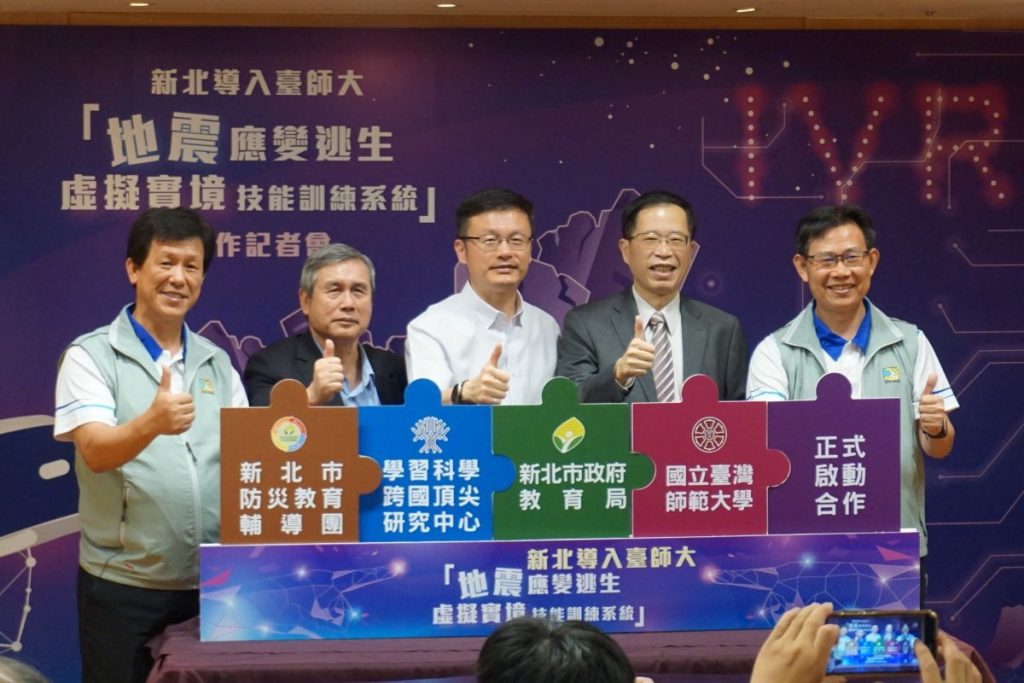
New Taipei City Launches Collaboration with National Taiwan Normal University on “Earthquake Response and Escape Virtual Reality Skills Training System.”
13.3.4 Inform and support government
Professor Chung-Chi Chen of the Department of Life Sciences at NTNU participated in an international and inter-university research team conducting the “Northwest Pacific Ocean Blue Carbon Integration Research” project, funded by the National Science Council’s “Navigation to the Blue Ocean Outline Project.” Through the “New Ocean Research No. 1” research vessel, the team carried out voyages for the “Navigation to the Blue Ocean Outline Project,” bringing back crucial observational data.
This data will provide valuable reference and support for global climate change mitigation and carbon neutrality goals, and is expected to promote the development of marine carbon removal technologies, further facilitating the effective control and management of global greenhouse gas emissions. Collecting scientific samples and parameter data to understand the distribution and impact of ocean mesoscale eddies on marine blue carbon is also a collaborative research effort involving international and inter-university researchers. In recent years, developing ocean-based carbon removal technologies has been considered one of the most cost-effective ways to achieve the “net-zero emissions” target set by the Paris Agreement.
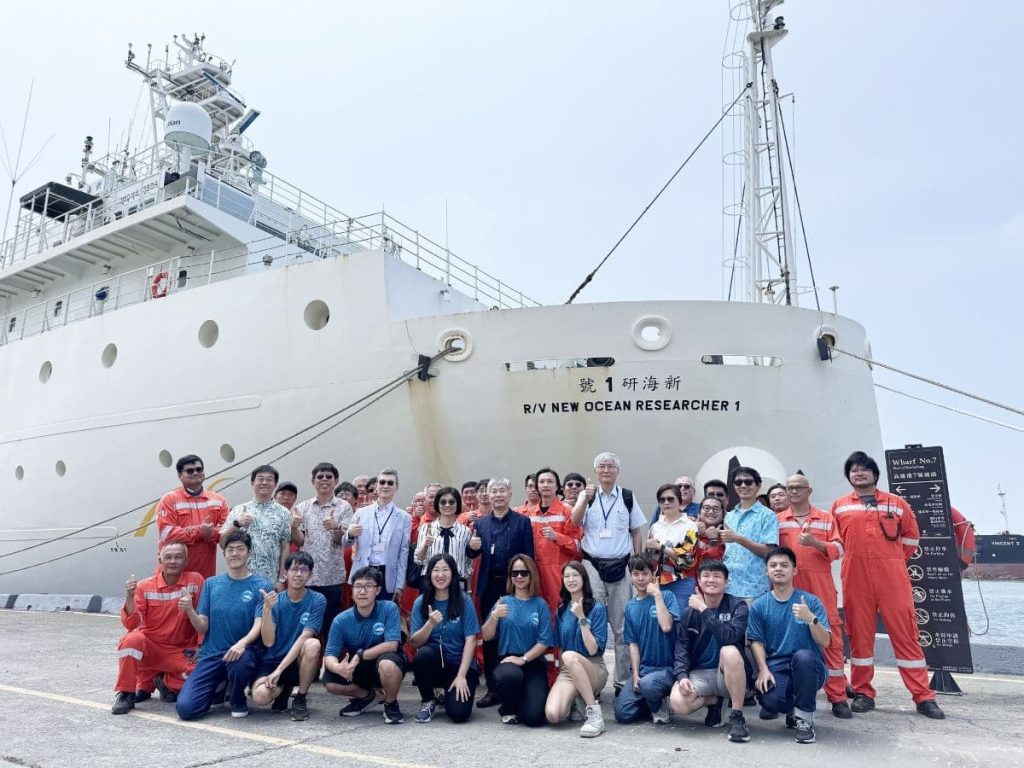
Professor Chen Chung-Chi of the Department of Life Sciences participated in a research team composed of six top universities in Taiwan, bringing back important monitoring data to support the government’s climate monitoring and early warning research efforts.
13.3.5 Collaborate with NGOs on climate adaptation
NTNU actively participates in collaborative projects on climate change issues. Following COP29, it discussed net-zero pathways, climate finance, and corporate risk governance with the Ministry of Transportation and Communications and business leaders, promoting public-private partnerships. To cultivate carbon management talent in the Asia-Pacific region, the university collaborates with Singapore’s HID Digital to offer practical carbon management courses. Furthermore, to implement the university’s climate action education program, NTNU co-organized a “Climate Crisis Photography Exhibition” with the Vision Engineering Foundation (a non-governmental organization) and the Taiwan Youth Sustainability Development Association, in conjunction with on-campus sustainability clubs and Cathay Financial Holdings.
1. Promoting Climate Action and Disaster Planning
Following the UN COP29 Climate Change Conference, the Graduate Institute of Sustainable Management and Environmental Education at National Taiwan Normal University has continued to promote climate action and disaster planning, actively participating in sustainability collaborations with governments and businesses. On December 3, 2024, a seminar titled “Analysis of Climate Change and Corporate Sustainability Trends After COP29” was co-hosted with the Ministry of Transportation and Communications, focusing on global climate policies and corporate adaptation strategies to promote inter-departmental cooperation and strengthen national climate resilience.
The seminar was attended by the Minister of Environment, the Director-General of the Climate Change Agency, and numerous corporate sustainability chiefs and industry leaders, who jointly explored climate finance, carbon reduction technologies, and sustainable adaptation actions. Participants engaged in in-depth exchanges on topics such as the “2050 Net-Zero Emissions Pathway,” “Energy Storage and Hydrogen Energy Applications,” “Climate Finance Mechanisms,” and “Corporate Climate Risk Governance,” forging a consensus on public-private sector cooperation in decision-making.
The “COP29 Post-Climate Change and Corporate Sustainability Trends Analysis Seminar” aims to address climate change by collaborating with governments and businesses to plan climate change disaster response actions.
Agenda for the “COP29 Post-Climate Change and Business Sustainability Trends Analysis Seminar.”
2. To implement NTNU’s climate action education program, our university, together with the Vision Engineering Foundation (NGO) and the Taiwan Youth Sustainable Development Association (NGO), co-organized a “Climate Crisis Photography Exhibition” with campus sustainability clubs and Cathay Financial Holdings. Themed “Every Year Is the Hottest Year,” the exhibition features 28 representative photographs covering topics such as the “COP United Nations Climate Summit,” “The Thawing of Greenland,” and “Urban Climate Refugees,” reminding everyone that “the climate crisis is not far away.”
To implement our university’s climate action plan and promote climate action with local governments and communities, our university, in collaboration with the Vision Project Foundation and the Taiwan Youth Sustainable Development Association, co-organized a “Climate Crisis Photography Exhibition“ with on-campus sustainability clubs and Cathay Financial Holdings. With the theme “Every year is the hottest year yet,” the exhibition includes content related to the “COP United Nations Climate Summit.”
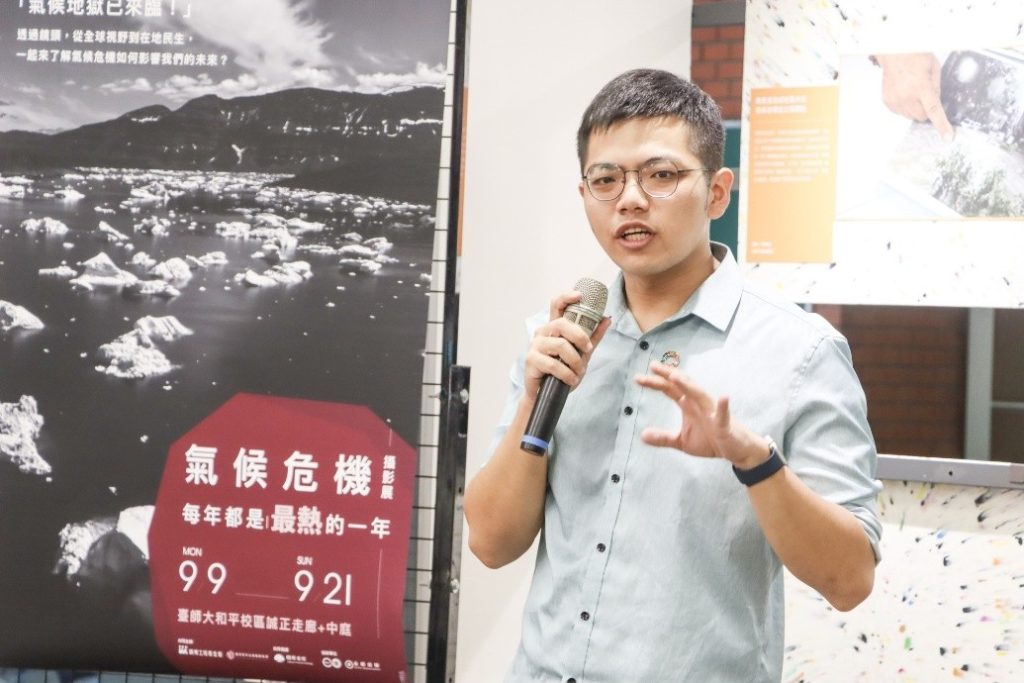
Tsai Wen-pei, chairman of the non-governmental organization “Taiwan Youth Sustainable Development Association”, affirmed the power of the National Taiwan Normal University’s “Promoting Sustainability” initiative.
3. In response to the challenges of global climate change and the goal of net-zero emissions by 2050, NTNU signed a memorandum of understanding for industry-academia collaboration with Singapore-based carbon management company Cedars Digital. This initiative also aligns with the UN’s call for “education at the heart of climate action.” The curriculum covers climate science, international carbon reduction and carbon disclosure policies and frameworks (such as TCFD, SBTi, CDP, RE100), relevant domestic and international climate regulations, carbon inventory practices (ISO 14064-1, ISO 14067, etc.), corporate carbon management practices, and in-depth analysis of the EU and Taiwan sustainability classification systems. This strengthens students’ ability to comprehensively apply various management tools, establishing NTNU as a training base for carbon management talent in the Asia-Pacific region.
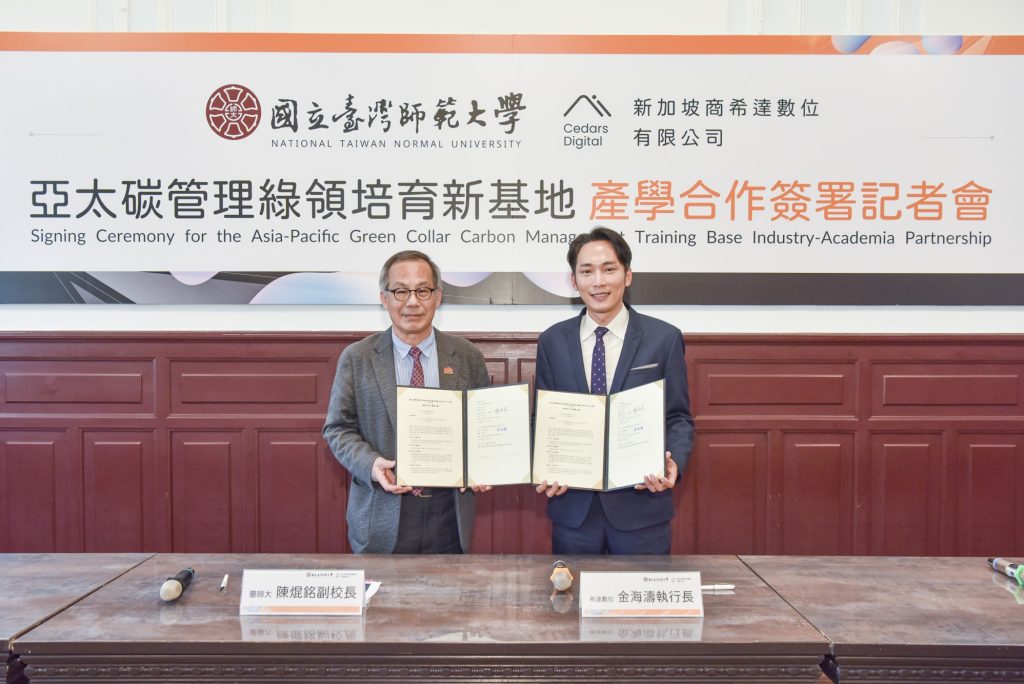
NTNU and Cedars Digital (Singapore) signed an industry-academia collaboration agreement.
13.4.1 Commitment to carbon neutral university
NTNU conducted its 2023 greenhouse gas inventory between October 2024 and March 2025, covering all four campuses and other buildings. The results were verified with a DNV-issued verification statement in March 2025.
NTNU’s greenhouse gas emissions for the 2023 reporting period, including Scope 1, Scope 2, Scope 3, Scope 4, and Scope 5 as defined in ISO 14064-1:2018, totaled 33,723.450 tons of CO₂e. Scope 1 and 2 emissions accounted for 16,755.852 tons of CO₂e, or 49.69% of the total.
13.4.2 Achieve by date
NTNU’s Carbon Neutral Claim
National Taiwan Normal University (NTNU) recognizes that a university has to play an essential role in the evolution of human civilization and promises to be carbon-neutral by 2048 in response to Taiwan’s 2050 Zero Emission policy and UN 2030 Agenda – Sustainable Development Goals (SDGs). In addition to continuing to cultivate talents and develop research, the university will fulfill social responsibilities and increase impacts. NTNU aims to reduce carbon emissions by 50% by 2030 and achieve complete carbon neutrality by 2048 through net-zero green life, energy efficiency, low-carbon emission electricity, and green energy.
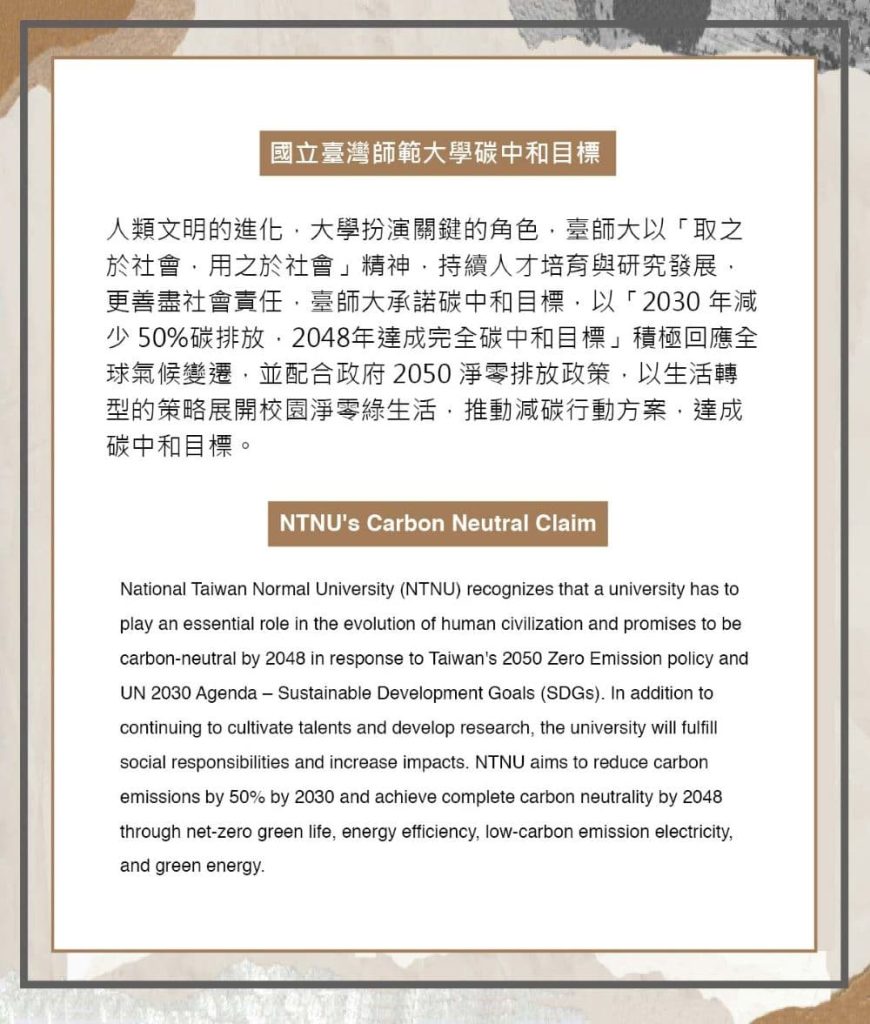
NTNU’s Carbon Neutral Claim