11.2.1 Public access to buildings
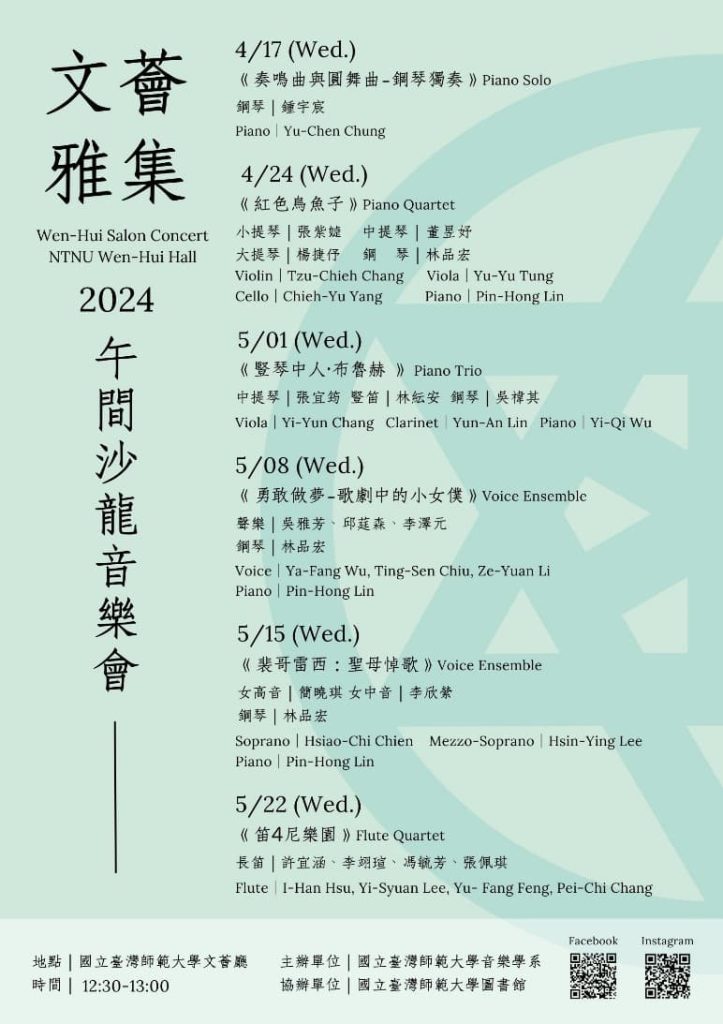
NTNU boasts a long history, and the campus still preserves the Puzi Building, Wenhui Hall, Auditorium, and Administration Building, all designated as Taipei City Historic Sites and protected by the “Cultural Heritage Preservation Act,” completed between 1926 and 1929. The “Liang Shiqiu Former Residence” was designated a Historic Site by the Taipei City Government in 2003 and is open to local residents, faculty, and students, with admission and professional guided tours available upon request. The “Wenhui Gathering” is a weekly Wednesday lunchtime performance held in the Wenhui Hall, open to faculty, students, and the community free of charge. To ensure the general public can also enjoy the open space of the campus, the entire campus is open to the public free of charge, including all buildings and cultural relics. Free guided tours can also be booked online; in 2024, 49 guided tours were held, with 1,139 participants.
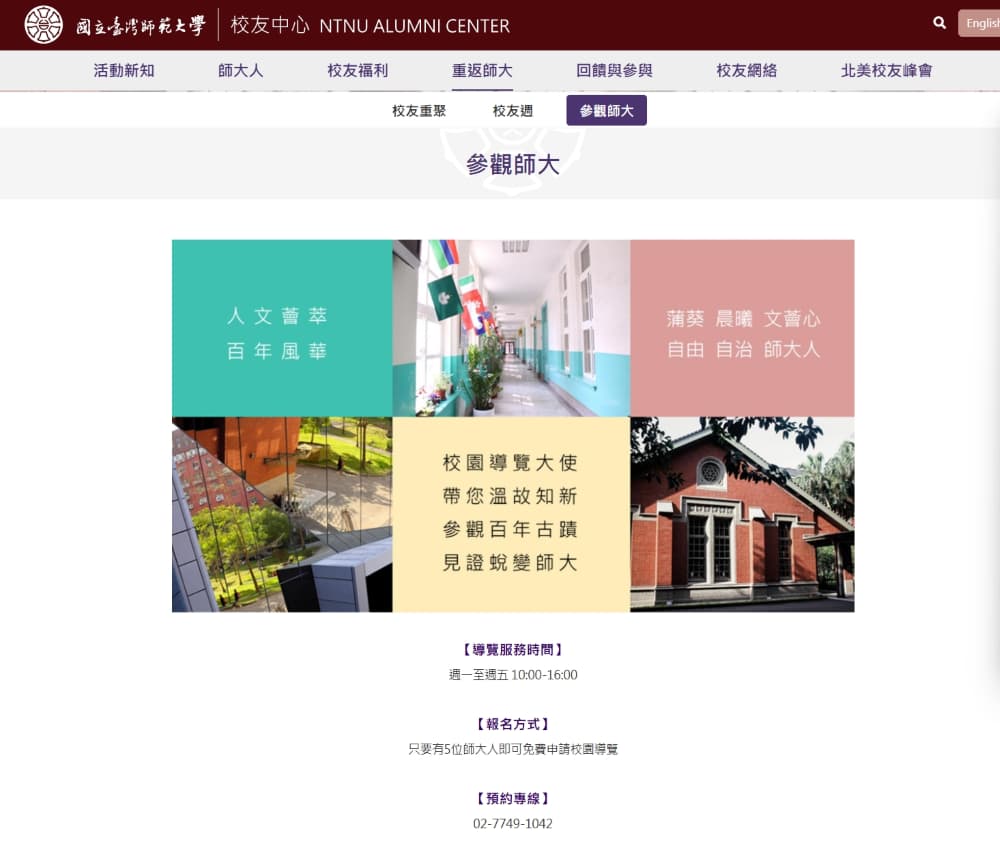
The NTNU website allows the public to freely visit buildings and historical sites, and also offers free guided tours.
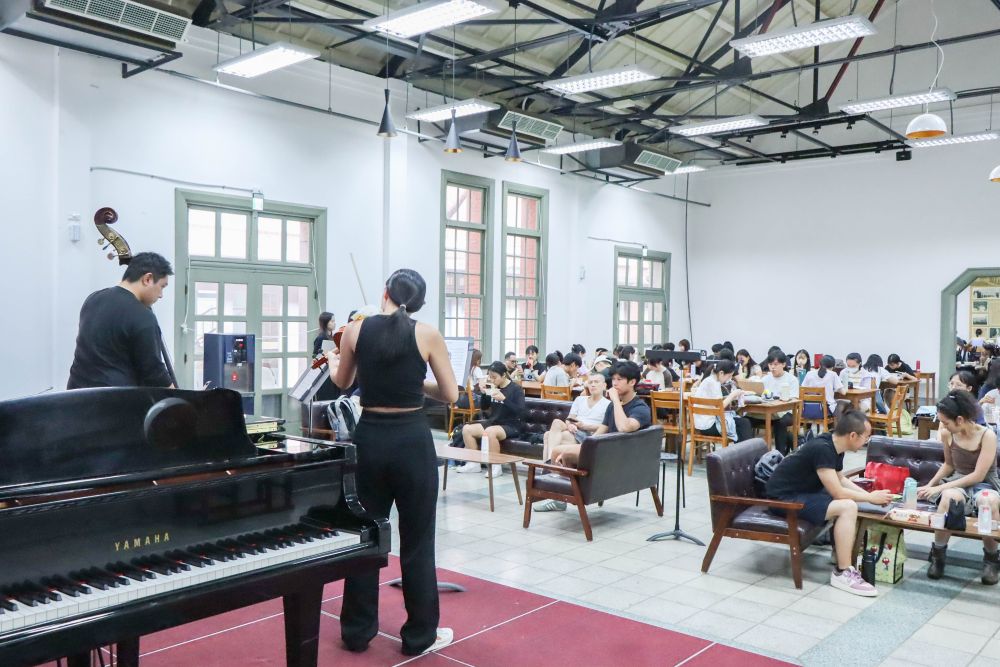
The Wenhui Music Concert is held every Wednesday at noon in the Wenhui Hall of the Heritage Site. Faculty, students, staff, and community members are welcome to attend.
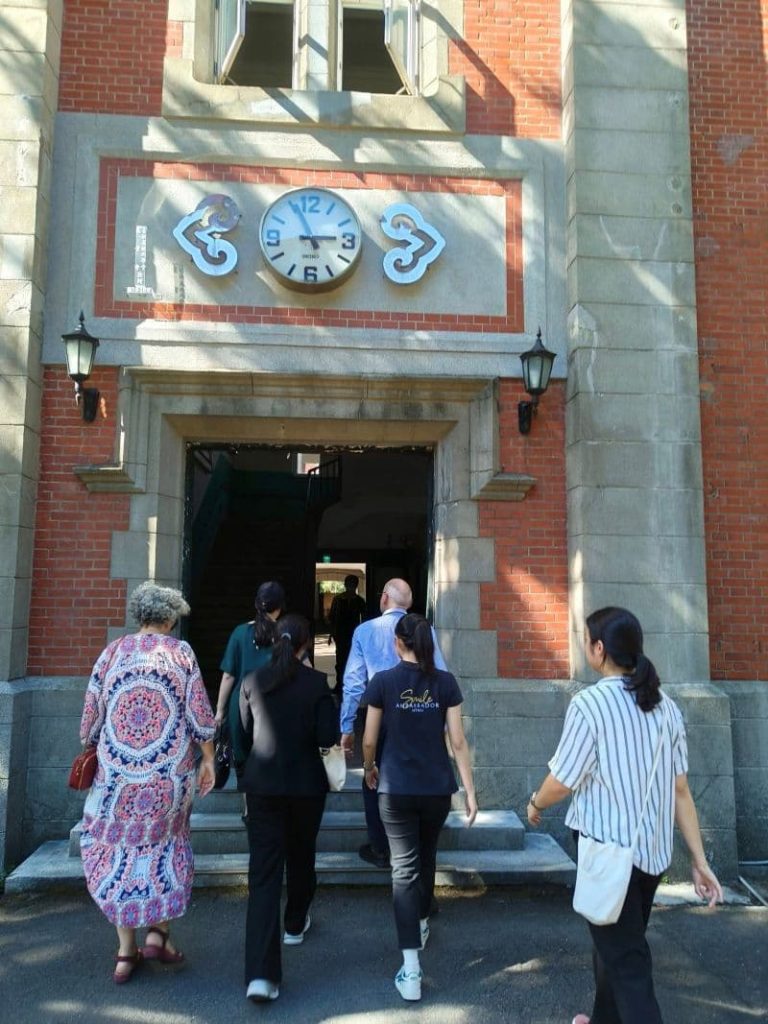
The campus buildings are open to the public, who can freely enter and exit, and can also apply for free guided tours.
11.2.2 Public access to libraries
NTNU has three branch libraries: the NTNU Library, the College of Science Library Branch, and the Linkou Campus Library Branch. The libraries are open year-round except for certain holidays. As of August 2025, the university library had 1,469,284 books; electronic resources included 283 databases, 106,032 e-journals, and 1,954,039 e-books. In addition to serving faculty, staff, and students, the library is open to the general public free of charge, and online resources are also available free of charge. In 2024, there were 790,919 visits from university staff and 146,304 visits from external visitors, totaling 937,223 visits.
- Open Physical Library: In addition to serving the faculty, staff, and students of NTNU, the library offers free access to the general public. It maintains guidelines such as “Guidelines for External Visitors,” “Recruitment Regulations for Friends of the Library,” “Borrowing Rules,” and “Guidelines for Borrowing Books by Faculty, Staff, and Families of NTNU,” facilitating the teaching and research needs of the general public. Visitors are free to visit and browse books and publications.
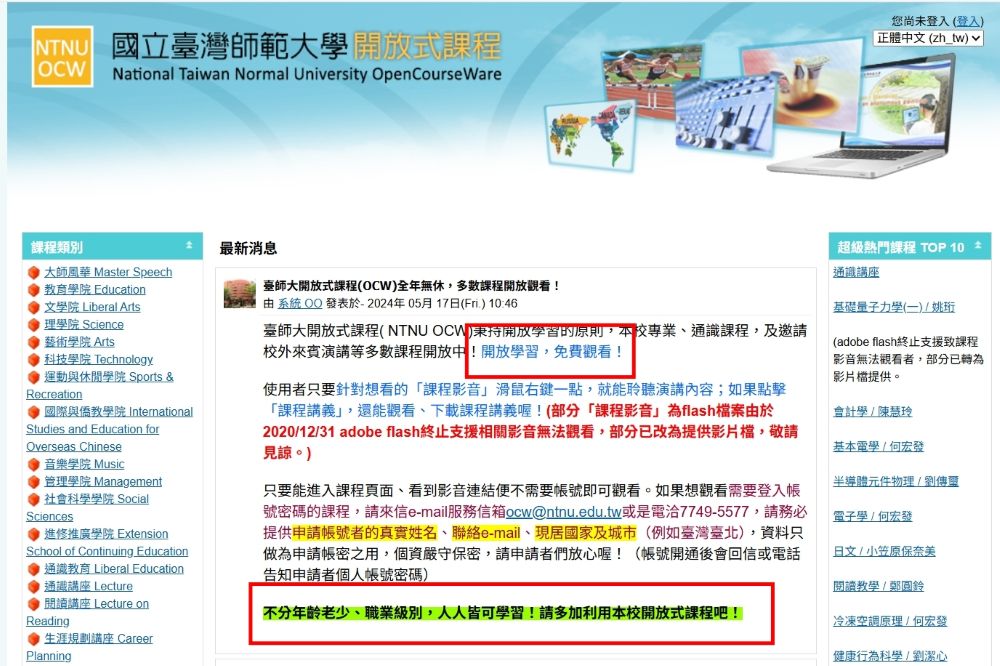
- Open Online Library: NTNU boasts a rich and diverse collection. In recent years, due to the advent of the digital age, the library has expanded its collection from primarily physical books to include more e-books, increasing usage and circulation. Following the example of MIT’s Open Course Ware, NTNU’s Open Course Ware (OCW) is available year-round, open to all ages, and free for reading and learning. Furthermore, the library’s digital collections, such as digitized rare and ancient books, facilitate free retrieval, reading, and learning.
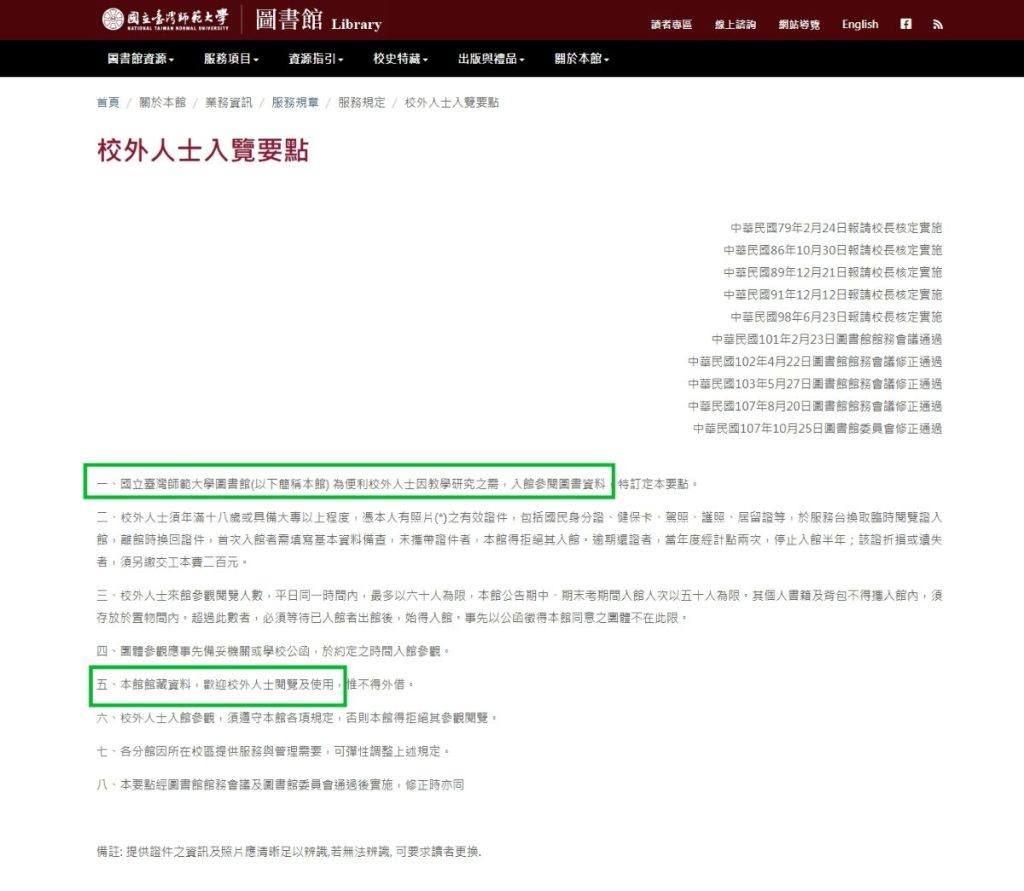
To facilitate teaching and research needs of the public, NTNU has established guidelines for external visitors to access the library, allowing the public to freely visit and read the books, publications, and exhibitions provided.
The NTNU Open Courses( NTNU OCW)are available year-round, open to everyone regardless of age or profession, and free to read and learn from.
11.2.3 Public access to museums and exhibition spaces.
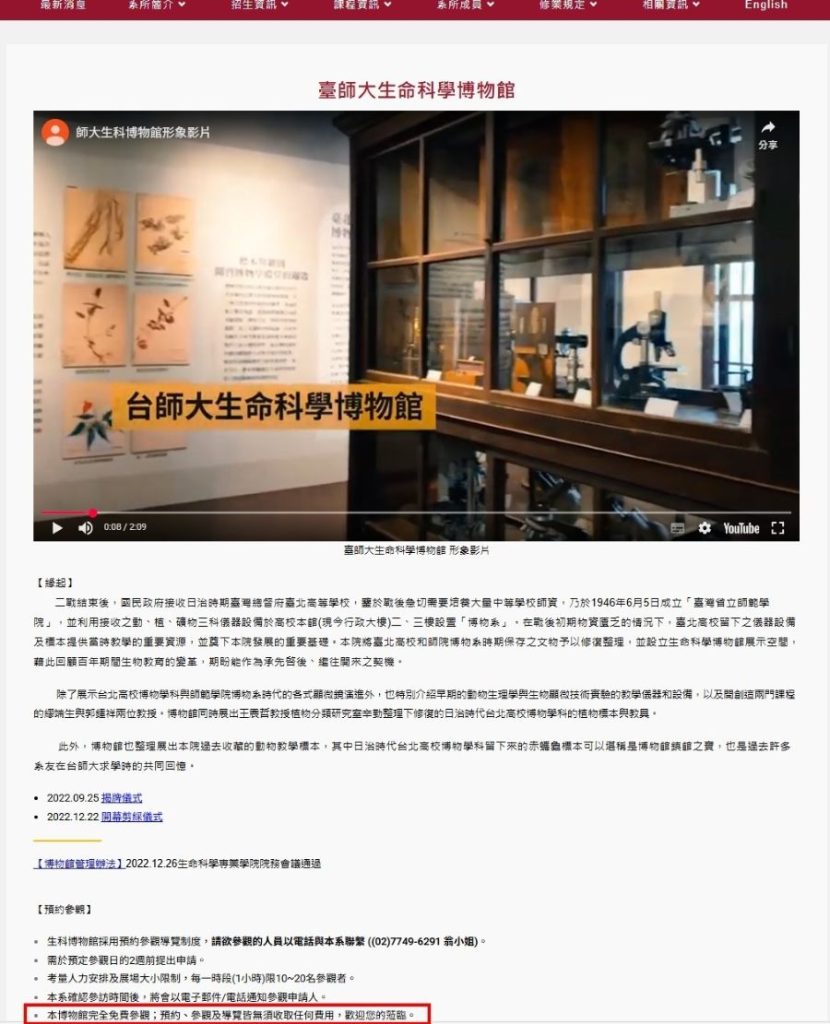
Museum of Life Sciences opened in 2022, housing a collection of precious artifacts. Through the museum’s establishment, the university’s rich cultural assets can be continuously presented to the public for understanding and appreciation, and the public’s understanding of the contributions of life science education and research in Taiwan can be deepened. To allow more people to experience the museum, free admission and guided tours are available. People from all walks of life, alumni, faculty, and students are welcome to visit in groups. News report: National Taiwan Normal University Museum of Life Sciences – A Century-Old Collection for Sustainable Preservation, Bearing the Glory of Biological Education History.
Life Science Museum Open Websitehttps::Public access to museums and free guided tours are available.
https://www.biol.ntnu.edu.tw/index.php/lifesciencemuseum/
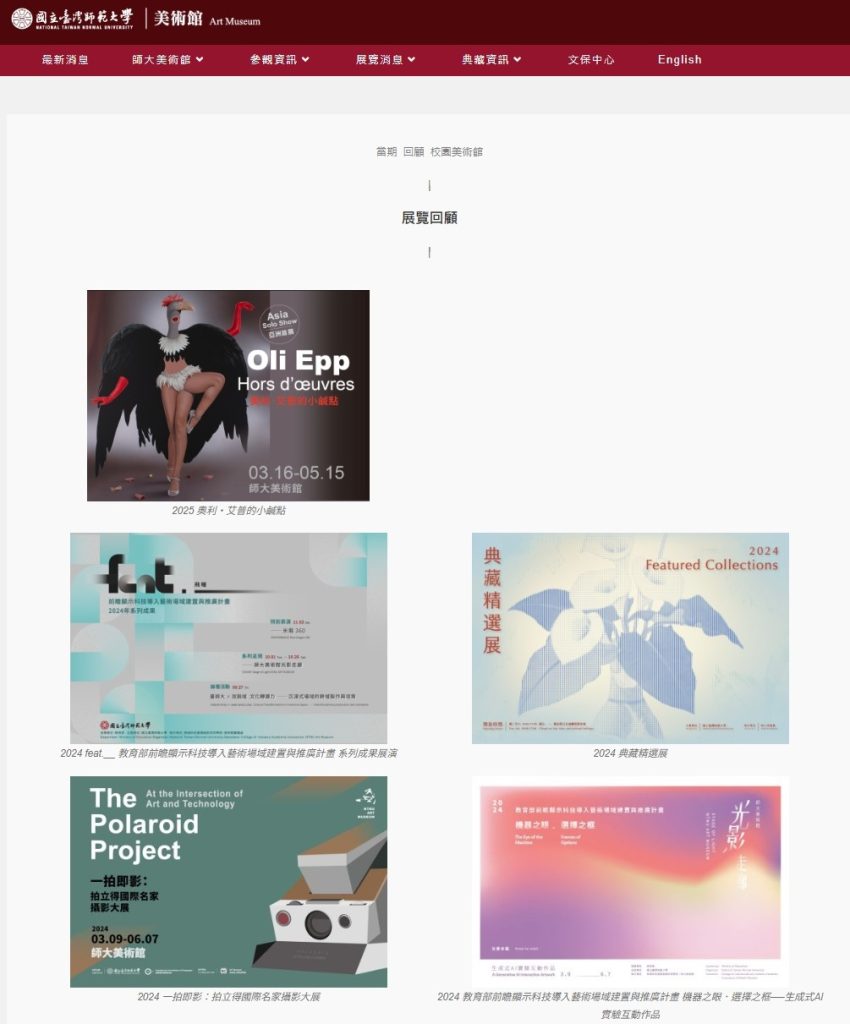
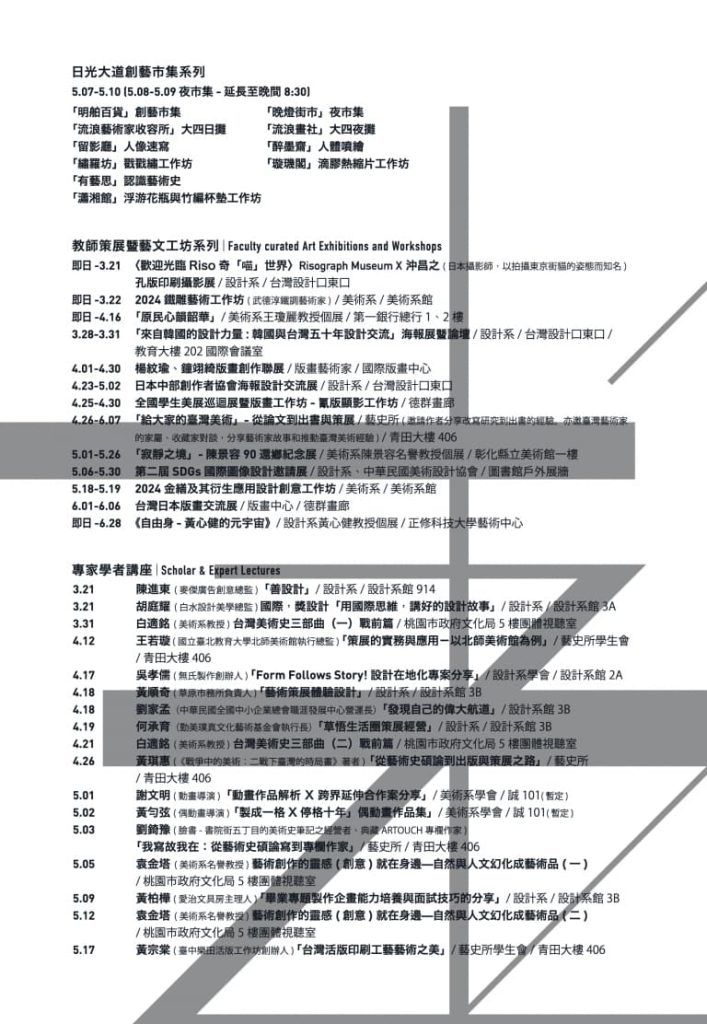
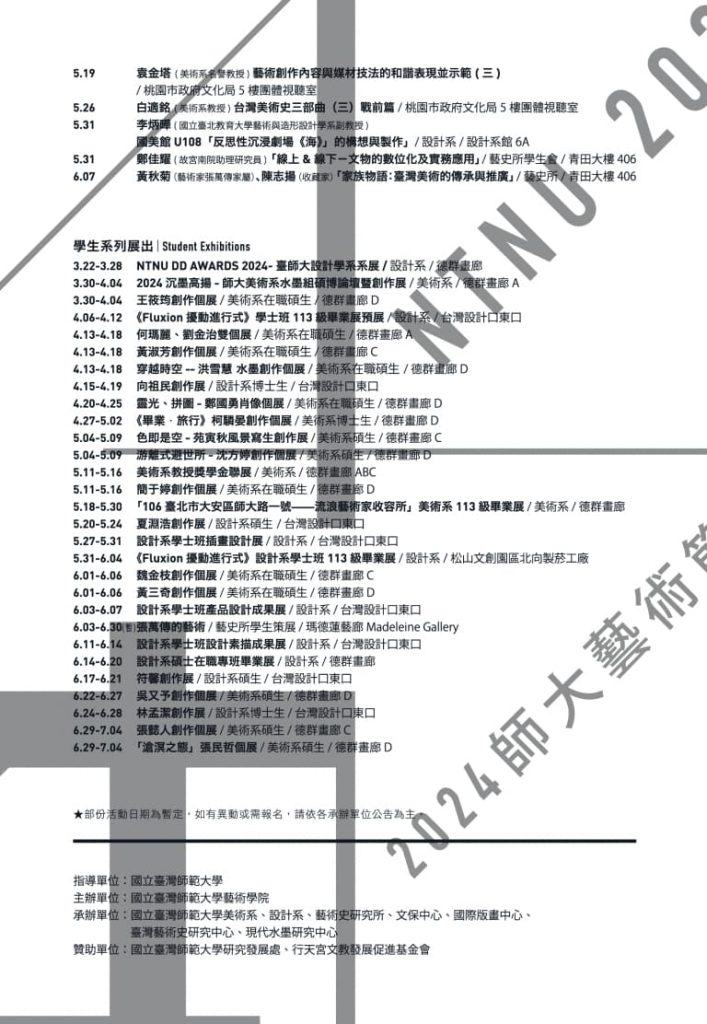
NTNU is the oldest art institution of higher learning in Taiwan, having hosted numerous masters and witnessed the pulse of modern Taiwanese art and cultural history. It is the birthplace of Taiwanese art development and a cradle for nurturing elites. The university boasts a diverse range of art galleries, including the NTNU Art Museum, Dequn Gallery, Taiwan Design Center, International Printmaking Center, and the library’s exhibition hall, offering a wide variety of artworks. At least 50 exhibitions are held regularly, open to the public free of charge. The College of Arts hosts an annual free art festival, with 51 lectures, workshops, and performances scheduled from March to June 2024. The NTNU Art Museum houses over 4,000 artworks, providing resources for art and cultural education and innovation. It also hosts special exhibitions such as the 2024 Ministry of Education’s Advanced Display Technology Integration and Promotion Project for Art Spaces, Generative AI Interactive Experiments, and Classic Selections from the Art Museum, all open to the public free of charge. In total, the university hosts at least 100 public art and exhibition events annually.
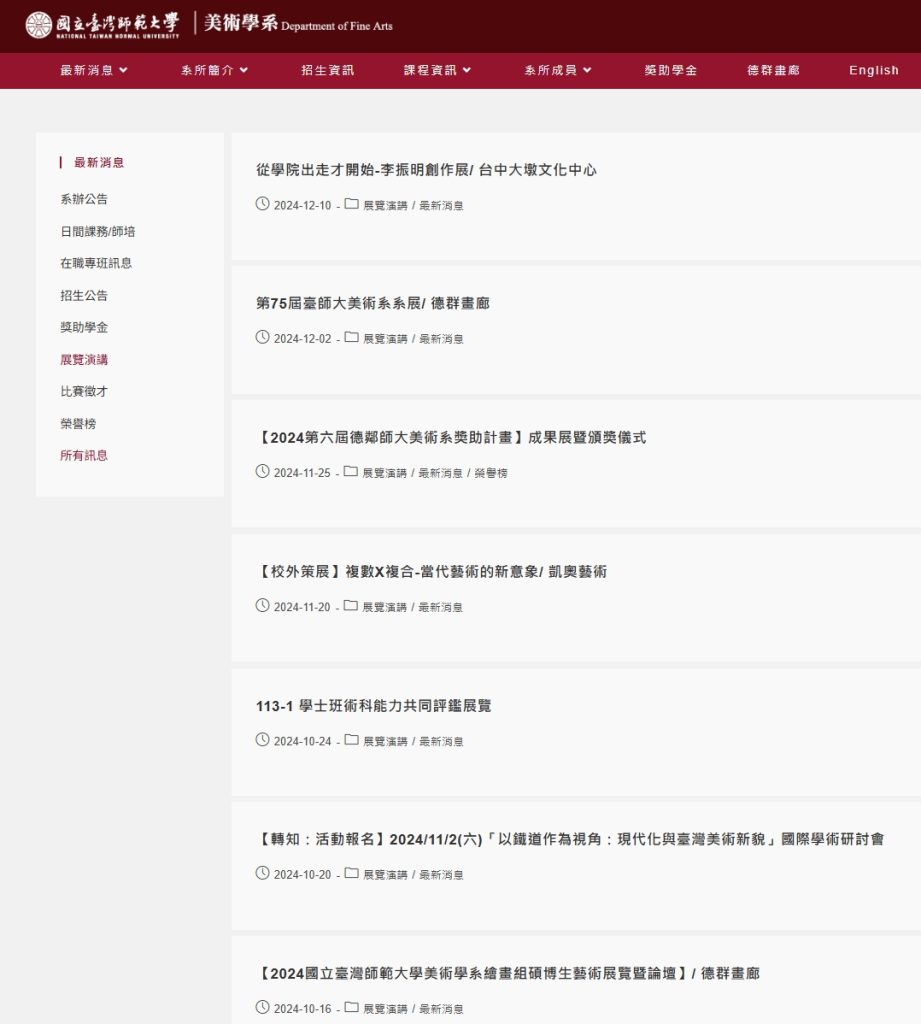
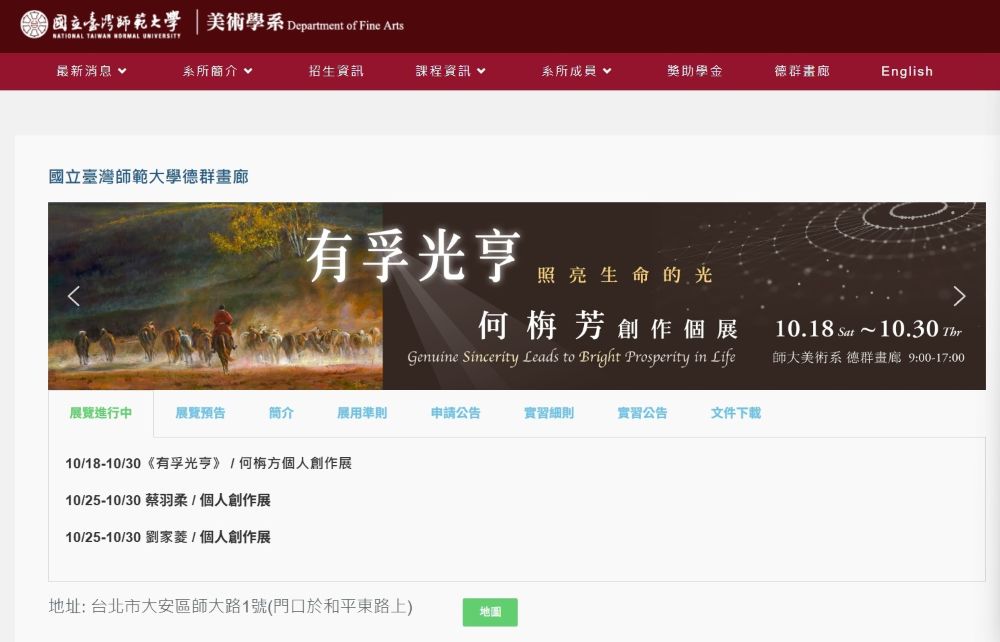
Information on open exhibitions and lectures in the Department of Fine Arts
Art Museum open their exhibition spaces to the public, showcasing fine art, artworks, and artifacts.
The exhibition space at Dequn Gallery hosts painting and artwork exhibitions nearly year-round.
11.2.4 Provide free public access to open spaces and green spaces
NTNU has long been committed to fulfilling its social responsibility as a university, actively promoting the concept of “university community and community school,” and has established an “Open Campus Declaration” to provide free public open spaces and green areas for the public to share a friendly and safe environment with local residents. Cars and motorcycles are completely prohibited from entering the campus, and dedicated pedestrian paths have been set up. Pets are also allowed, allowing more people to freely access green spaces. Research shows that parks and green spaces have self-purification capabilities, effectively reducing air pollution, noise, and the heat island effect, and enhancing the public’s sense of well-being.
The campus’s sports fields, gardens, lawns, and artificial wetlands function like urban parks, becoming important areas for residents’ daily leisure. Residents from surrounding communities can freely enter and exit the campus, using public facilities such as green spaces, sports facilities, water fountains, and restrooms. In the mornings and evenings, various clubs such as dance, martial arts, and yoga are often seen conducting activities in the campus’s open spaces and green areas, jointly promoting sports and healthy living for all and showcasing a beautiful scene of harmonious coexistence between the campus and the community.
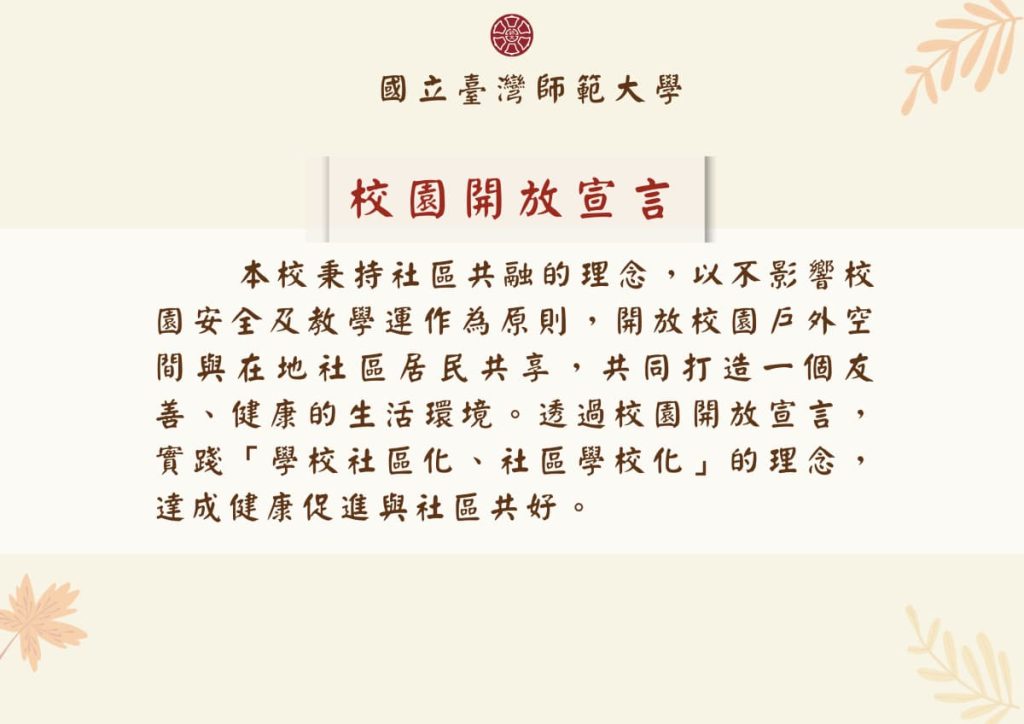
Publicly release of the “Campus Open Declaration” ,provide free public access to open spaces and green spaces.
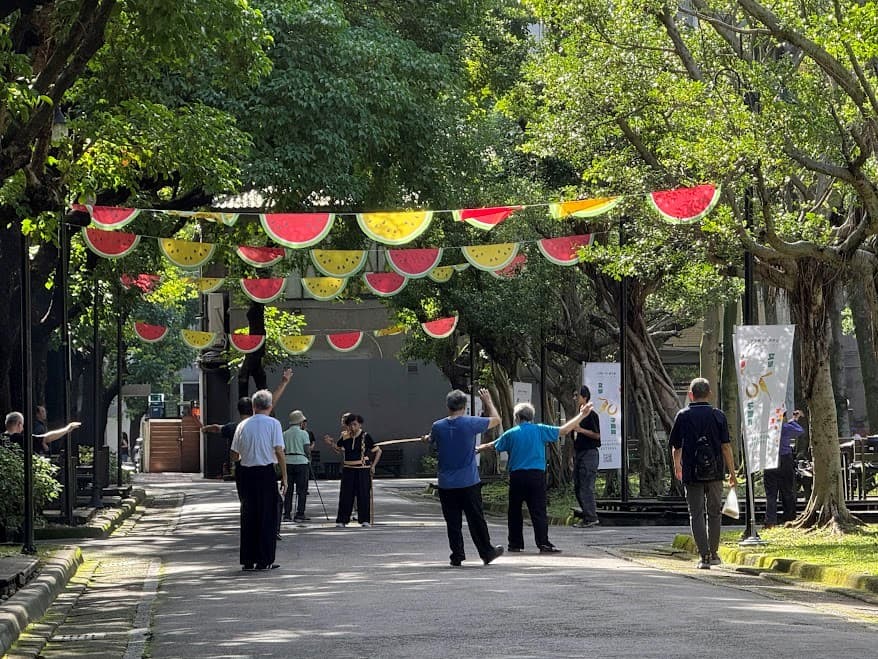
The public spaces and green areas are provided free of charge, and many people and groups can be seen exercising there every day.
11.2.5 Arts and heritage contribution
NTNU has long been committed to promoting arts education and cultural heritage, continuously fostering local arts development and community connections through diverse performance activities. The campus features performance spaces such as the Heritage Hall, Auditorium, Music Department Recital Hall, Oles Hall, and Zhiyin Theater. Through regular public performances such as music festivals and arts festivals, and irregular performances by the Music Department, the Graduate Institute of Ethnomusicology, and the Graduate Institute of Performing Arts, NTNU has made significant contributions to Taiwanese arts and the revitalization of cultural assets.
Since 2009, the “NTNU Music Festival” has been held annually from March to June, now in its 16th year. The festival encompasses symphony orchestras, solo performances, drama, dance, and choral music. In 2024, the festival will feature 32 public performances, becoming a vital event for promoting campus and local arts.
In addition, the NTNU Choir and Orchestra regularly and irregularly hold public, free performances in the local community, including New Year’s, winter, Christmas, and charity tours. During the semester, a lunchtime concert is held every Wednesday at noon in the Heritage Hall, inviting faculty, students, and community members to enjoy it freely.
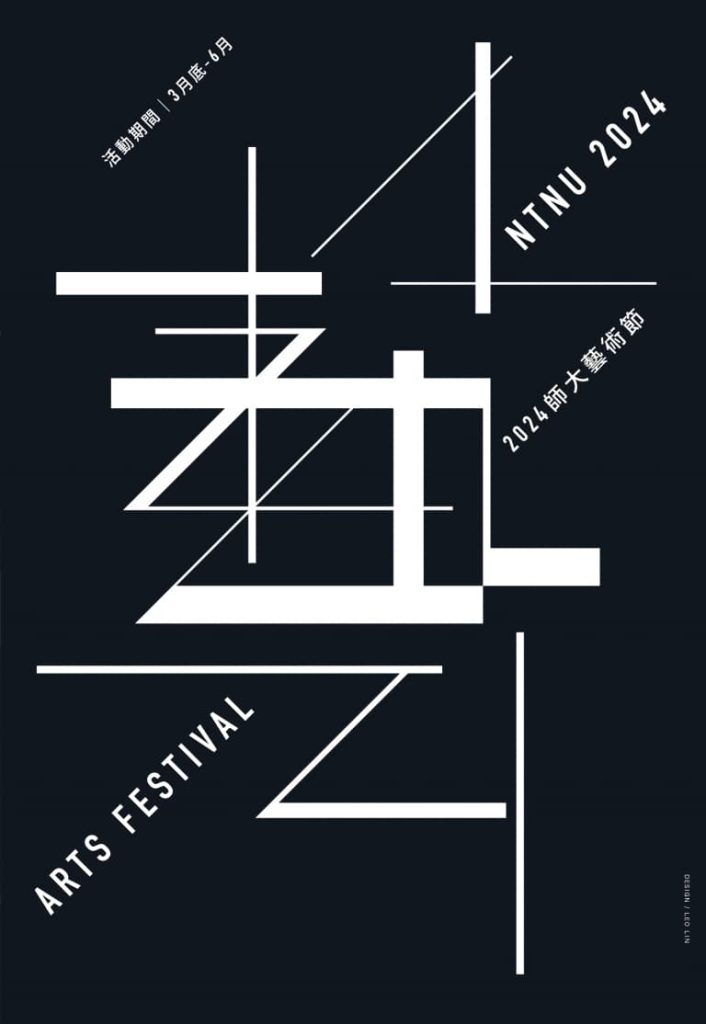
In addition, since 2019, the College of Arts has been holding the “NTNU Arts Festival” from March to June every month. It is jointly organized by the Department of Design, the Department of Fine Arts, and the Institute of Art History. The festival includes a cultural and creative market, creative exhibitions, workshops, lectures, and a raffle. In 2024, there will be 8 on-campus exchange exhibitions and arts and culture workshops, 29 student exhibitions, and 14 lectures by scholars and experts, for a total of 51 events.

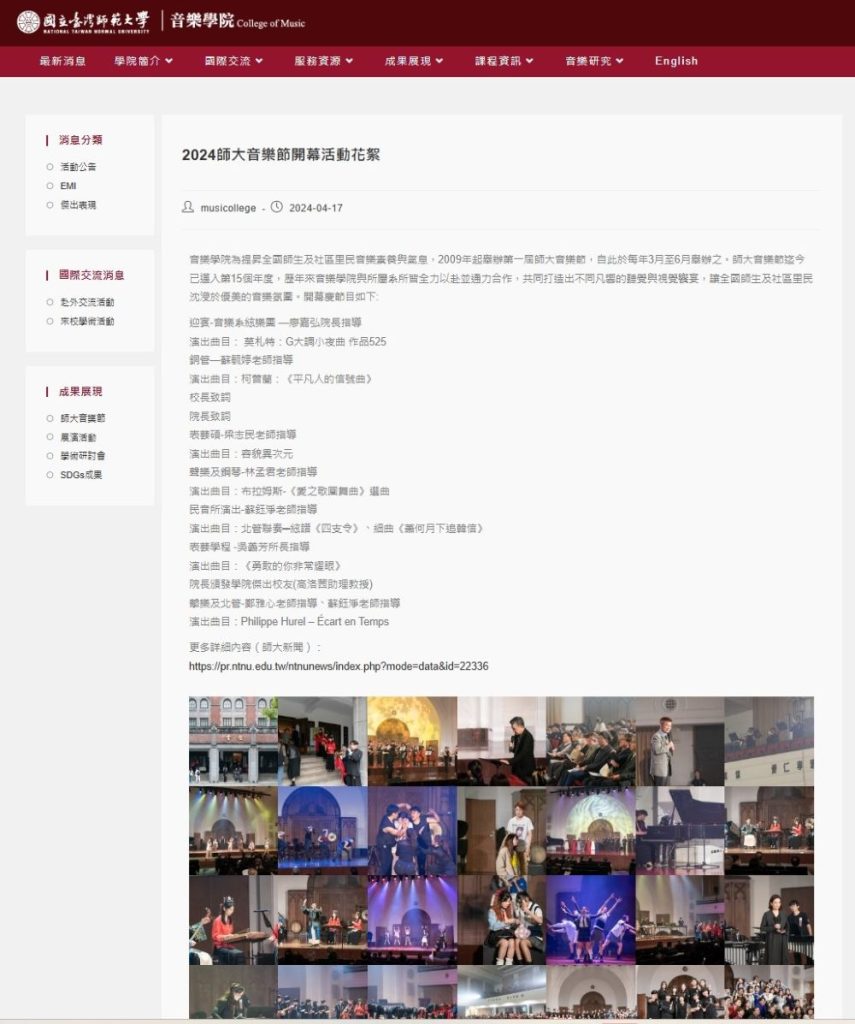
The opening ceremony of the “2024 NTNU Music Festival” featured a free public performance by students from the Department of Performing Arts.(https://www.musicollege.ntnu.edu.tw/index.php/category/uncategorized/music-festival/)
The Wenhui Music Concert is held every Wednesday at the Wenhui Hall in the Heritage Site. Faculty, students, staff, and community members are welcome to enjoy the performance free of charge. (https://pr.ntnu.edu.tw/ntnunews/index.php?mode=data&id=22481)
2024 NTNU Music Festival: 32 public performances, event schedule and lineup.
序號 | 日期 | 節目名稱 |
1 | 3/16(六) | 2024師大菁音協奏曲音樂會 |
2 | 3/18(一) | 2024 Fun 4小提琴演奏會 |
3 | 3/19(二) | 2024師大音樂節開幕慶 |
4 | 3/23(六) | 師大之夜 拍手傳情 |
5 | 3/24(日) | Suren Bagratuni 和師大絃樂團 |
6 | 3/30(六) | 《超脫時間、身份的侃侃之談》 |
7 | 3/31(日) | 《映象新聲・隨聲活樂》當代作品音樂會 |
8 | 4/1(一) | 復活節音樂會—NTNU雙語推動系列活動 |
9 | 4/10(三) | Victor Rosenbaum 鋼琴獨奏會 |
10 | 4/13(六) | 《大音希聲、大象無形》音樂會 |
11 | 4/19(五) | 研究生論文發表暨影音作品發表會 |
12 | 4/21(日) | 遇見經典音樂會 |
13 | 4/23(二) | 2024 音樂之夜 |
14 | 4/27(六) | Victor Rosenbaum x師大音樂系師生~室內樂音樂會 布拉姆斯之夜 |
15 | 5/3(五) | 原創音樂劇《 四季公寓》 |
16 | 5/3(五) | 師大音樂系2024春季巡迴公演 |
17 | 5/9(四) | 「蛻變與成長:2024學校實地音樂教學成果發表會」 |
18 | 5/9(四) | 「浮生半日弦」室內樂之夜 |
19 | 5/12(日) | 絃樂團公演 |
20 | 5/15(三) | 交響璀璨電子琴音樂會 |
21 | 5/16(四) | Canzone d’amor音樂會 |
22 | 5/17(五) | 桃李璀璨 歲月如歌—席慕德教授紀念音樂會 |
23 | 5/20(一) | 人聲武林—混聲合唱團音樂會 |
24 | 5/22(三) | 2024師大音樂系管樂室內樂音樂會 |
25 | 5/23(四) | 戲如人聲歌劇選粹音樂會 |
26 | 5/24(五) | 《2024臺師大女聲合唱團公演》 |
27 | 5/24(五) | 音樂田野調查成果學術研討會 |
28 | 5/24(五) | 2024表演藝術學程年度聯合製作《Boom!表藝聯合報》 |
29 | 5/26(日) | Liebeslieder—布拉姆斯《愛之歌》音樂會 |
30 | 5/29(三) | 絃管雅集音樂會 |
31 | 6/3(一) | 世界音樂系列:芬蘭傳統民謠 |
32 | 6/8(六) | 《布拉姆斯之夜》 音樂會 |
The 2024 festival website has released posters and program schedules, featuring a total of 51 performances.( https://arts.ntnu.edu.tw/index.php/artfes/
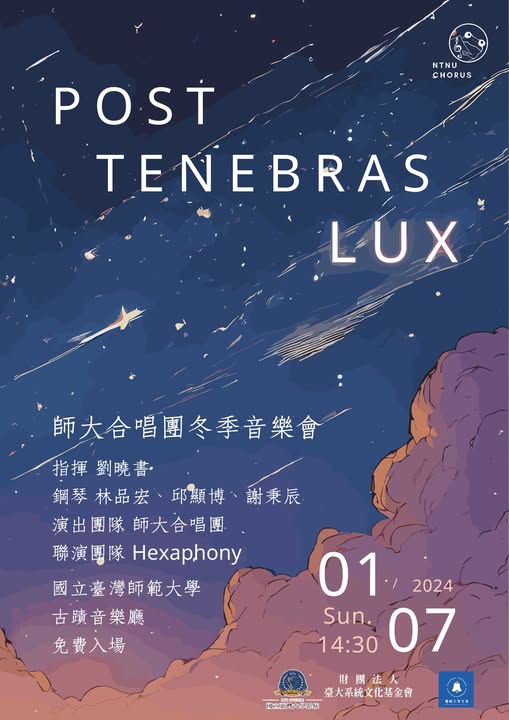
The NTNU Choir regularly holds free winter concert performances every year.
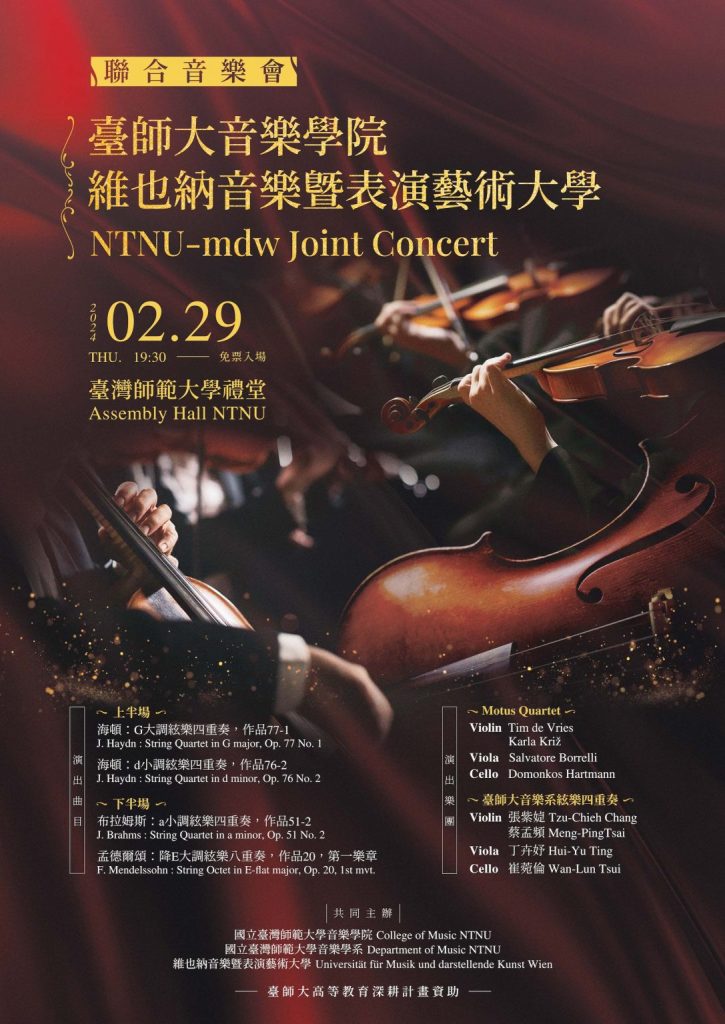
Free joint concert between NTNU Academy of Music and Vienna University of Music and Performing Arts on February 29, 2024
11.2.6 Record and preserve cultural heritage
Established in 2010, our university’s “Digital Archive Center for Music ” is Taiwan’s first dedicated center for recording and preserving intangible cultural heritage, including the preservation of precious musical documents related to local folklore, traditions, and languages. It has completed over 30 archiving projects, including 15 national-level digital archiving technology projects, preserving nearly 200,000 digital records from various countries, regions, and ethnic minorities, achieving remarkable results. We collaborate with institutions possessing valuable collections both domestically and internationally, such as the Taiwan Music Museum at the National Center for Traditional Arts, the Digital Culture Center at Academia Sinica, the American Folklife Center at the Library of Congress, and the Phonogrammarchiv. Our musical archives include printed documents, audio materials, and instrument collections. Project findings are presented annually at the annual meetings of international music associations such as the IAML (International Association of Music Libraries, Archives and Documentation Centres) and IASA (International Association of Sound and Audiovisual Archives).
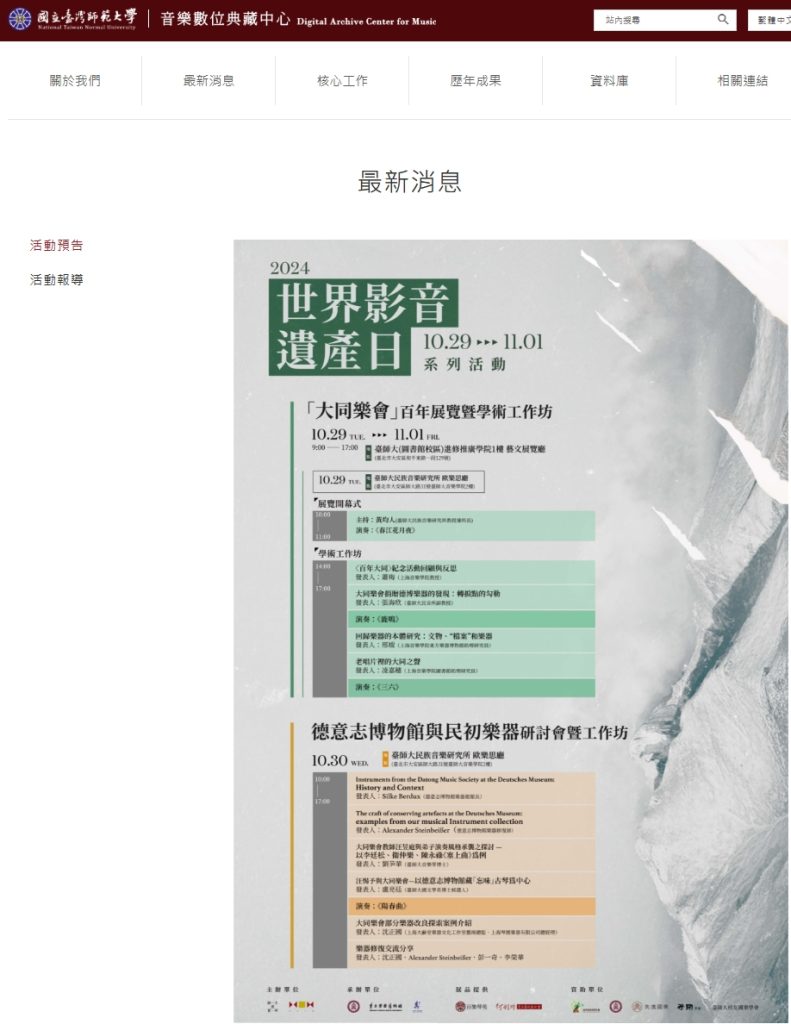
The World Audiovisual Heritage Day events will be held from October 29 to November 1, 2024, focusing on documenting and preserving artifacts, archives, and musical instruments. https://dacm.ntnu.edu.tw/web/news/news_in.jsp?np_no=NP1729499950080
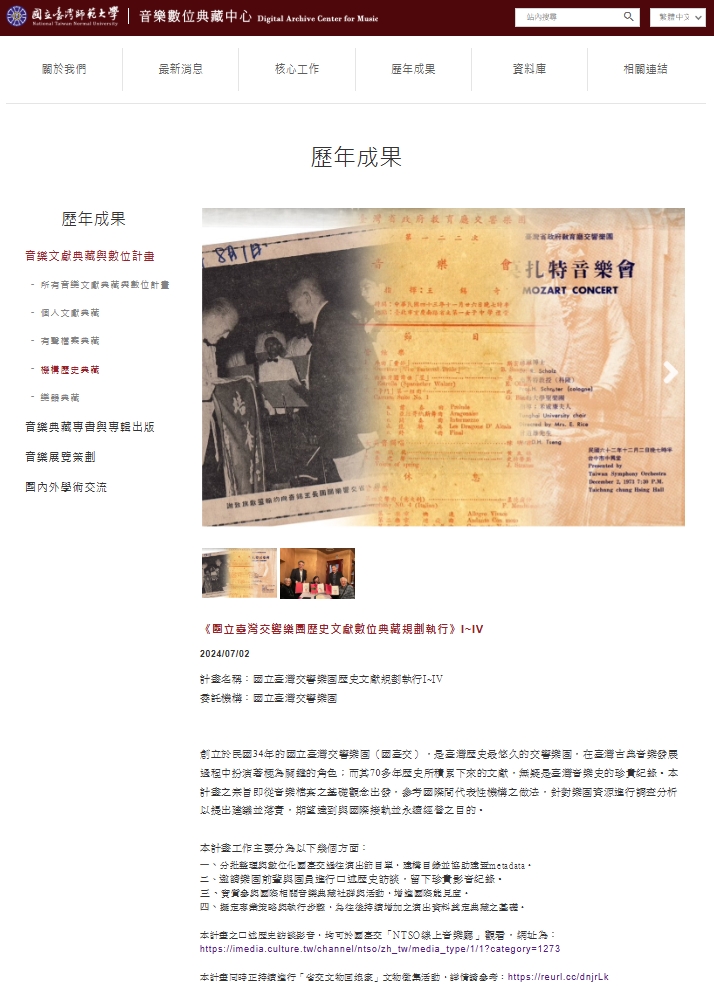
The results of the National Taiwan Symphony Orchestra’s Historical Documentation Project, including oral history interview videos, are available on the “NTSO Online Concert Hall” at: https://imedia.culture.tw/channel/ntso/zh_tw/media_type/1/1?category=1273
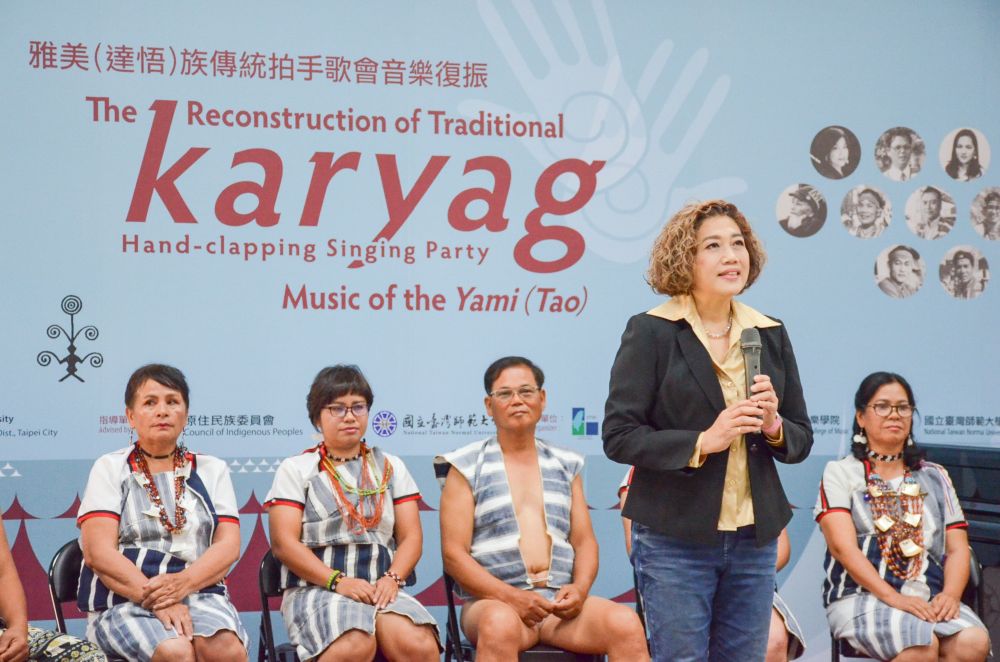
The Institute of Ethnomusicology at NTNU has long focused on the fields of indigenous music, musical images, and music documentaries. Through recordings and videos of traditional music and songs, as well as the writing of books, it has undertaken important initiatives to preserve indigenous music, language, and culture, making significant contributions to the preservation of intangible cultural heritage. For example, the Yami (Tao) Traditional Music Revitalization Project (2022-2024) actively revives traditional indigenous tunes. The karyag (clapping song festival) was once a popular evening activity for the Tao people, where young men and women sang and chatted in their makarang (high houses). With societal changes, the karyag faces the risk of disappearing in the 21st century, along with the karyag songs. NTNU and the Tao people have collaborated for two years to revive the karyag. To prevent the Yami (Tao) people of Orchid Island from losing their karyag, they have assisted 13 Tao individuals in becoming seeds for the transmission of these ancient songs, and a concert showcasing the results has been held. On October 27, 2024, “World Day for Audiovisual Heritage,” we will collaborate with the Deutsches Museum in Germany to host an exchange activity on the restoration of our treasured artifacts and musical instruments.
The “Yamei (Tao) Tribal Traditional Music Clapping Song Concert” (karyag) will be held at National Taiwan Normal University in March 2024, including a press conference and a concert showcasing the results of the revitalization of ancient tunes.
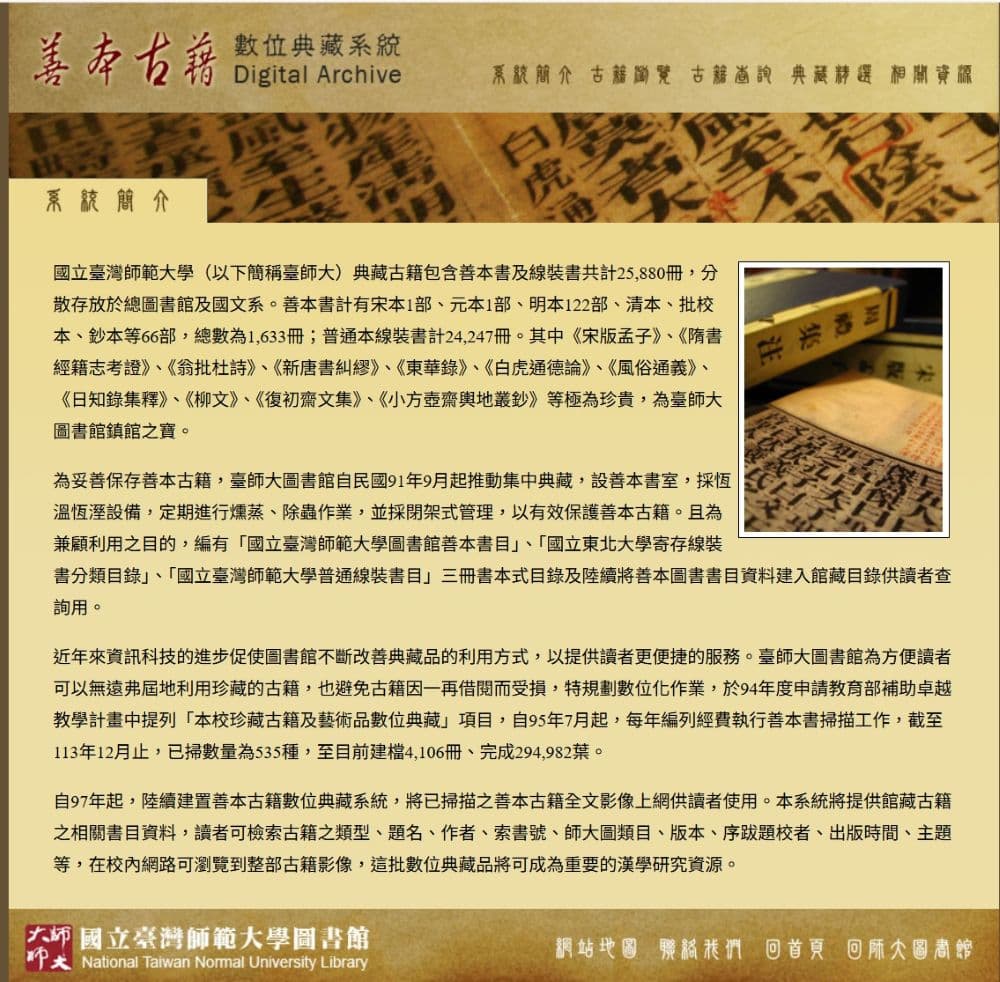
NTNU has established specialized collections and research centers to document and preserve intangible cultural heritage through projects. Its collection of rare books comprises 25,880 volumes, including rare and thread-bound books. To ensure the proper preservation of these rare books, the library has been promoting centralized collection since 2002, establishing a rare book room and allocating funds annually for scanning. As of December 2024, 535 titles have been scanned, with 4,106 volumes currently archived and 294,982 pages completed. The “Malaysian Chinese Literature Database” (185,171 entries), the “Digital Archive of Liang Shiqiu’s Documents” (approximately 1,353 entries), and the “Gao Xingjian Database” (approximately 2,892 entries) are all accessible through the library’s special collections website. In addition, the “Special Collection of Asian Studies” focuses on Asian culture, art, and ethnicity, covering art, literature, customs and traditions, rituals, and opera. It also includes dictionaries of some Asian countries or minority languages, which are of great help to the recording and research of culture and the sociology of art.
The library has implemented “Digital Archives of Rare Ancient Books and Works of Art” and “Digital Archives System of Rare Ancient Books,” and these digital collections have become important and valuable resources for Sinological research.
Established in 2011, “The Research Center for Conservation of Cultural Relicst” is dedicated to the health examination, diagnosis, preservation, and maintenance of damaged paintings and various cultural relics. It is the first national university in Taiwan to establish a restoration center. The center examines and restores over 4,000 items annually for its collection and is the preferred choice for cultural relic restoration commissioned by major museums and collectors in Taiwan. It has successfully rescued valuable Picasso and Renoir paintings worth hundreds of millions of NT dollars from collectors’ collections, important unearthed artifacts such as the Juyan Han bamboo slips, and important historical manuscripts and national treasures from government agencies. The 2024 preservation and restoration project’s achievements include the restoration of the city government’s cultural relics, the works of Japanese artist Fumio Yamazaki, and the restoration of the
11.4.1 Sustainable practices targets
NTNU encourages faculty and students to prioritize low-carbon modes of transportation, such as walking, public transportation, cycling, and electric vehicles. The University also collaborates with municipal authorities and relevant companies to establish concrete actions and quantifiable goals across various aspects of sustainable mobility, including walking, cycling, public transportation, and other low-carbon commuting options.The sustainable commuting goals include the following:
1. Walking Promotion
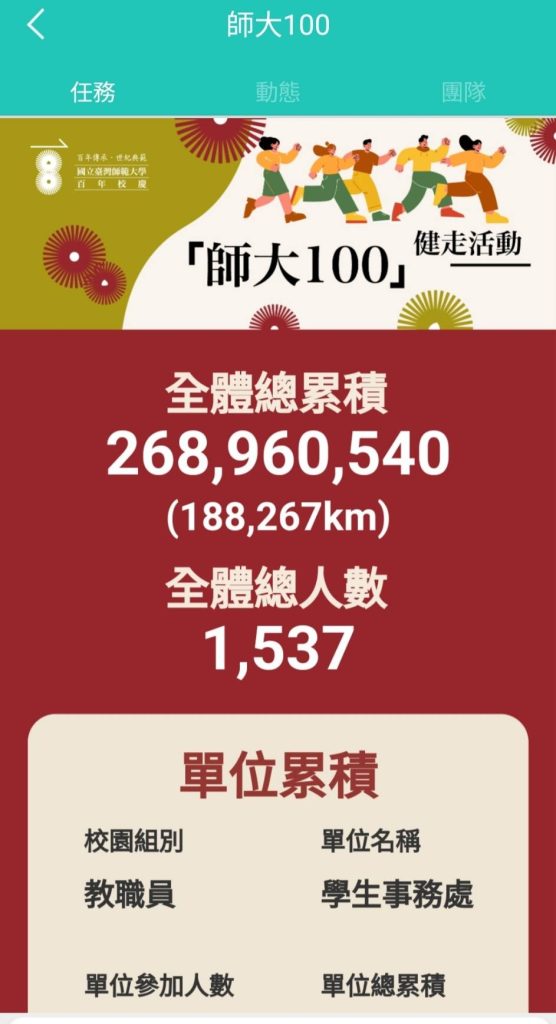
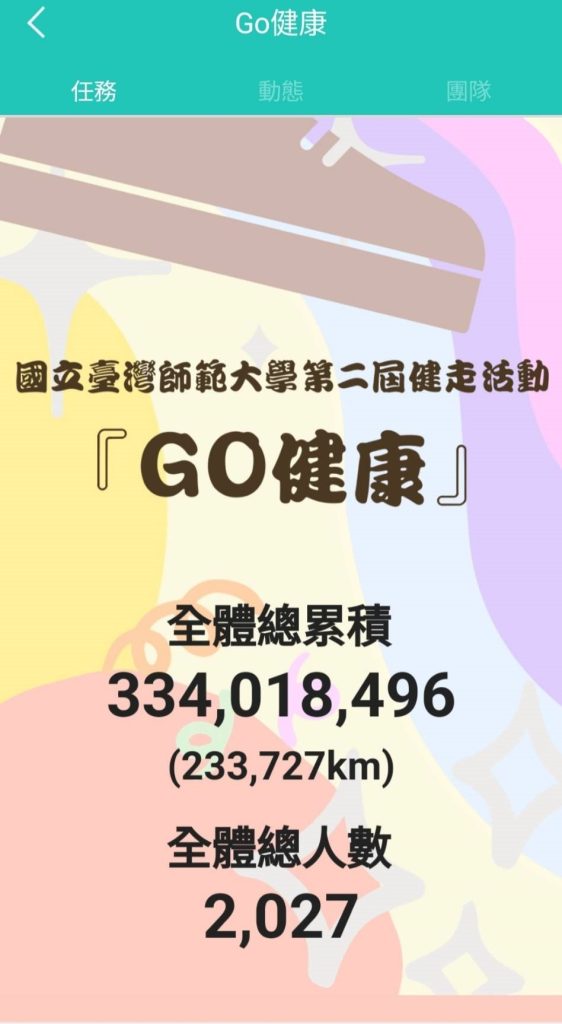
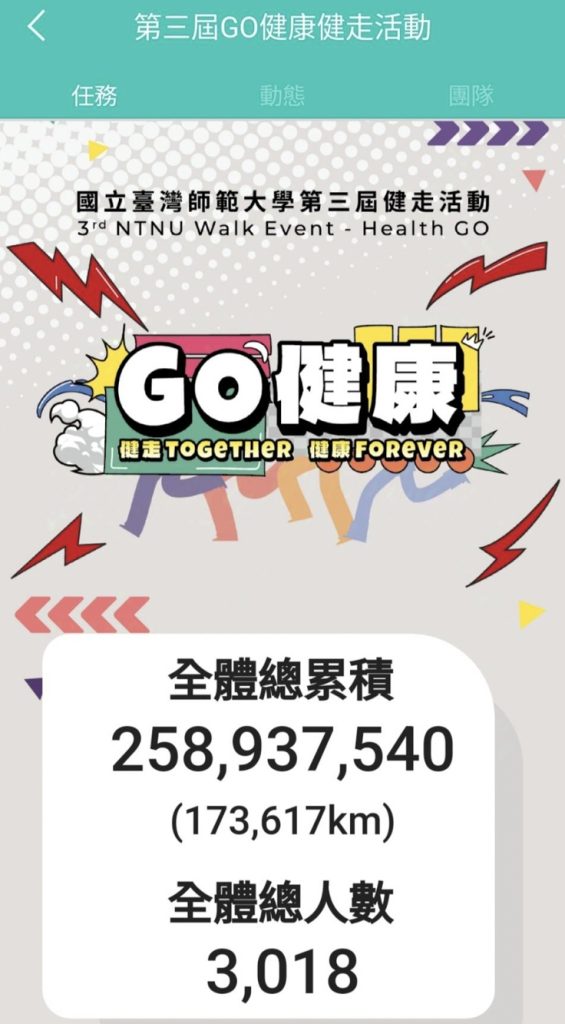
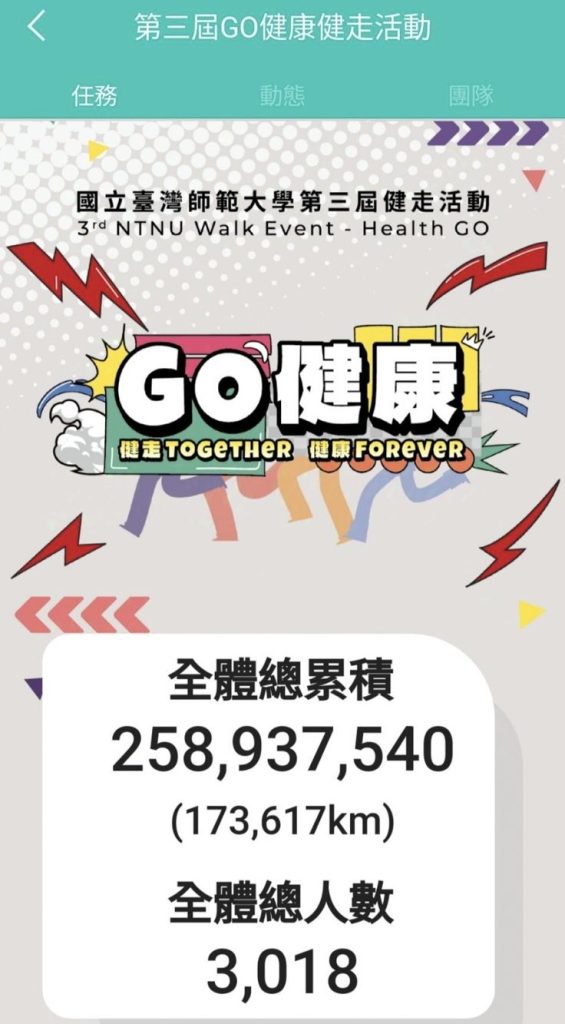
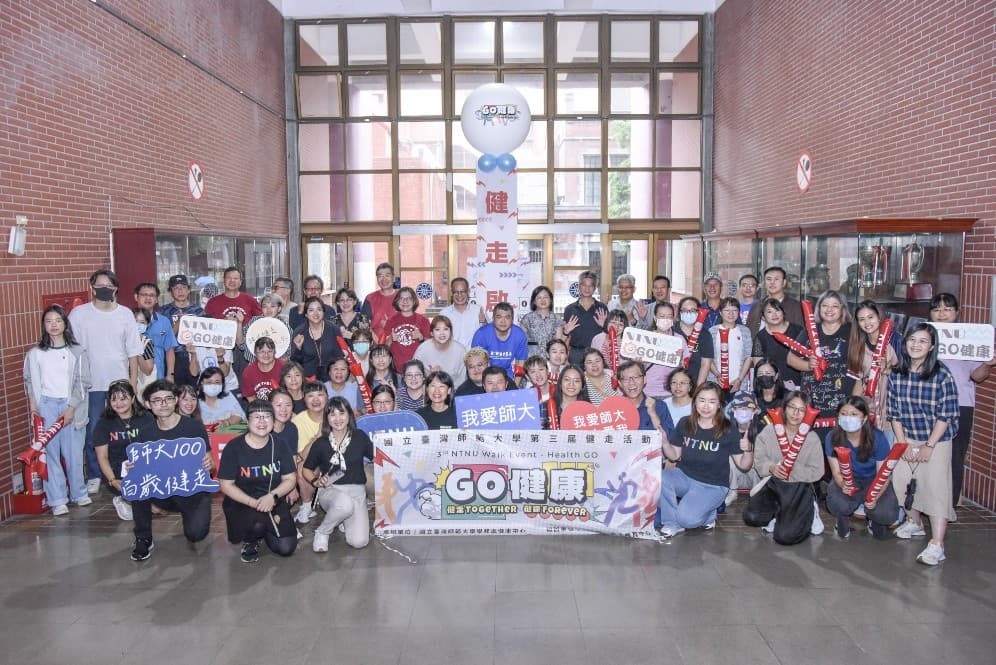
Since 2022, NTNU has implemented the “Walking for the Whole School” program. In 2022, 1,537 faculty, staff, and students participated in the GO Healthy Walking activity; in 2023 , participation increased to 2,027; and in 2024, the third year of the event, participation reached 3,018. The initiative continues in 2025, advancing the goals of promoting healthy, safe, and sustainable transportation.
GO Health Walk Event Releases News Results
GO Health Walk Event Public News Report
2022:https://pr.ntnu.edu.tw/news/index.php?mode=data&id=21252&keywords=%E5%81%A5%E8%B5%B0
2023:https://pr.ntnu.edu.tw/news/index.php?mode=data&id=22140&keywords=%E5%81%A5%E8%B5%B0
2024:https://pr.ntnu.edu.tw/news/index.php?mode=data&id=23113&keywords=%E5%81%A5%E8%B5%B0
2025:https://pr.ntnu.edu.tw/news/index.php?mode=data&id=23877&keywords=%E5%81%A5%E8%B5%B0
The 2025 “GO Healthy Walk” poster marks the program’s fourth year and emphasizes its goal of promoting health, safety, and sustainability.
2. Expand Bicycle Infrastructure and Promote Carbon Reduction Initiatives
Expand Bicycle Stations and Parking Facilities :In 2022, there were 240 bicycle stations, with a target to increase the number by 40% over three years (by 2024). Future plans include the continuous addition of YouBike stations across campus.
Bicycle Usage Promotion : In collaboration with YouBike, NTNU has developed a dedicated bicycle carbon reduction calculator app to enhance bicycle usage. Additional YouBike rental stations will be established around campus, and the number of members joining the app-based system is expected to increase by 20%.
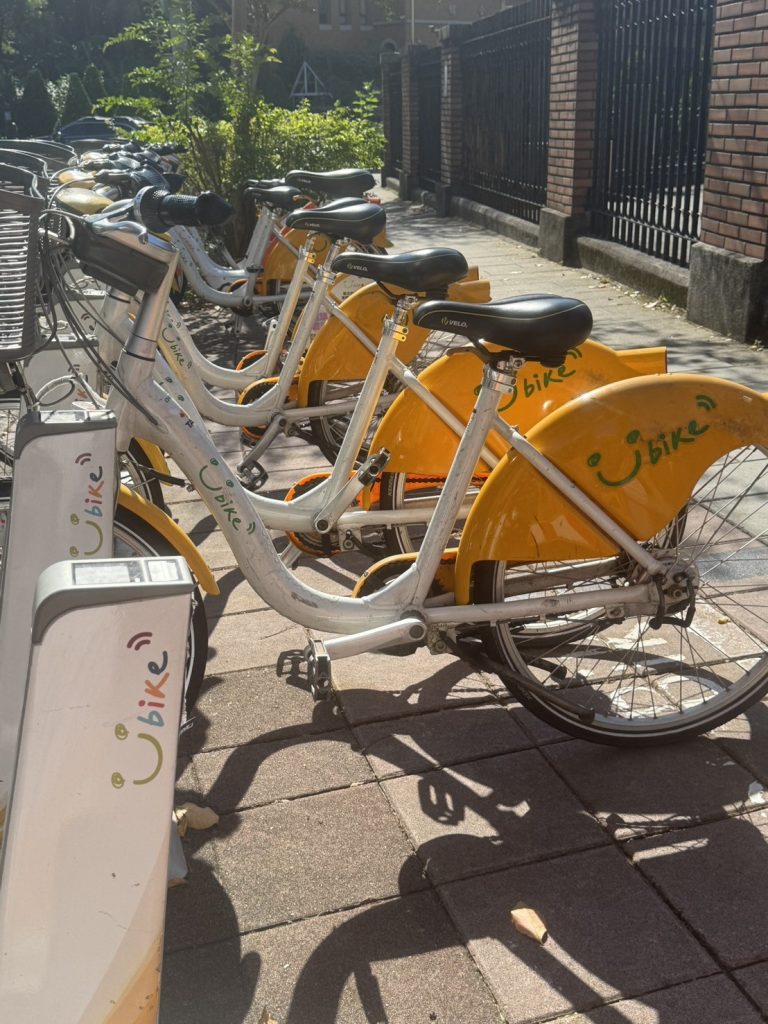
The school campus provides convenient bicycles as part of its goal of sustainable commuting.
3. Convenient Public Transportation
The University encourages the use of public transportation and provides information on shuttle services. Free shuttles operate between campuses and among the three universities in the National Taiwan University System Alliance, offering safe and convenient transportation. The goal is to increase service frequency by 50% over the next three years.
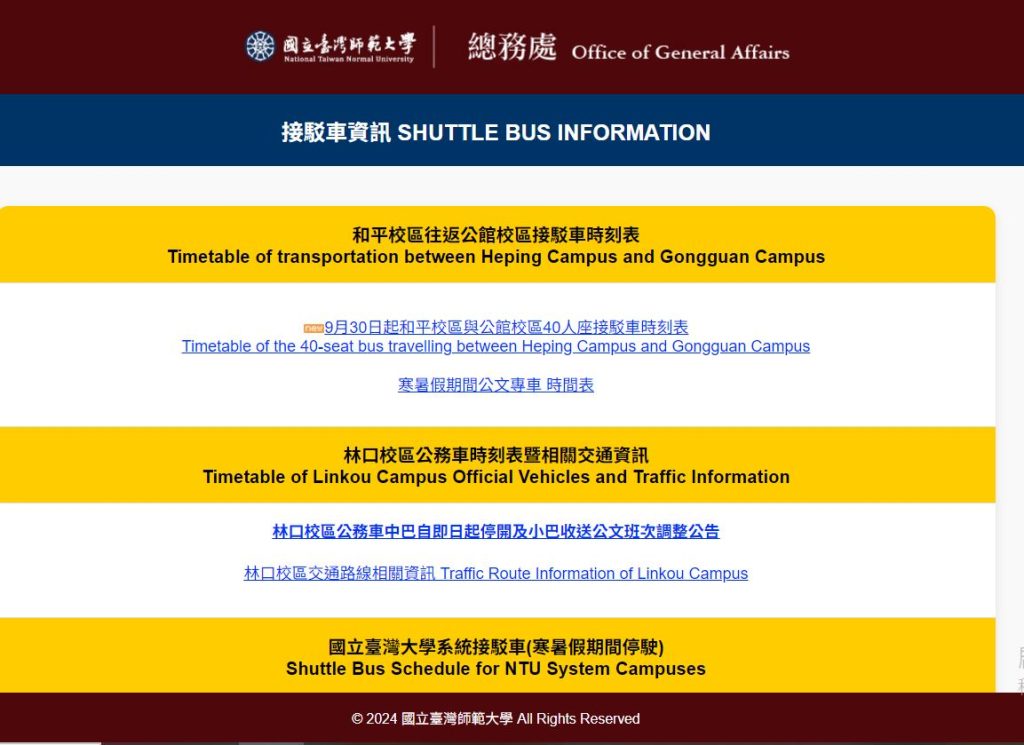
Shuttle Bus Information Website: Provides information on free shuttle bus services connecting NTNU campuses and the three universities within the National Taiwan University Alliance to support sustainable and low-carbon mobility.
4. Low-Carbon and Electric Transportation
All newly procured campus vehicles, including cars and motorcycles, are required to be 100% low-carbon electric models.
5. Battery swapping stations
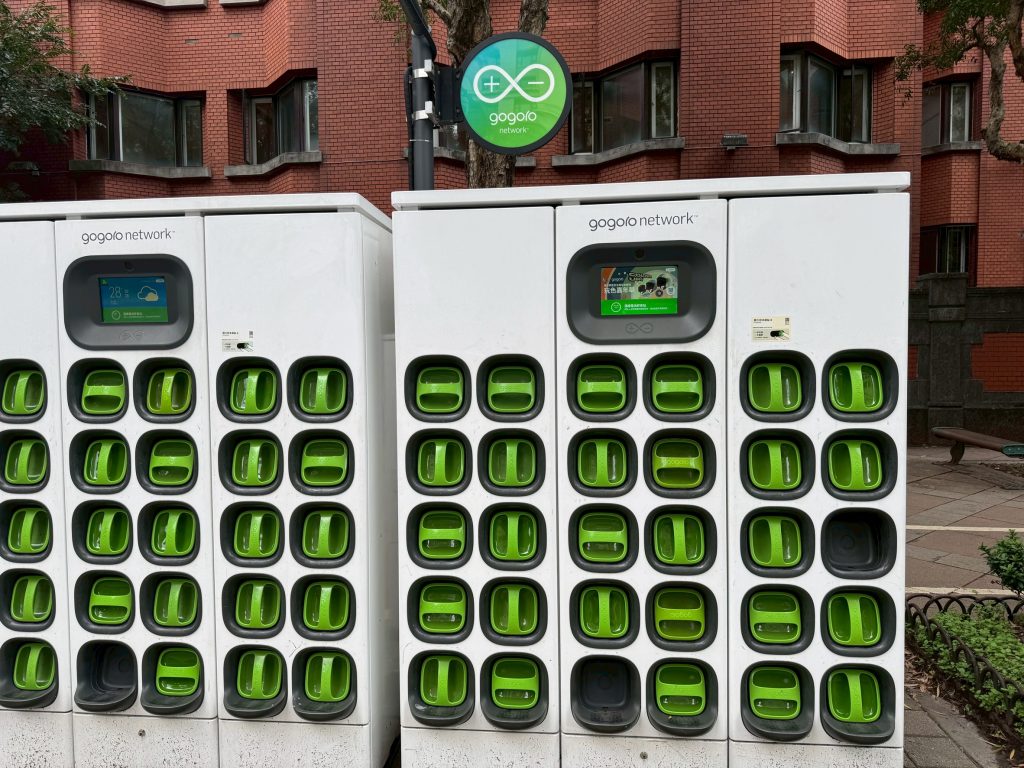
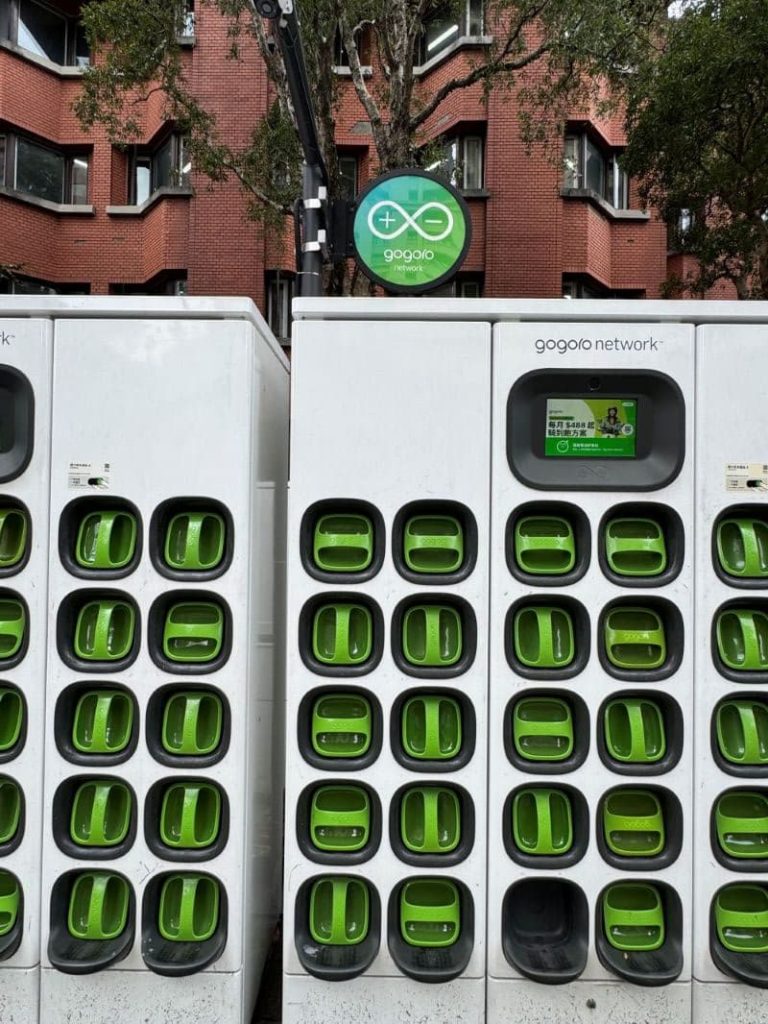
To facilitate the use of electric scooters, Gogoro battery-swapping stations have been installed on and around the campus. One station was established in 2023, and the University plans to add one new station each year, targeting a 300% increase over three years.
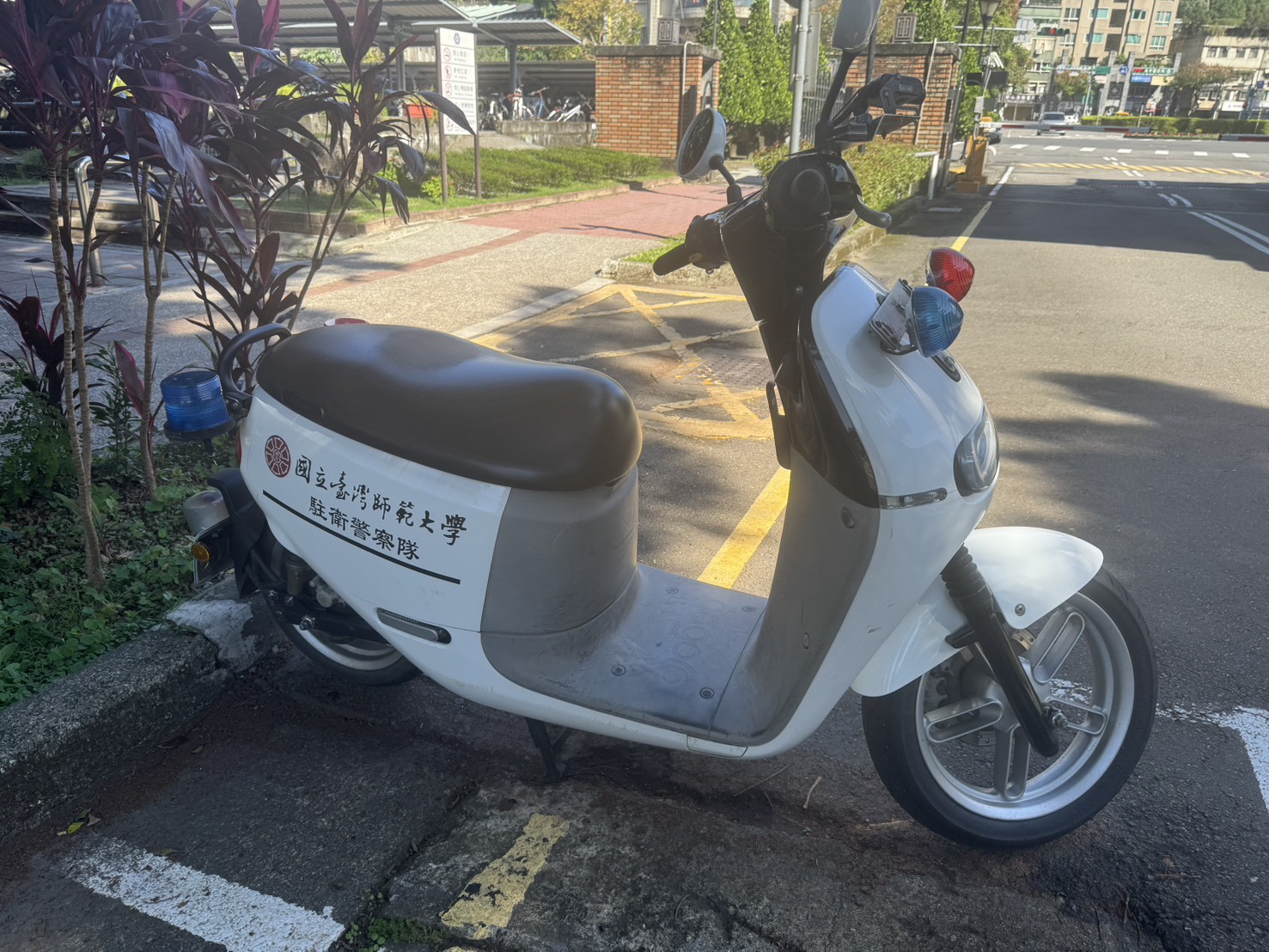
All patrol vehicles on campus are low-carbon emission vehicles.
Battery swapping stations
6. University Commuting Pathway Program
The University has developed three safe bicycle lanes and, since 2022, has implemented the “University Pathways: Interdisciplinary Inquiry and Integrated Development Program.” This initiative engages faculty and students in examining commuting-route challenges and identifying sustainable development solutions. Through field observations, user-experience studies, and reviews of urban landscapes, traffic regulations, and mobility culture, the program encourages students to explore green mobility options that align with the principles of “low-carbon, safety, and convenience.”
On May 31, 2024, the University hosted the “University Pathways” Faculty–Student Forum, focusing on bicycle commuting and sustainable development. By integrating these themes into coursework, the University strengthens students’ understanding of sustainable transportation and advances the goal of promoting green mobility that is low-carbon, safe, and convenient.
7. Construction of New Dormitories to Reduce Commuting Demand
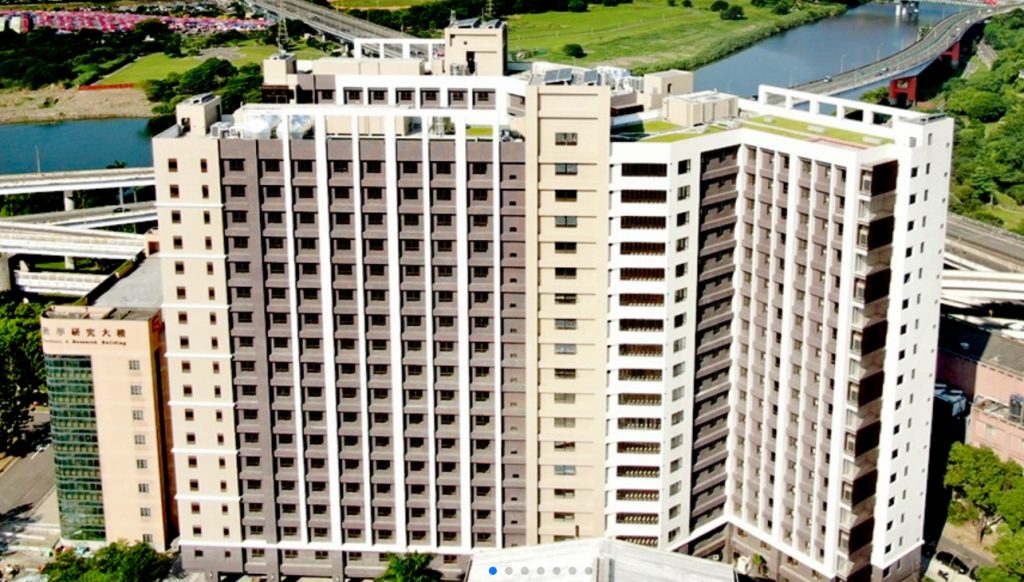
In 2022, the University completed the Second Student Dormitory, providing 3000 additional beds, and is currently constructing the Mandarin Learning Dormitory. The expansion of on-campus housing encourages students to reside on campus, thereby reducing long-distance commuting and lowering transportation-related energy consumption. Since 2022, the University has set a three-year target to reduce the number of commuters by 50%.
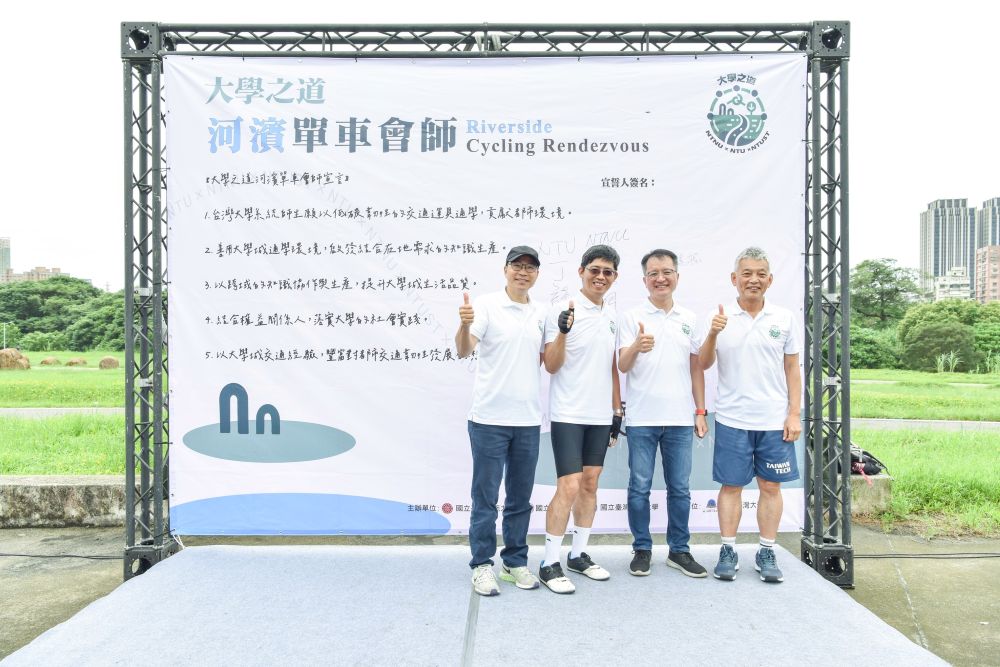
The “Interdisciplinary Inquiry and Integrated Development” project of “The Way of the University” involves 250 faculty and students from different departments, aiming to achieve green transportation goals that are “low-carbon, safe, and convenient”.
The second student dormitory has 3,000 beds, reducing commuting needs.
11.4.2 Promote sustainable commuting
To promote more sustainable commuting methods, the school has taken concrete actions such as running an annual walking program, providing free inter-campus shuttle buses, low-carbon transportation and charging facilities on campus, encouraging cycling, and building safe cycling paths.
1. Promoting walking and healthy commuting:
Since 2022, the university has held the “Go Healthy” walking event annually. In 2024, over 3,000 people participated, bringing the cumulative participation to 11,000, covering a distance of over 170,000 kilometers, reducing carbon dioxide emissions from public transportation by approximately 37.57 tons. This initiative extends from promoting sports on campus to the surrounding community and alumni, creating a “Campus-wide Walking” campaign.
The “GO Health” walking program is a concrete measure to promote sustainable commuting. In the third year of the program in 2024, a total of 3,018 people participated, accumulating a total distance of over 170,000 kilo
In 2024, the “GO Health” walking event will expand to include seniors at community centers, fulfilling the university’s social responsibility.
2. Provide sustainable commuting options for the campus:
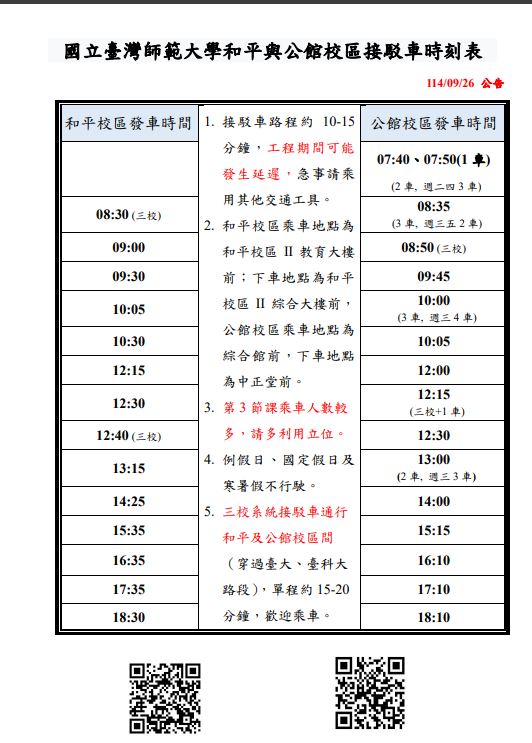
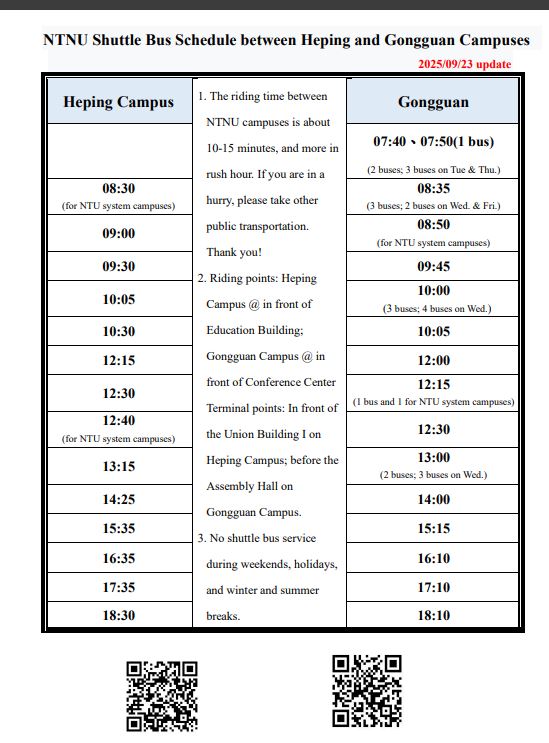
The Heping Campus and Gongguan Campus are approximately 10-15 minutes apart by car. To reduce carbon emissions and traffic pollution caused by students traveling to and from classes and accommodations, the university provides free, safe, and convenient shuttle buses between campuses, including shuttle buses between the Heping and Gongguan campuses, as well as free shuttle buses for students traveling across campuses within the three-school alliance. The number of services is continuously increasing, and currently, the number of daily shuttle buses has been increased to 30, with a capacity of at least 1,200 passengers.
Real-time information from a shuttle bus information website promotes sustainable commuting.
To promote sustainable commuting transportation between campuses, a detailed timetable has been announced.
3. Low-carbon transportation vehicles and vehicle charging equipment on campus:
(1) Purchase of Low-Carbon Transportation: Our school has completed the green procurement of all transportation vehicles, using 100% low-carbon electric vehicles.
(2) Electric Scooter Battery Swapping Stations: In cooperation with manufacturers, Gogoro electric scooter battery swapping stations have been installed on campus to facilitate commuting for faculty and students using low-carbon electric transportation. The number of battery swapping stations is continuously increasing, and currently there are three.
A low-carbon electric locomotive battery swapping station is set up on campus.
4. Increase the number of parking spaces for electric vehicle charging:
Twelve dedicated EV charging spaces were established by 2024, with a subsequent target to increase this capacity by 40%.
5. Encouraging Bicycle Use to Promote Sustainable Carbon-Reducing Commuting
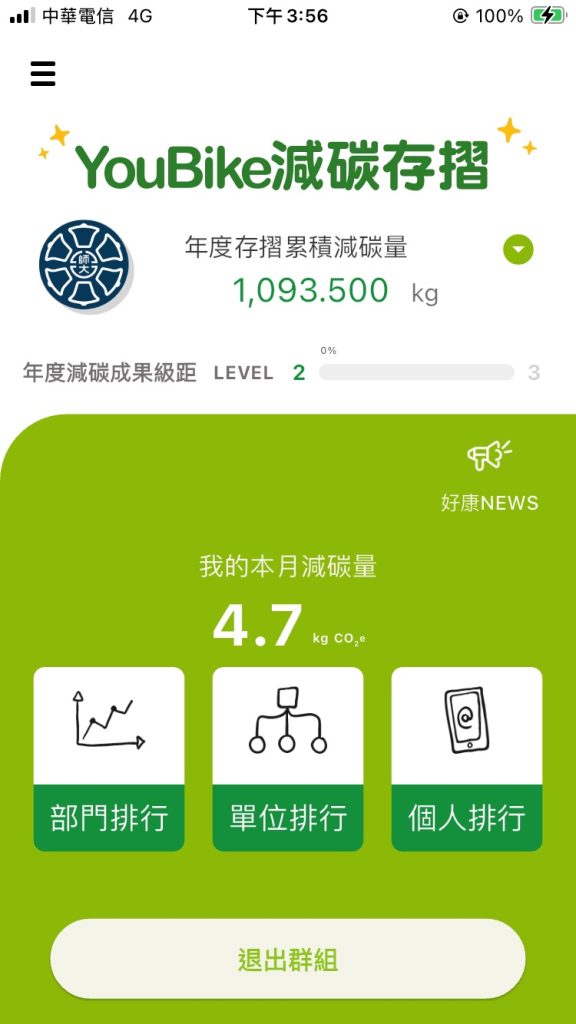
In collaboration with the private bicycle company YouBike, a dedicated YOUBIKE carbon reduction savings app system has been established for National Taiwan Normal University. This system encourages participation in carbon-reducing activities using bicycles as a healthy, safe, and sustainable mode of transportation, and includes incentives for participation. The app not only tracks individual bicycle usage and carbon reduction but also provides data on the overall carbon reduction of the university, alumni, and retired staff.
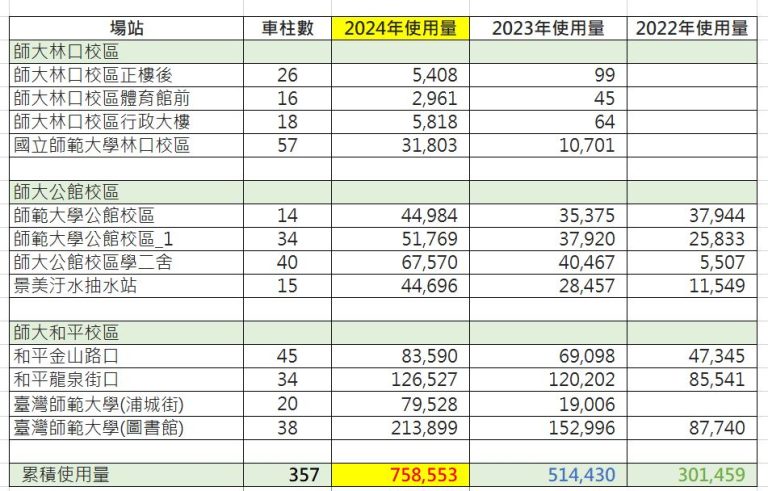
The number of bicycle stations for sustainable commuting increased significantly over the past three years, from 240 in 2022 to 357 in 2024, exceeding the target by 30% to 48.8%. The number of uses also increased dramatically by 152%, from 301,459 in 2022 to 514,430 in 2023 and 758,553 in 2024.
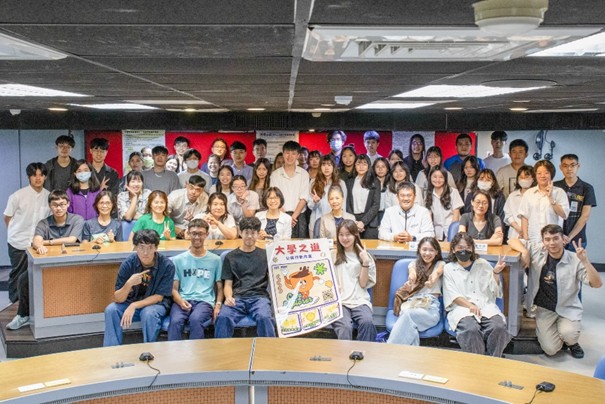
On May 31, 2024, a forum for faculty and students entitled “The Way of the University” will be held, focusing on the issue of bicycle transportation. The forum aims to encourage faculty and students who commute by bicycle to their studies to ride on a low-carbon, safe, and convenient “way” to the university. This will not only symbolize the promotion of a resilient urban environment but also represent the university’s social practice and responsibility. The goal is to integrate the three universities into the community, connecting them with the community, and building a mutually beneficial university town living circle for university faculty, students, and the community.
The YOUBIKE carbon reduction savings app system, exclusively organized by NTNU, displays the total carbon reduction amount for individuals and groups.
Statistics on bicycle transportation hubs and usage for sustainable commuting, showing significant growth from 2022 to 2024.
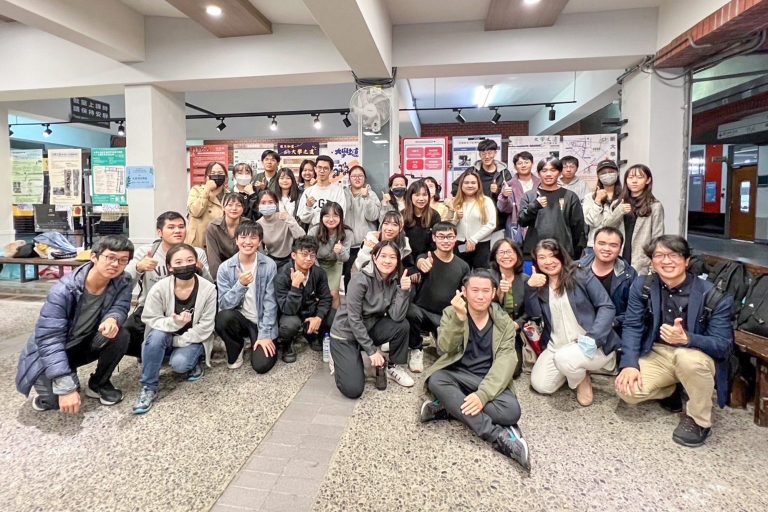
On December 8, 2024, we will hold a student end-of-term public exhibition and workshop on “Interdisciplinary Exploration and Integrated Development of The Way of the University“, which will raise questions and practical solutions for the interdisciplinary learning path from a humanistic perspective.
6. Increase the number of dormitories, reduce the number of commuters, and lower commuting demand:
In recent years, our school has successively carried out dormitory space renovation and reconstruction projects. Following the opening of the second student dormitory in 2022, which added 3,000 beds, there are now more than 5,800 beds to meet the accommodation needs of students. In 2023, the International Student Dormitory project broke ground and is expected to be completed in 2027, which will provide about 300 more beds in the future. By increasing the accommodation ratio, it is expected to reduce the number of commuters by 50% in 3 years, which will significantly reduce student commuting.
11.4.3 Allow remote working
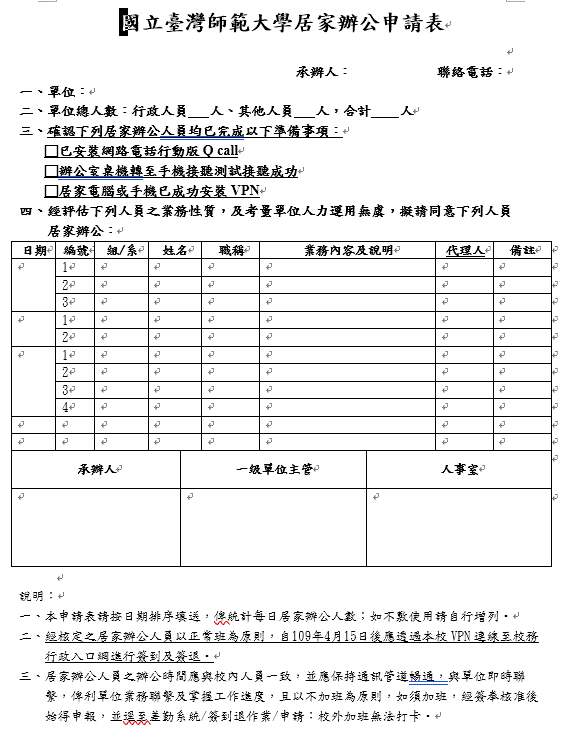
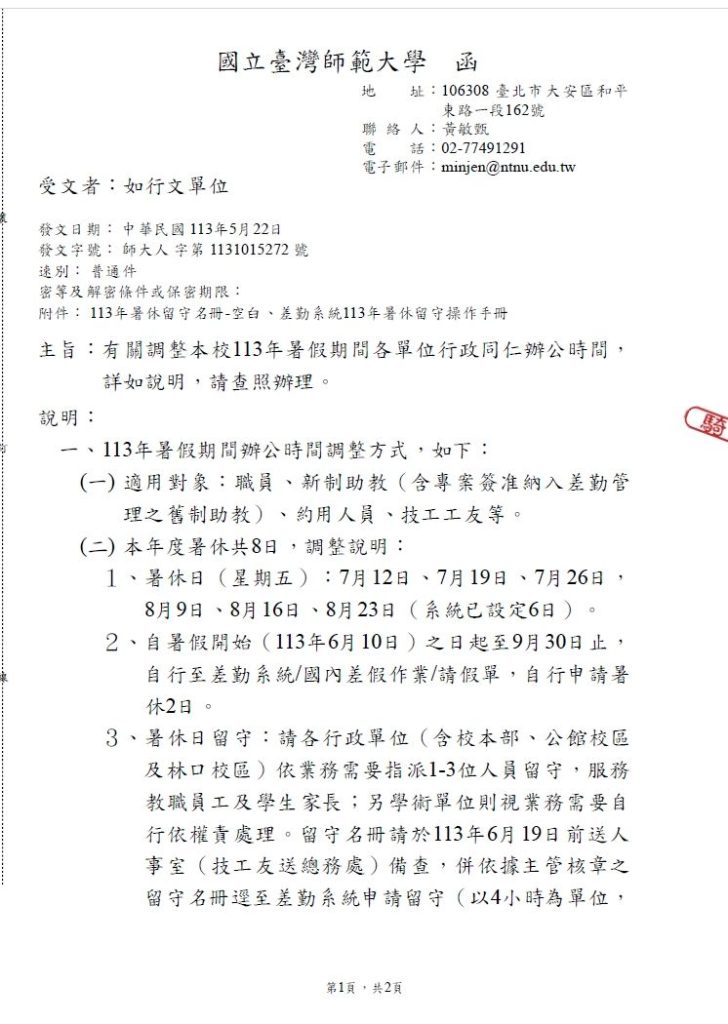
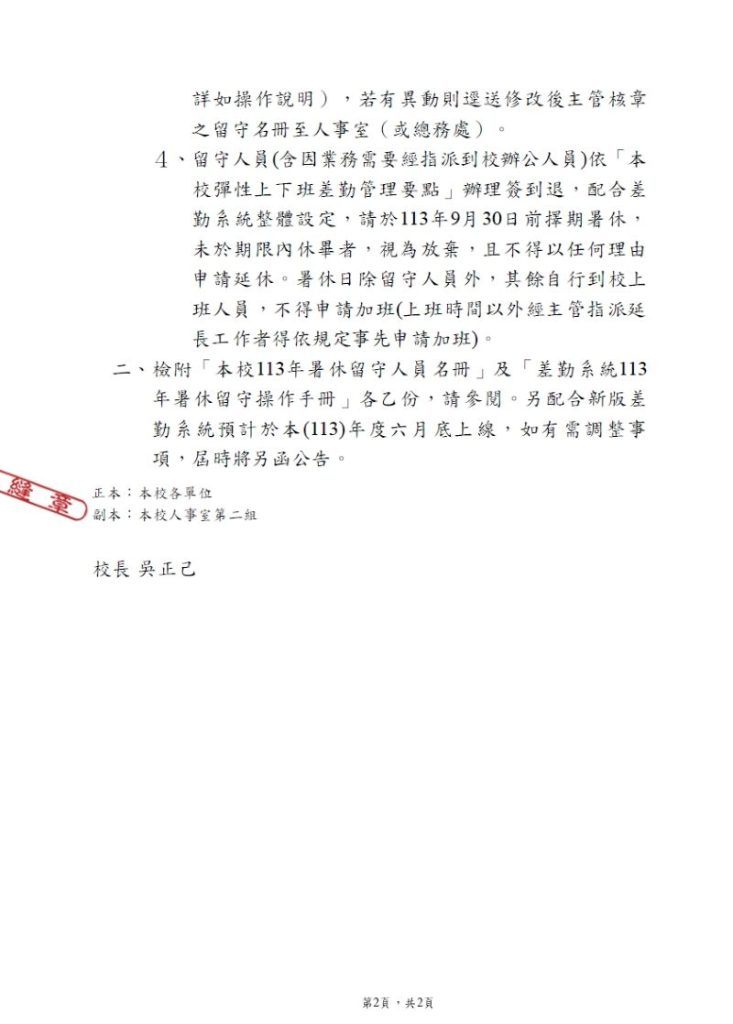
NTNU has established “Principles for Working from Home for Some Staff” and a work-from-home application form, allowing staff to work remotely and reduce commuting. Employees can securely log in to the university’s administrative portal via the university’s VPN to handle work remotely. In addition, a concentrated work schedule is implemented during winter and summer breaks to adjust the number of working days and reduce commuting days.
To support remote work and reduce carbon emissions from commuting, the university has implemented the following measures:
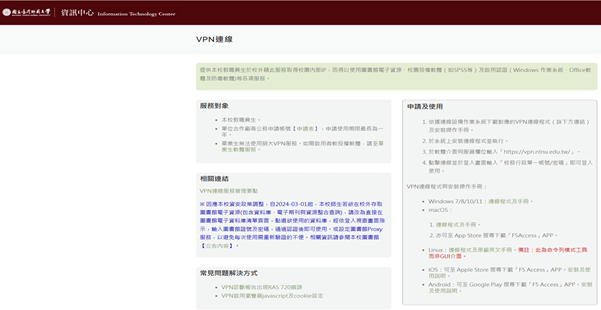
- VPN Remote Connection Service: Staff can securely connect to the university’s administrative portal via VPN to handle official documents and business in real time while working remotely.
- Concentrated Work Schedule: Concentrated work schedules are implemented during winter and summer breaks to adjust the number of working days and reduce commuting days.
- Communication Support System: A free GPHONE system is provided, allowing staff to transfer calls from on-campus extensions to their personal mobile phones to maintain remote business communication.
- Video Conferencing Tools: A free WEBEX video conferencing system is provided to facilitate real-time remote communication.
- Mobile Administrative Services: The NTNU APP integrates attendance, official documents, human resources, online services, and library information to facilitate remote and mobile work.
VPN connections enable remote work from home.
Employee remote work application.
A public announcement was made regarding adjustments to employee workdays to reduce employee commuting.
11.4.4 Affordable housing for employees
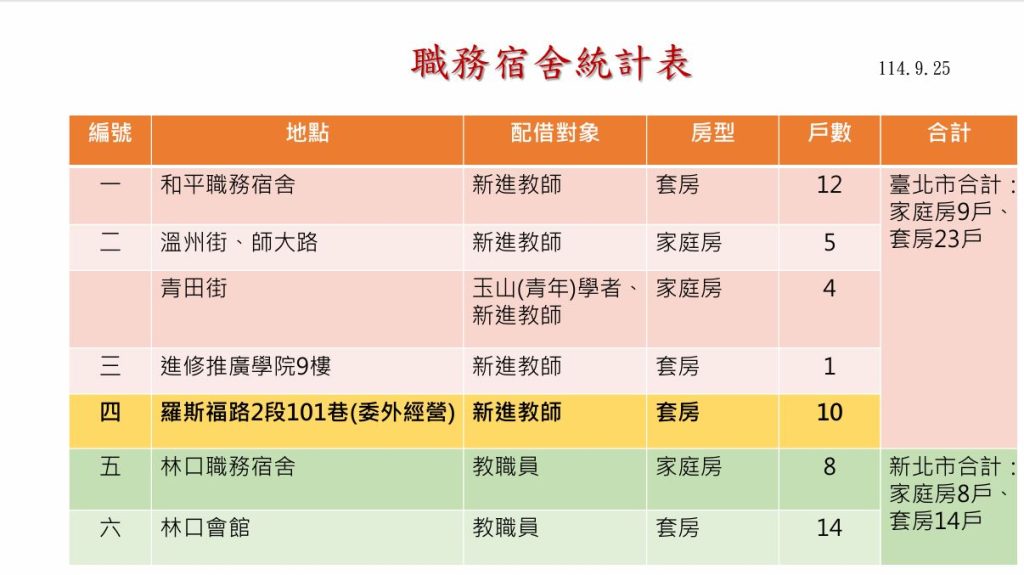
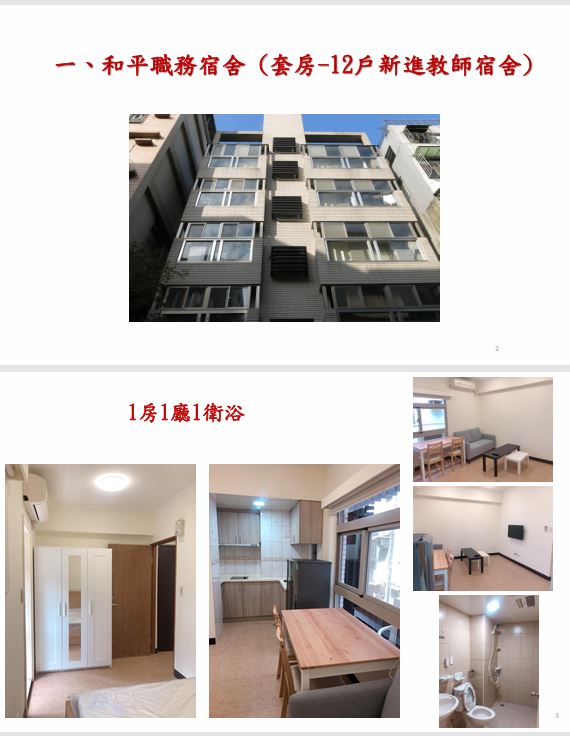
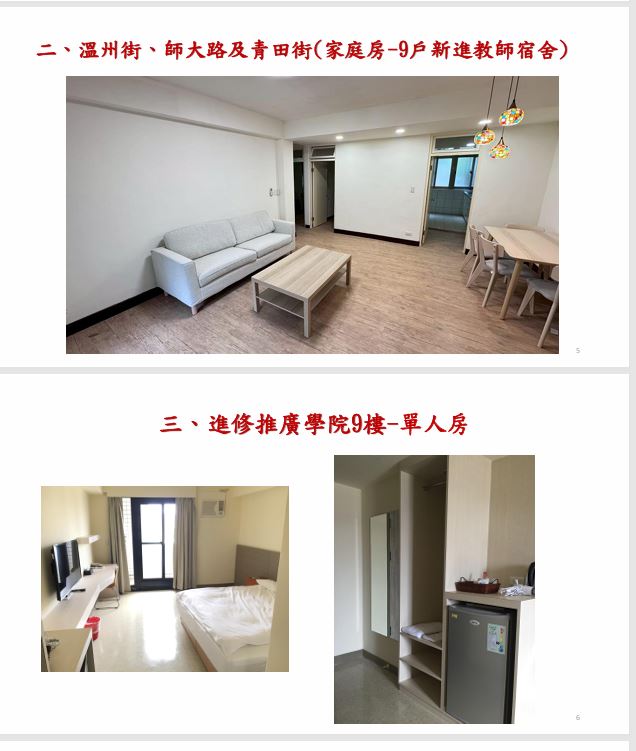
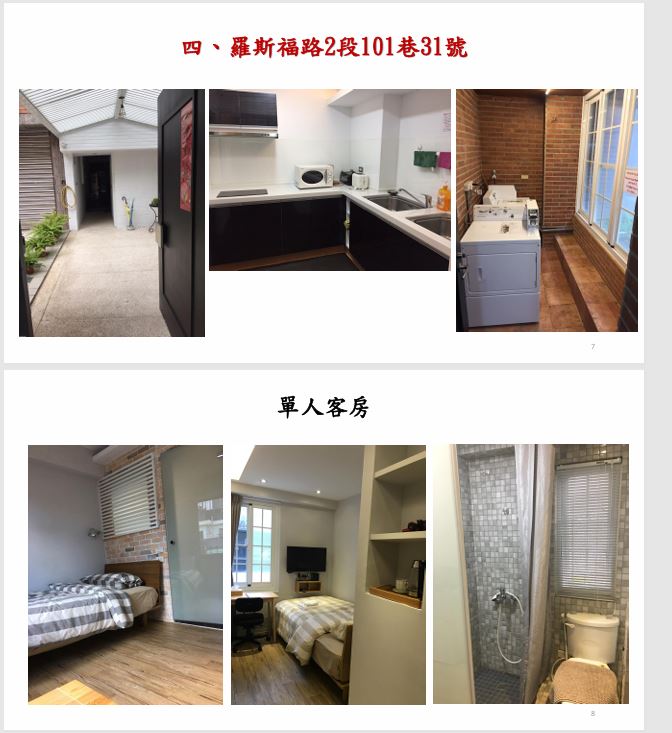
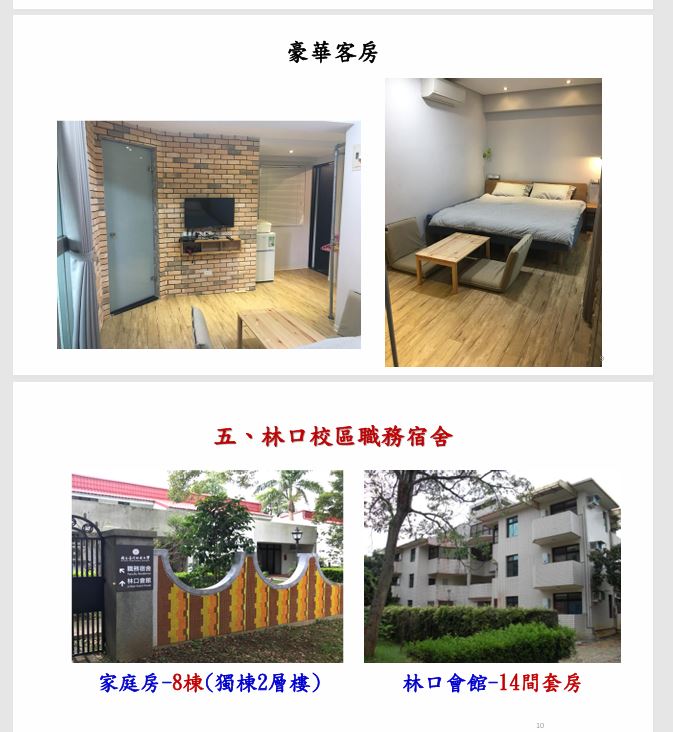
Located in the city center, the cost of renting a house is high. To reduce commuting time and rent, and to provide affordable housing for faculty and staff, the university has established staff dormitories and has formulated the “Guidelines for the Borrowing and Management of Staff Dormitories at National Taiwan Normal University.” The dormitories are equipped with sofas, wardrobes, air conditioning, televisions, and other amenities. Applicants may apply for housing during their employment period if (1) the university’s tenured faculty and staff, (2) university-appointed faculty and staff, postdoctoral researchers, and contract employees, if their work and actual needs necessitate such housing, or (3) personnel hired based on national policy or special business needs. The cost is 60% lower than the market price. NTNU staff dormitories consist of 54 rooms in total: 37 single-room dormitories (23 on the main campus and 14 in Linkou) and 17 multi-room dormitories (9 on the main campus and 8 in Linkou).
Employee Affordable Housing Information Form
Newly renovated faculty and staff dormitories at the Gongguan campus.
Affordable housing plans for employees.
11.4.5 Provide affordable housing for students
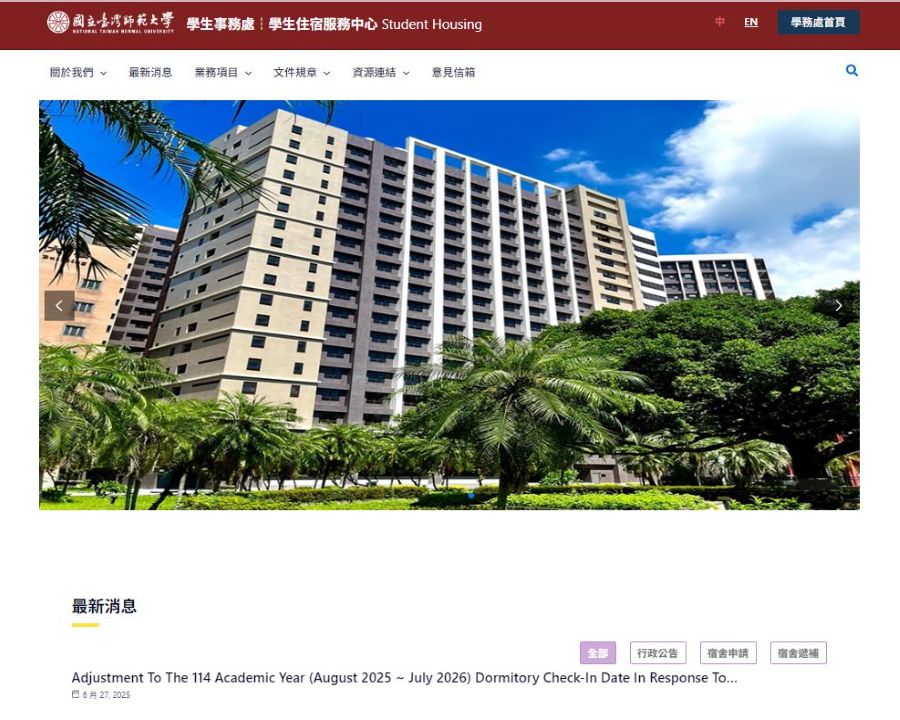
NTNU has established a dedicated student accommodation service center, and student accommodation committees have been formed by students in each dormitory. The university currently has two dormitories: Dormitory 1 (male and female) on the main campus; Dormitory 2 (male and female) and Dormitory 7 on the Gongguan campus, totaling three buildings. These offer various room types, including six-person, four-person, three-person, double suites, accessible rooms, and rooms for special needs. Student dormitories on the Heping campus include Dormitory 1 (male and female) on the Heping campus; Dormitory 2 (male and female) and Dormitory 7 on the Gongguan campus, totaling three buildings; and student dormitories on the Linkou campus. Affordable student housing is provided as follows:
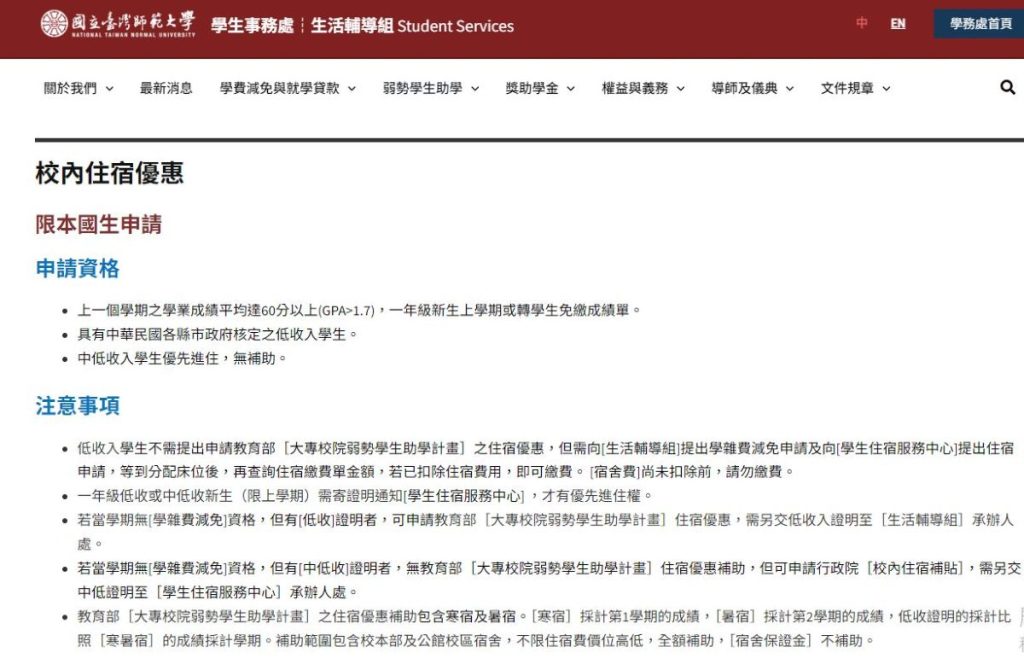
- To assist disadvantaged students, on-campus accommodation discounts are offered. Students from low- and middle-income families have first priority in applying for dormitory accommodation, and their accommodation fees are fully waived. A dedicated website for applying for on-campus accommodation discounts is available.
- Students facing financial difficulties can apply for deferred payment of accommodation fees and, depending on their circumstances, contact the Student Affairs Office’s Student Assistance Section to apply for relevant scholarships, financial aid, or emergency relief.
- Student dormitories have a total of 6,417 beds. During the academic year, 8,006 students applied for accommodation, resulting in an 80% selection rate.
- To assist international students from around the world with accommodation, the university is constructing a new international dormitory, expected to provide an additional 300 beds upon completion in 2027.
- Starting from the 2012-2012 academic year, student dormitory accommodation fees will be adjusted according to the number of weeks of classes, including semester and winter/summer vacation fees.
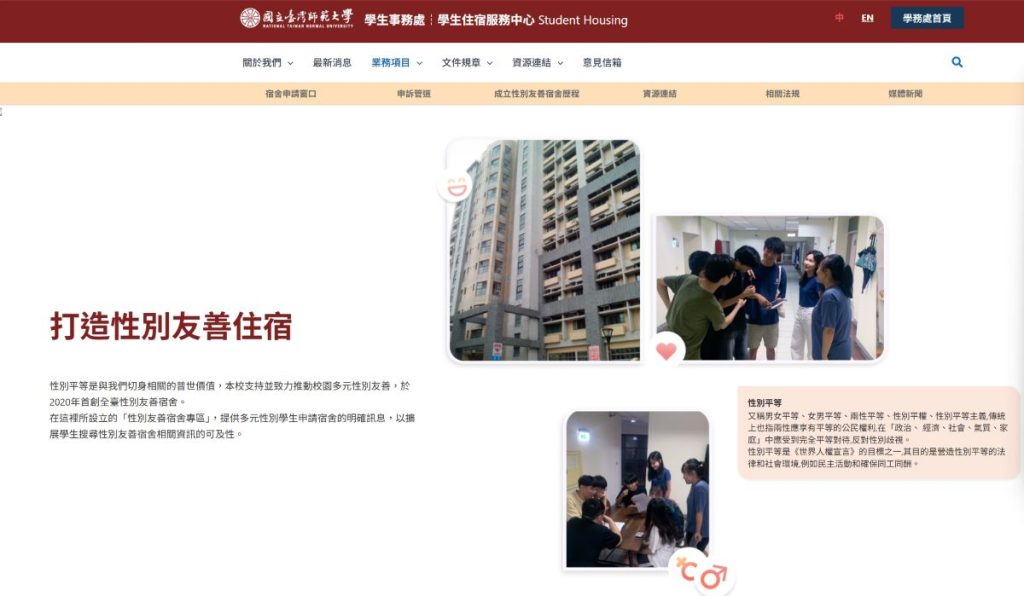
- To encourage students to respect diversity, create a friendly environment, and proactively assist transgender students with their accommodation needs, our university pioneered gender-friendly dormitories in Taiwan in 2020, establishing the “National Taiwan Normal University Student Dormitory Gender-Friendly Handling Principles” and providing 88 beds.
Student Accommodation Discount Website -In addition to providing affordable student housing, there are also free subsidy programs available for application.
NTNU Student Accommodation Services Center Website
NTNU is the first in Taiwan to create gender-friendly dormitories.
11.4.6 Pedestrian Priority on Campus
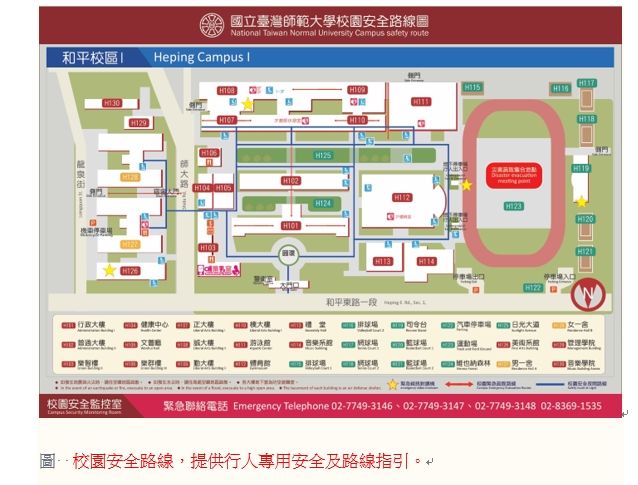
NTNU prioritizes pedestrian access in its campus management and planning. As the university is an open campus, open to the general public, the university has established “Guidelines for Vehicle and Goods Access Management” to ensure pedestrian priority and safety. At the campus planning and design level, prioritizing pedestrian access and safety is a core principle, with dedicated pedestrian walkways, covered walkways, and campus safety routes. The environment of pedestrian walkways has also been optimized, for example, by installing permeable pavements and landscaped walkways.
Campus safety routes provide pedestrian-only safety and route guidance.
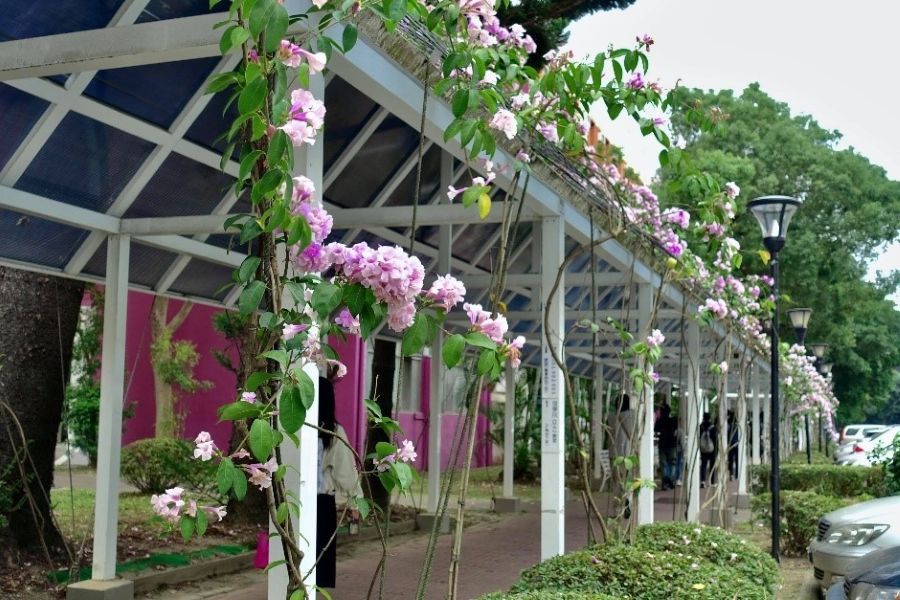
Pedestrians should be given priority on campus, and pedestrian walkways should be equipped with rain shelters.
11.4.7 Work with local authorities to resolve the issue
NTNU’s practices in collaborating with local authorities to address planning and development issues, as well as alleviate housing demand pressures, are as follows:
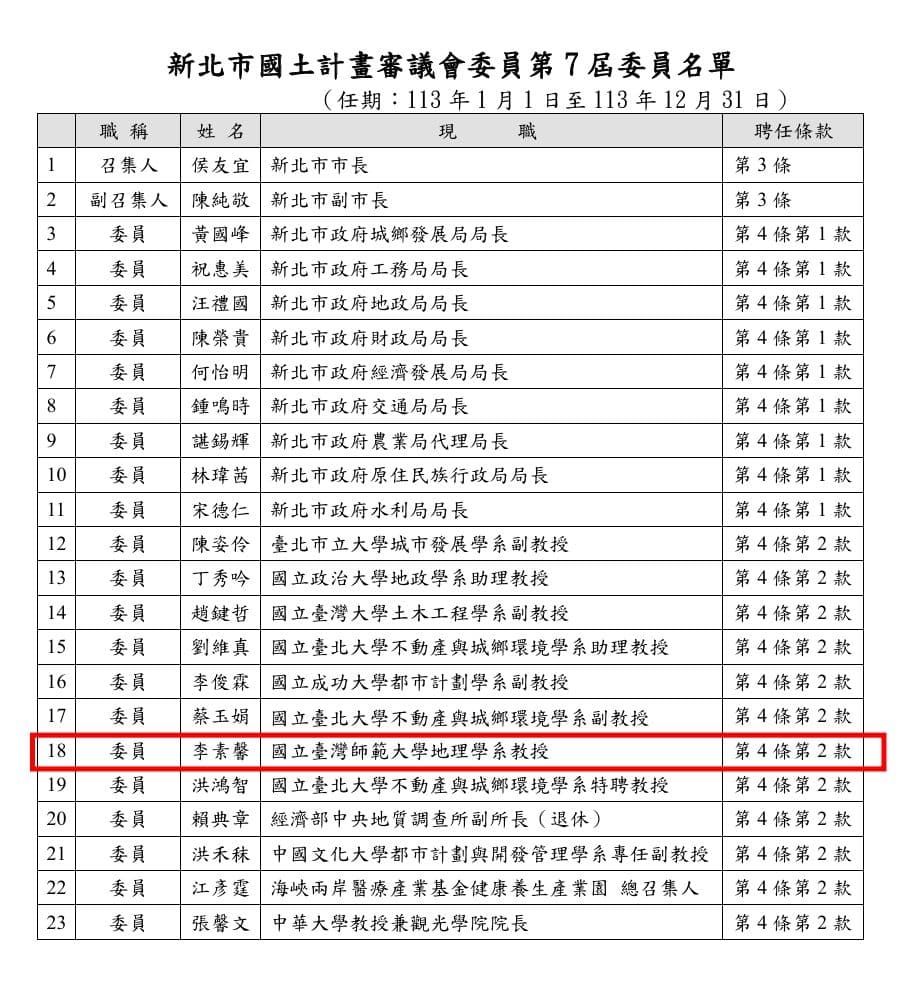
1. First, Professor Su-Hsin Lee of the Department of Geography serves as a member of the New Taipei City Land Planning Review Committee, assisting government agencies in convening special meetings to review the “New Taipei City Land Functional Zoning Map.” Through this mechanism, NTNU is able to collaborate with local governments to resolve planning and urban development issues.
Professor Su-Hsin Lee of the Department of Geography serves as a member of the New Taipei City Land Planning Review Committee, assisting local authorities in resolving planning and urban development issues.
2. Promoting the “University Path” Project: This project, in collaboration with industry, academic institutions, and stakeholders from the Taipei City Government, addresses urban transportation development planning issues and promotes low-carbon transportation. Since 2021, our university, in partnership with the three universities in the National Taiwan University system, has launched the “University Path” project. This initiative involves Taipei City councilors, the Taipei City Transportation Bureau, communities, private engineering companies, and cycling associations to discuss possible routes and methods for university pathways. Three distinctive bicycle lanes have been planned, with a focus on the cycling environment around the three universities in the National Taiwan University system from 2023 to 2024. Stakeholders include university faculty and students, local residents, business owners, the city government, and local neighborhood chiefs. Over the past two years, the project has involved cross-sectoral collaboration, technological support, and the participation of faculty and students, as well as cooperation and communication with the business community and local residents to address urban planning and development issues.
On June 3, 2024, in collaboration with the Taipei City Government Traffic Control Engineering Office and nearby universities, the bicycle riverside connection was completed.
The University Way Project collaborates with the Taipei City Government Transportation Bureau to address issues related to bicycle lane planning.
3. Providing Affordable Accommodation to Alleviate Urban Housing Pressure
NTNU is located in the city center of a metropolitan area, surrounded by a mixed educational, residential, and commercial area characterized by high population density and relatively high land and housing prices. NTNU has adopted measures such as providing relatively affordable dormitory rents for faculty and students, and also offering discounted accommodation for researchers, to alleviate housing demand in the context of high local housing prices.
4. Addressing Other Planning and Community Development Issues
Regarding planning issues, in addition to cooperation on land review, NTNU has also taken action to address the severe shortage of parking space in the metropolitan area, alleviating the parking difficulties in neighboring communities. The university has opened its campus parking lots for nearby residents to use on a temporary or annual rental basis (see “Parking Management Guidelines”), to solve the local community parking problem and promote good neighborly relations.
11.4.8 New Building Standards
1. To fulfill the school’s commitment to sustainable development, all new construction projects on campus incorporate green building design. Upon completion, the project successfully obtained the Taiwan Smart Building Label standard.
2. The following buildings have been completed in recent years and have obtained the Smart Building Label certificate:
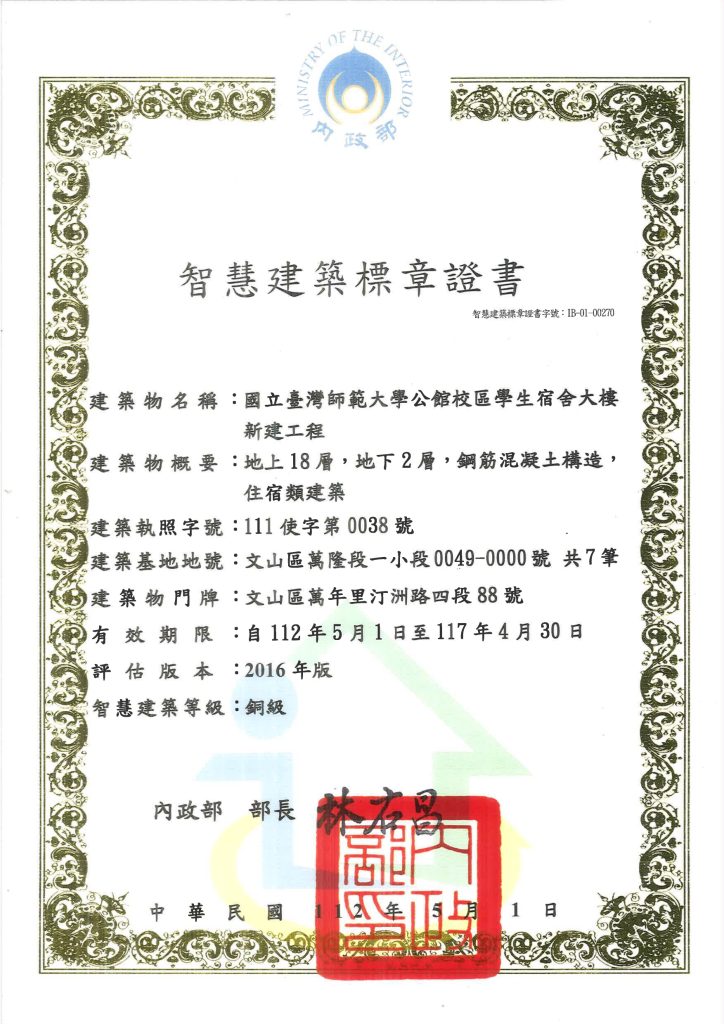
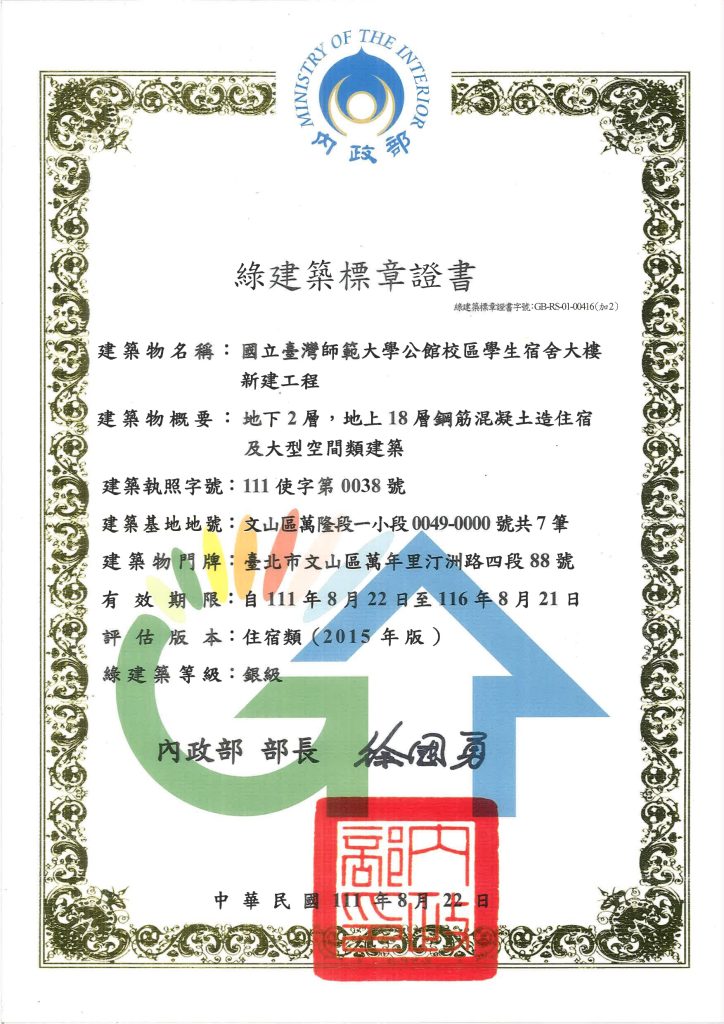
(1). Gongguan Campus Student Dormitory Building (Student Dormitory 2) Bronze Level (20230501-20280430)
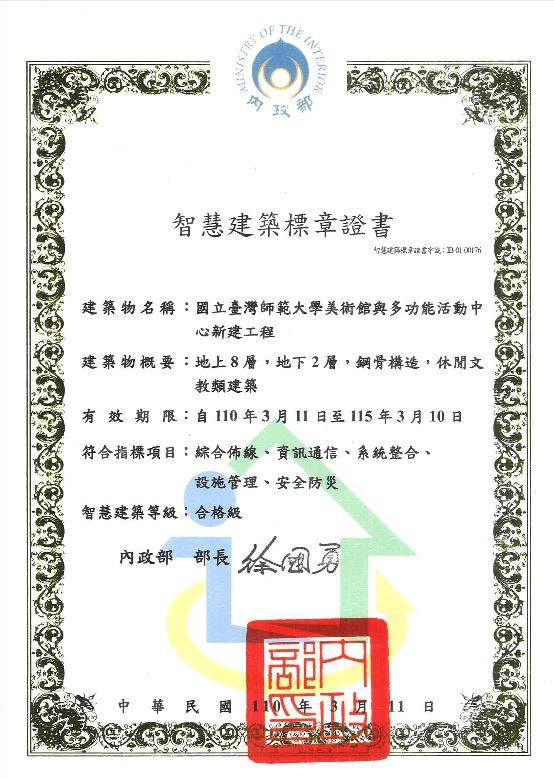
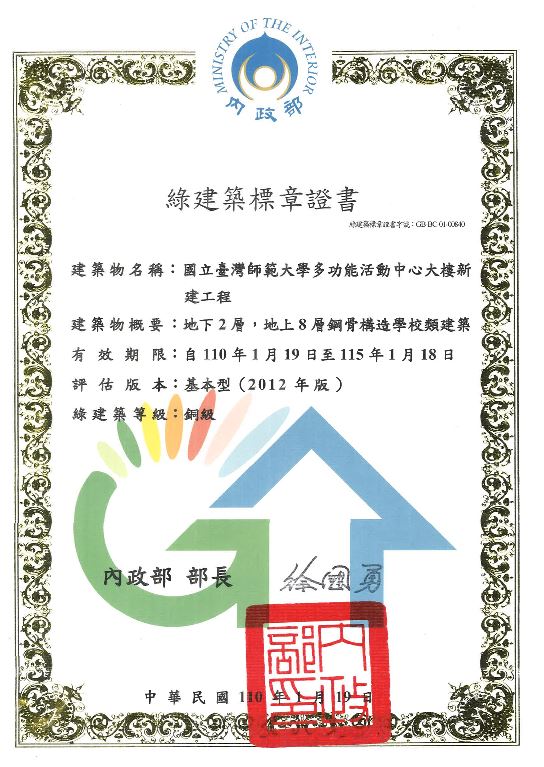
(2). Multi-purpose Activity Center (National Taiwan Normal University Art Museum) Qualified Level (20210311-20260310)
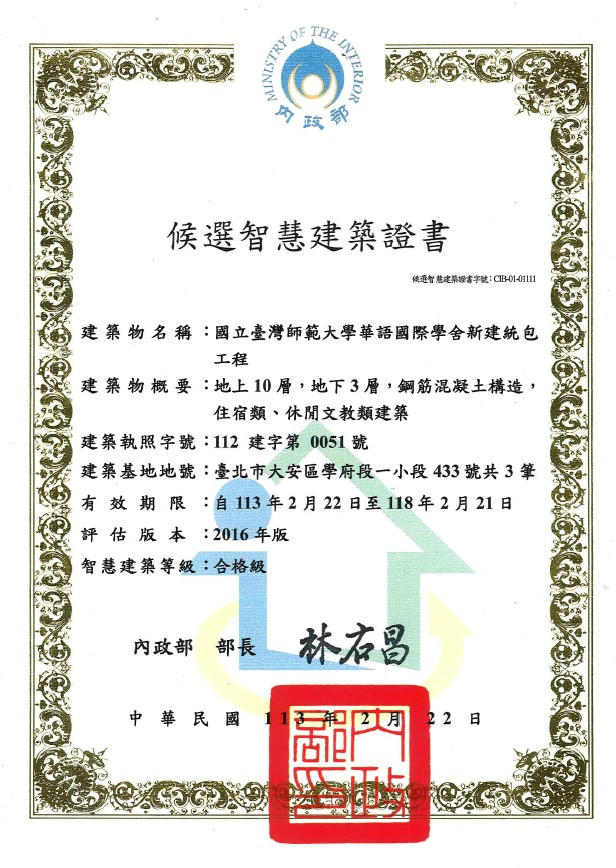
3. NTNU’s newly constructed “Chinese International Student Dormitory” project is a candidate for the Smart Building Certificate.
Art museum and multi-functional activity center smart building qualified.
Art Museum and Multifunctional Activity Center Green Building Bronze Level
The new student dormitory building at the Gongguan campus has achieved a bronze-level smart building certification.
The new student dormitory building at the Gongguan campus has achieved a Silver rating in green building certification.
Candidate for Smart Building Certificate Level Qualified for the New Construction Project of Huayu International School
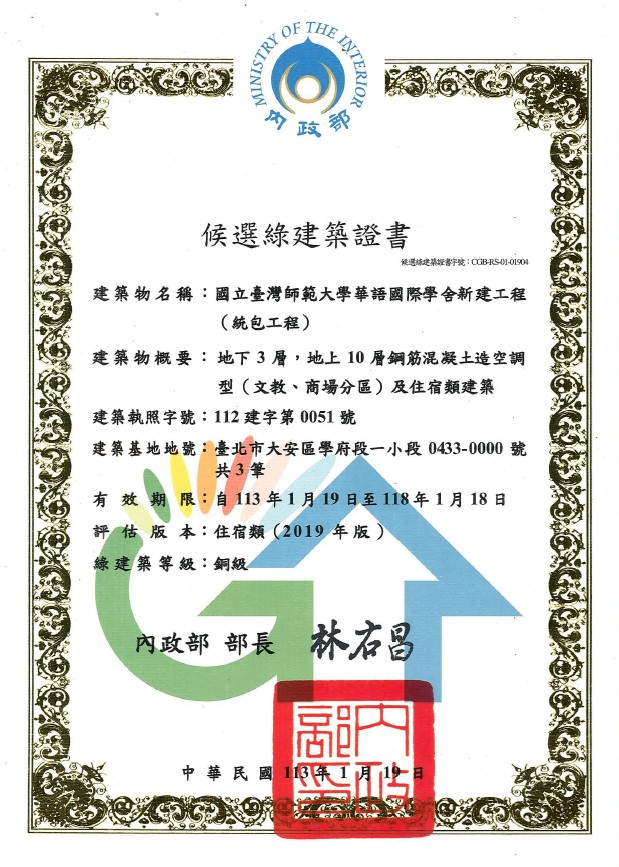
Candidate for Bronze Grade Green Building Certificate for the New Construction Project of the Chinese Language International School
11.4.9 Building on brownfield sites
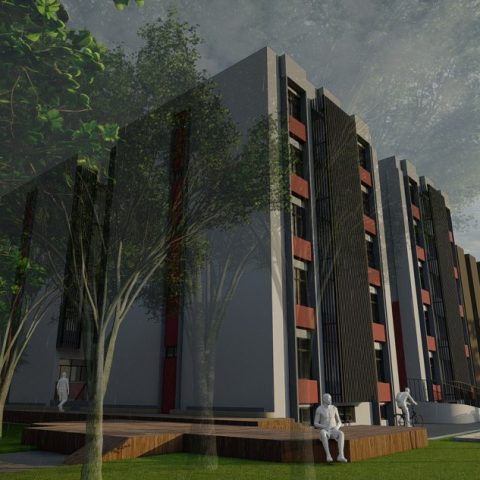
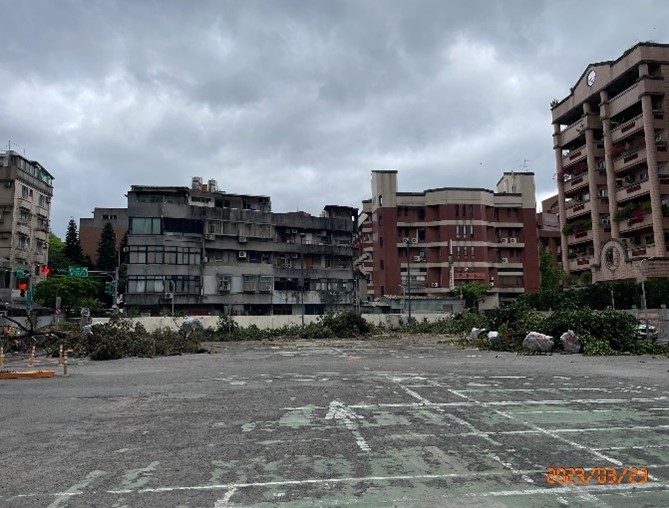
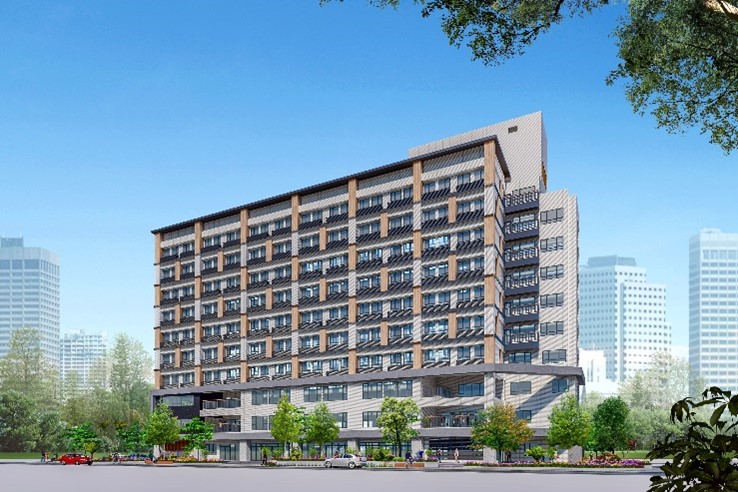
1. The site of the NTNU “New Chinese Language International Dormitory Project” on Wolong Street was originally an idle space belonging to another institution, which was then transferred to our school for land revitalization and reuse. Because our school is committed to promoting Chinese language and literature education, and to address the short-term housing needs of international students, the existing brown area will be used to build dormitories. Accessible suites will be provided for students with disabilities, creating a friendly living environment. Space will be reserved for YouBike bicycles, green flowerbeds, a leisure plaza, and parking spaces, significantly contributing to the living functions of the surrounding community. Construction began in 2024 and is expected to be completed in 2027.
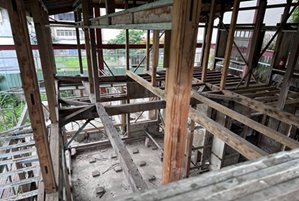
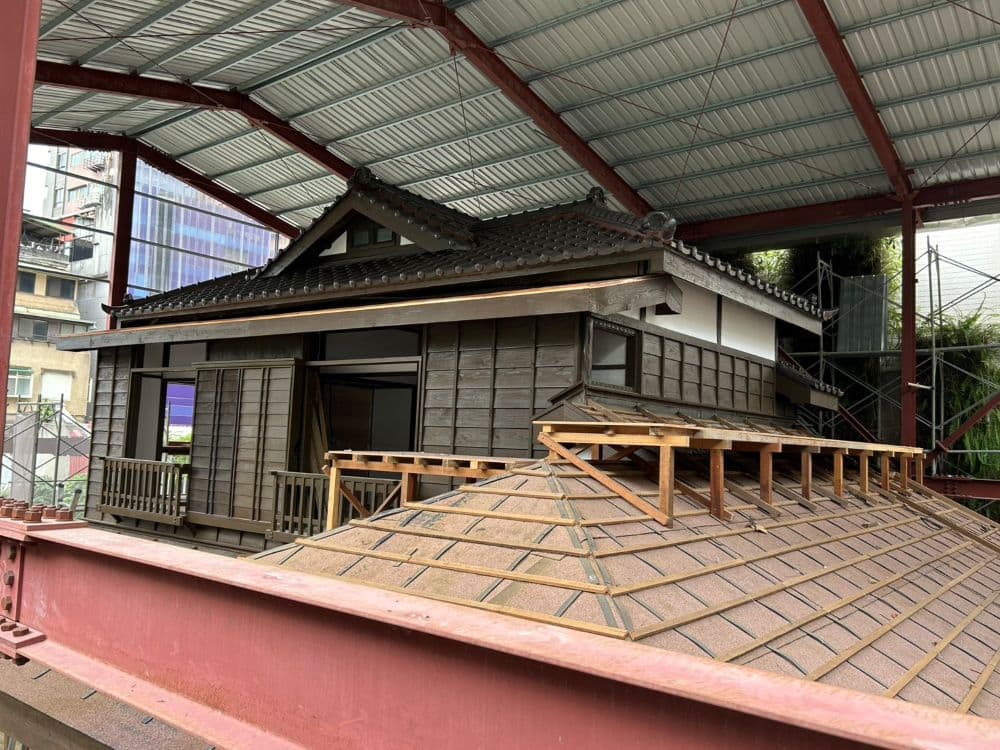
2. The “No. 11 Fuzhou Street Japanese-style Dormitory,” formerly the residence of our school’s Principal Liu Zhen, is a wooden building constructed during the Japanese occupation period, a rare example of a two-story Japanese-style residence in Taipei, holding significant architectural historical importance. Our school will renovate the abandoned old dormitory and undertake the restoration project of the No. 11 Fuzhou Street Japanese-style Dormitory, a municipal historical site. Reconstruction will begin on the original site in September 2024 and is expected to be completed by the end of 2025.
The former brown area, formerly a parking lot, has been redeveloped to create a new Chinese-language international dormitory.
Chinese-language international dormitory built on brownfield redevelopment.
Restoration work is underway on the brownfield grounds of the Japanese-style dormitory at No. 11 Fuzhou Street.
The revitalization and restoration project of the old Japanese-style dormitory started in September 2024.